


 Radiophysics humor: Illustrating the common sentiment that the field is complex and often misunderstood by others.
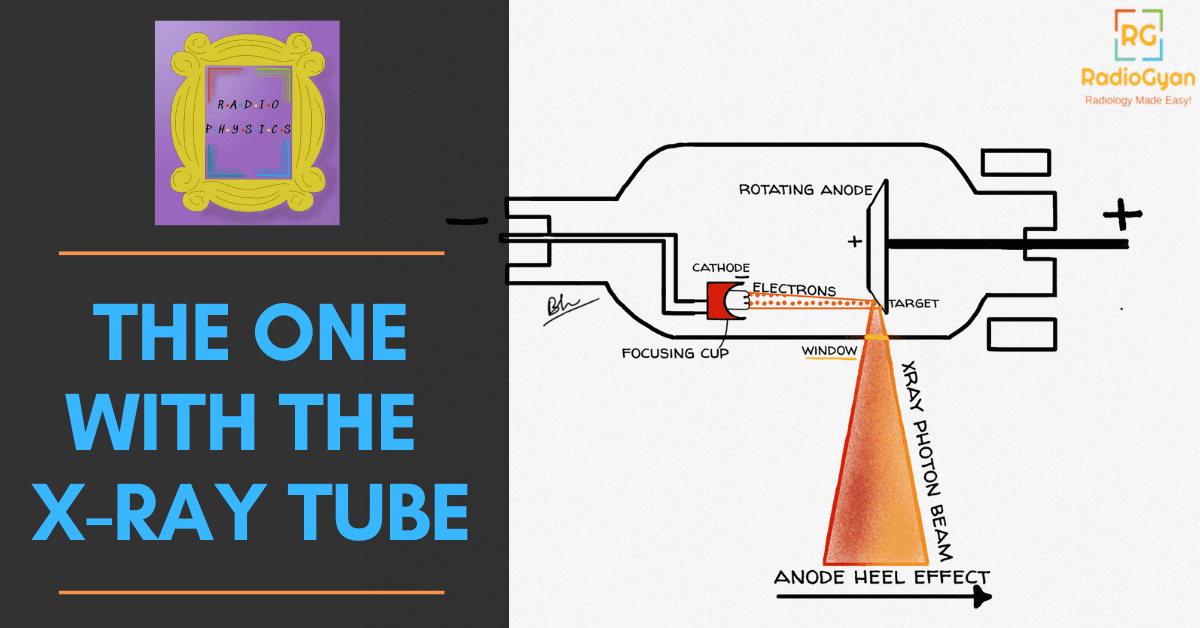
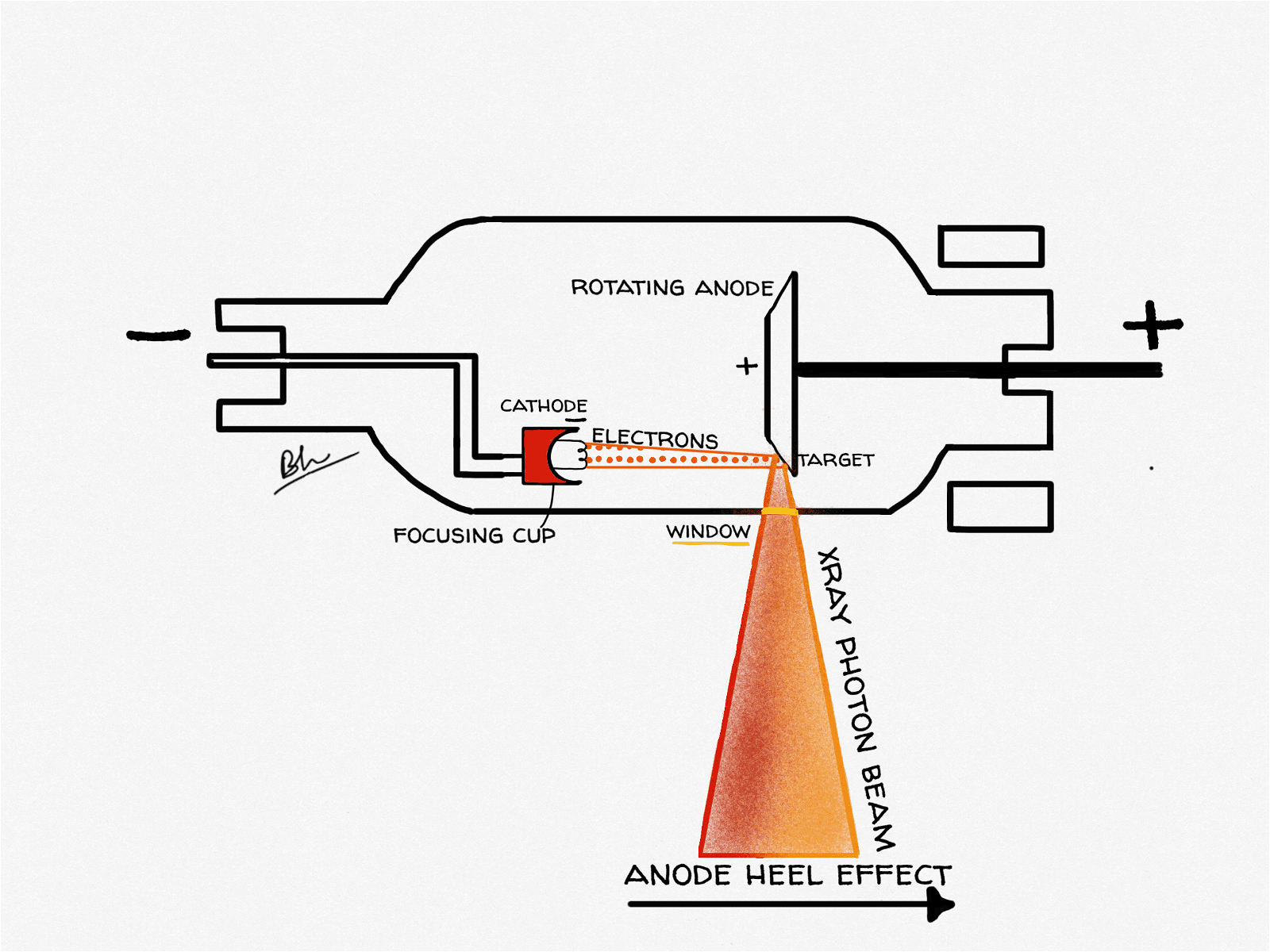
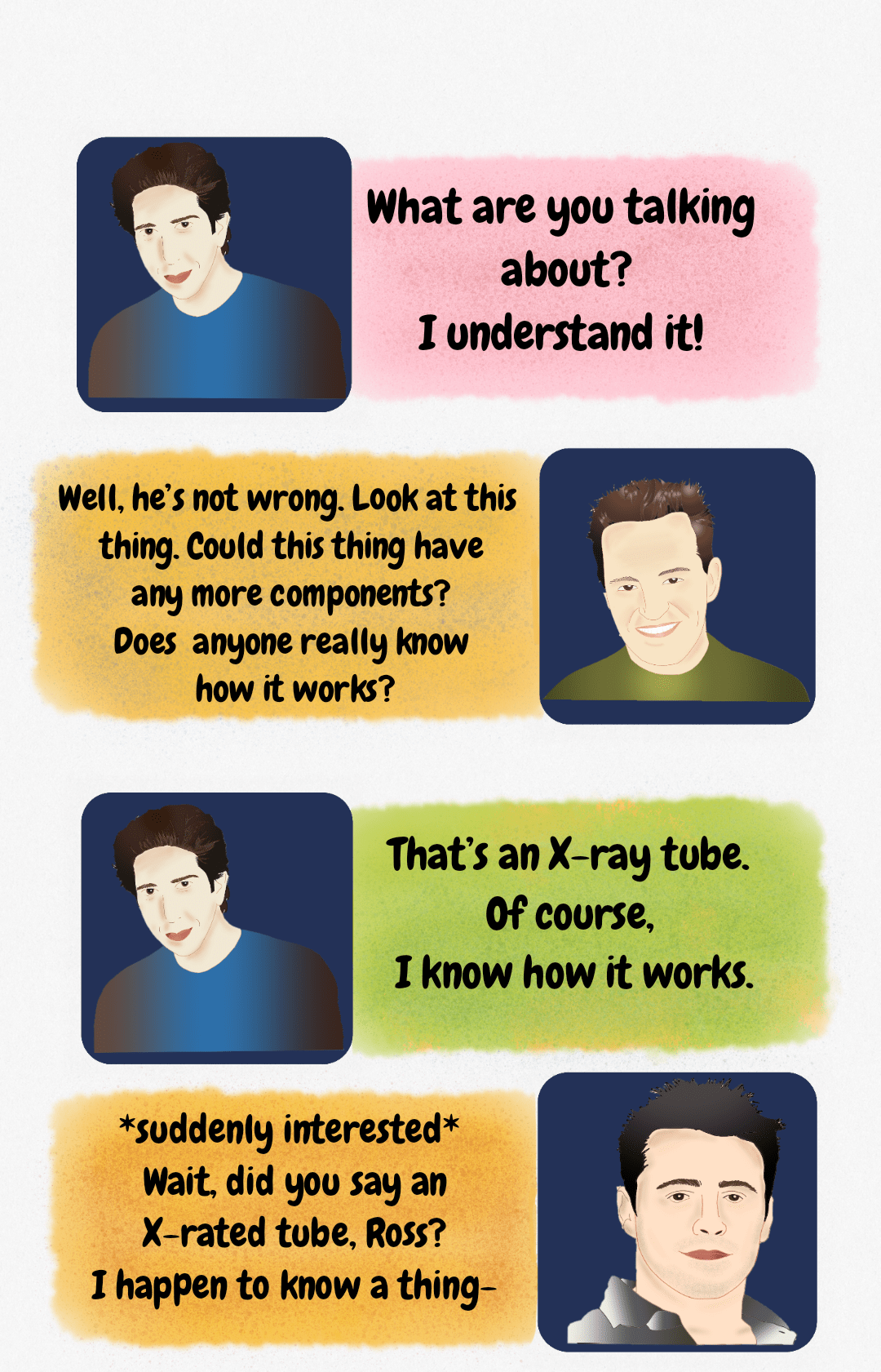 A lighthearted teaching moment referencing the components and function of an X-ray tube, relevant to radiology physics education.
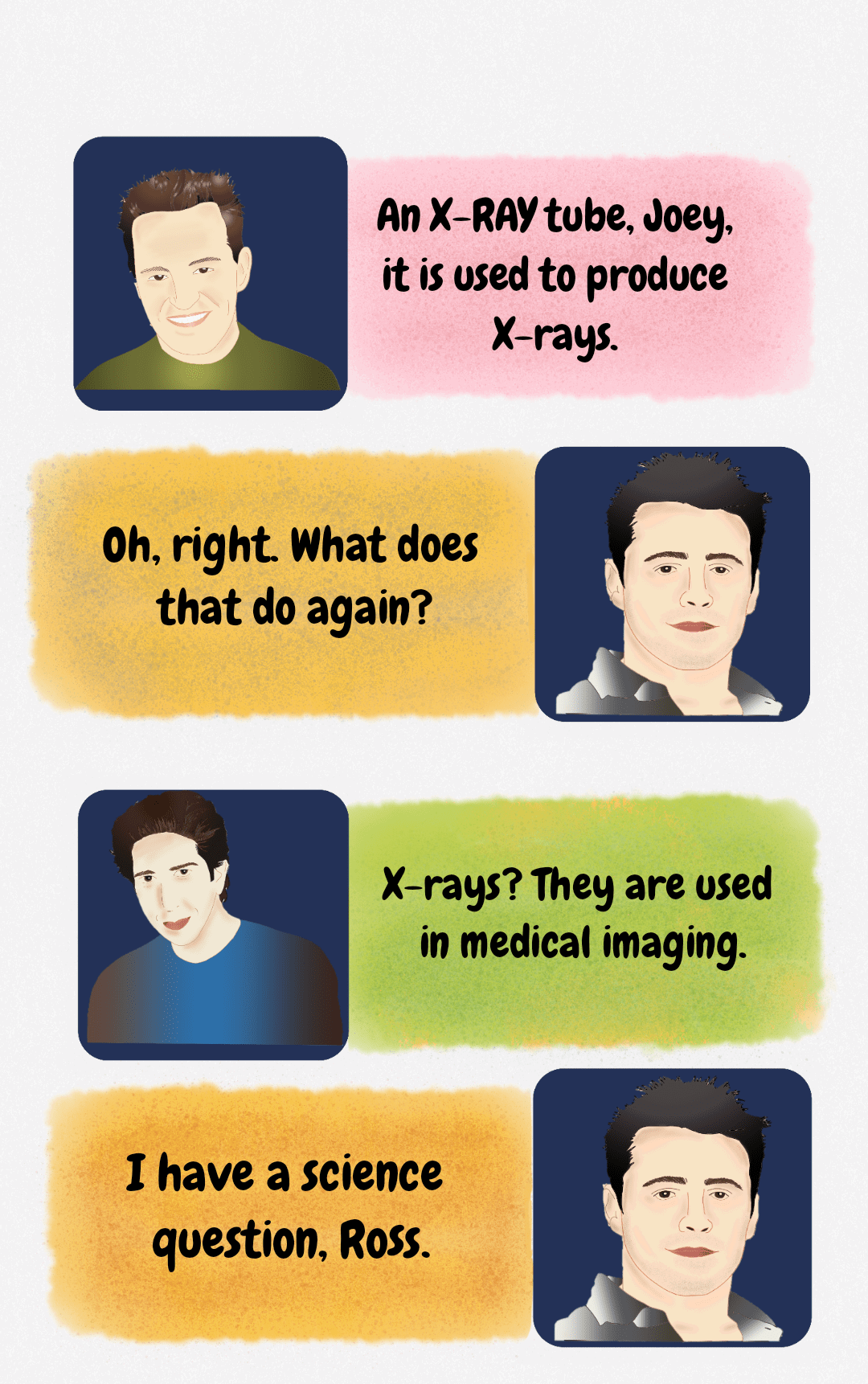 A lighthearted educational figure explaining that an X-ray tube is used to produce X-rays for medical imaging.
 Humorous educational figure summarizing the basic concept of X-ray penetration capability, referencing the ability to see through clothes and the body.
 Meme-style educational figure illustrating the dynamic of explaining complex concepts, such as X-ray physics, to a less engaged audience.
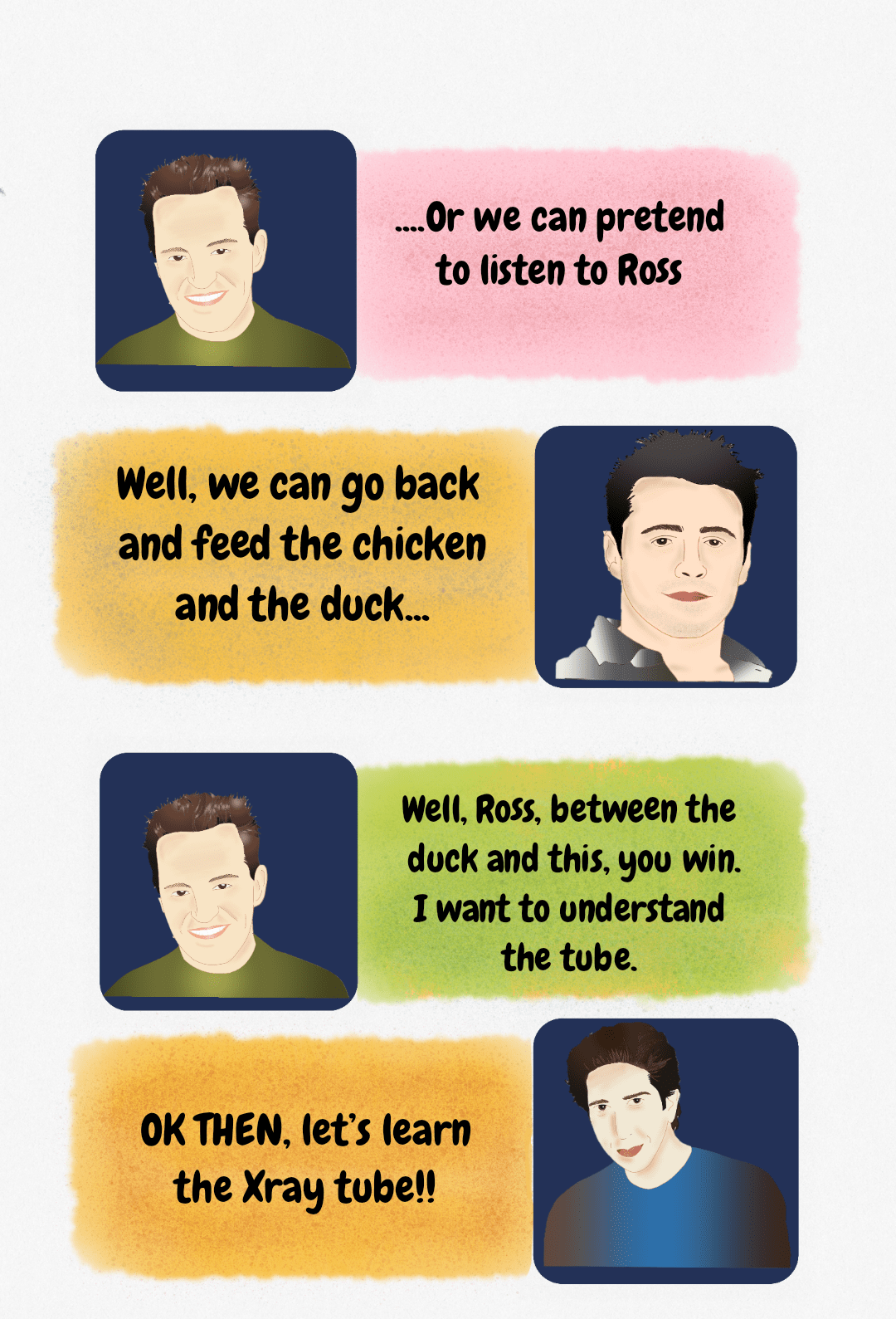 Humorous introduction to radiology physics: choosing to learn about the X-ray tube over distractions.
 Explanation of the cathode end of the X-ray tube, detailing the role of the filament in generating the electron cloud.
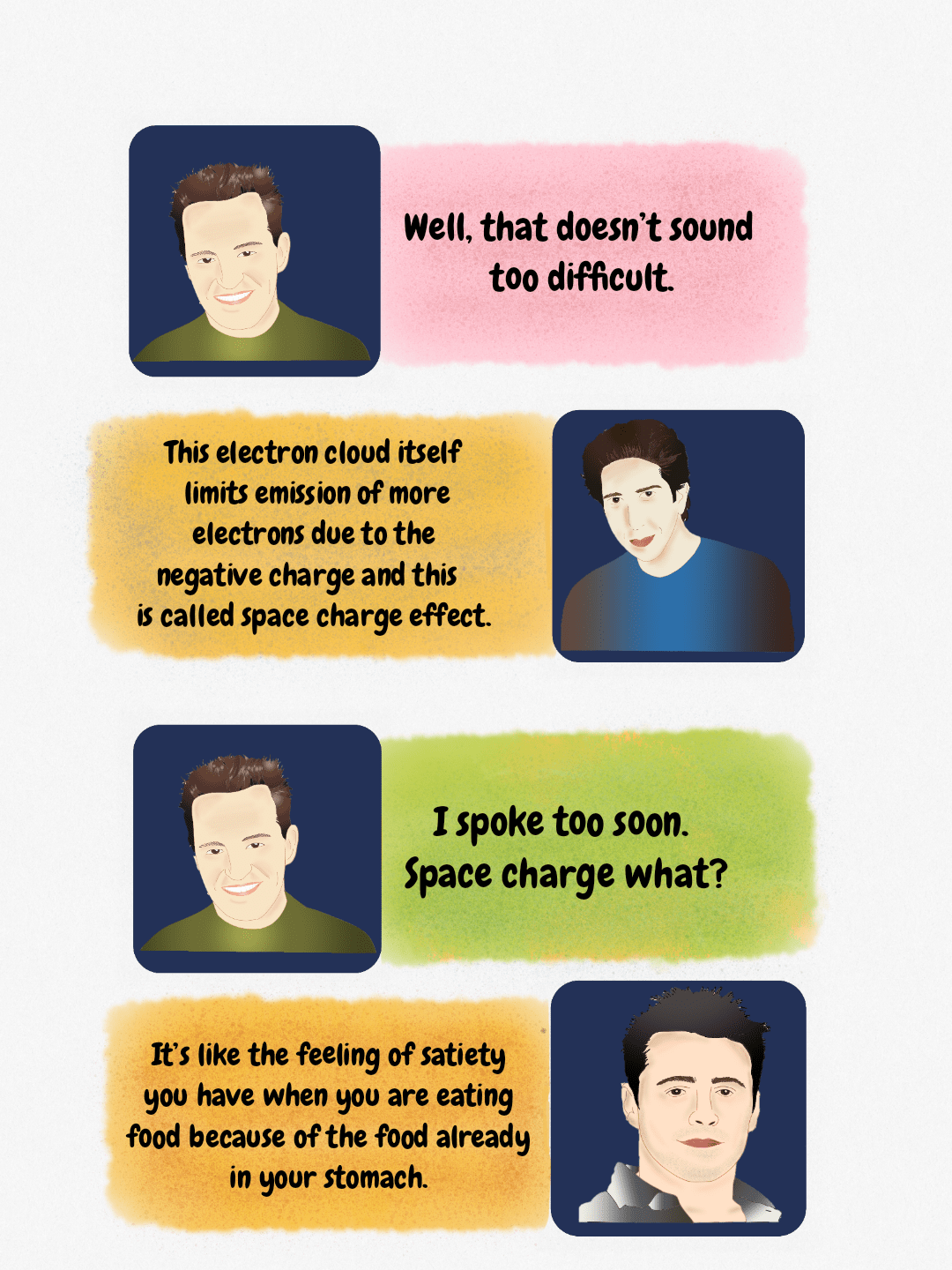 Mnemonic-style diagram illustrating the space charge effect: the negative charge of the electron cloud limits further electron emission from the cathode.
 Humorous diagram explaining the overcoming of the space charge effect in X-ray tube physics using Ross and Joey.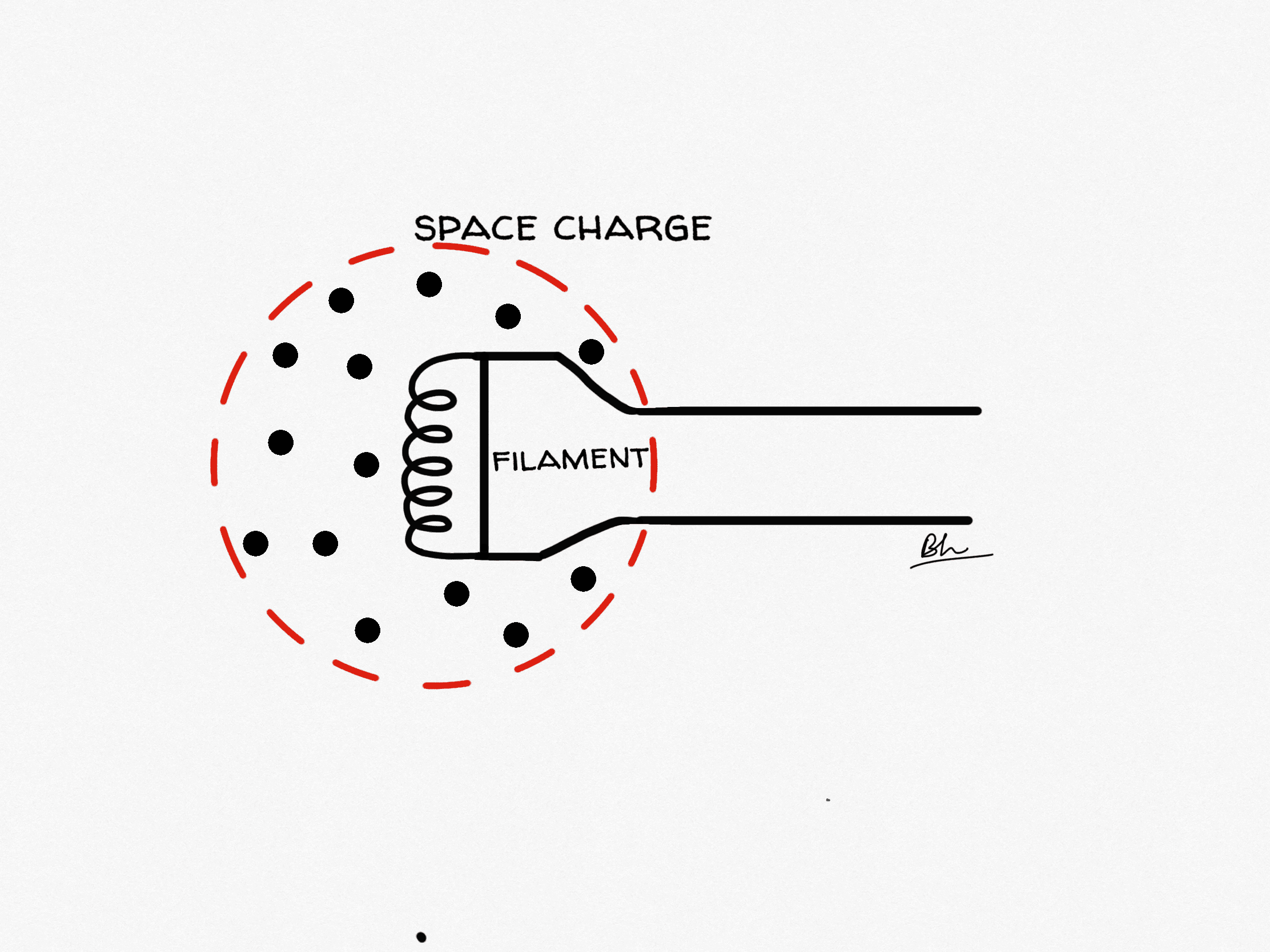
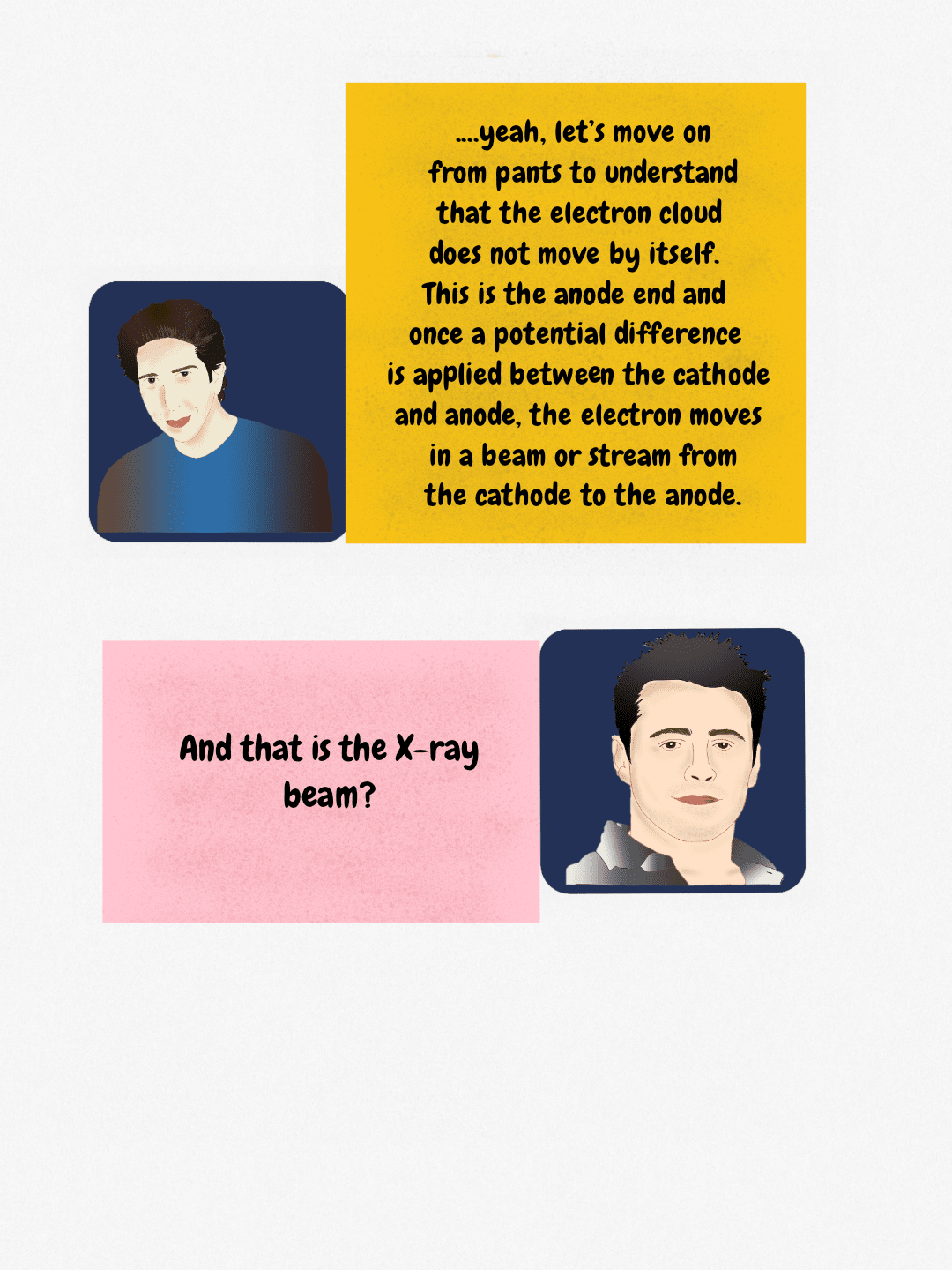 Explanation of electron stream generation in the X-ray tube, moving from the cathode to the anode after potential difference is applied.
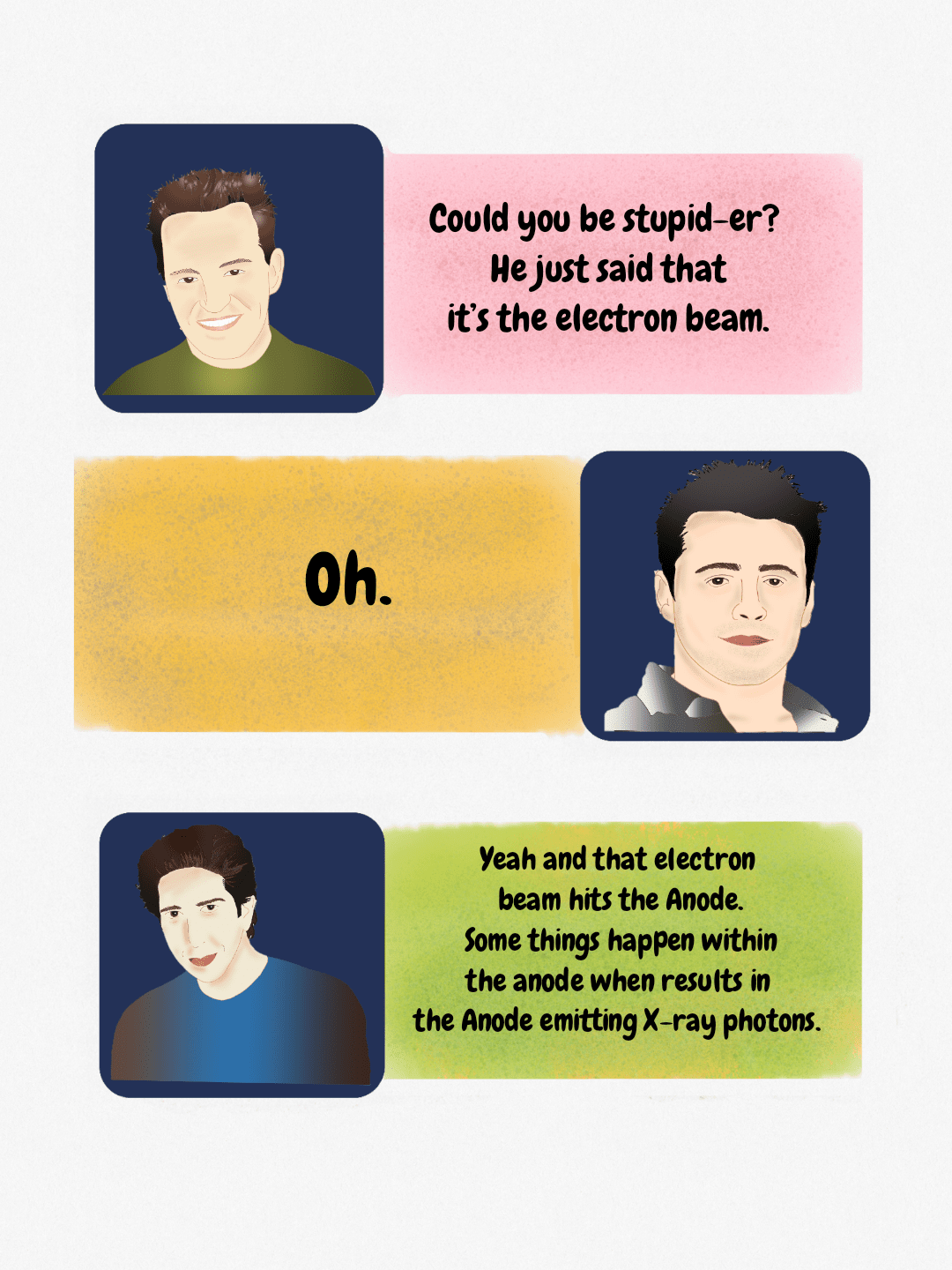 A teaching diagram explaining that the electron beam striking the anode results in the emission of X-ray photons, a key concept in X-ray physics.
 Dialogue explaining the two types of electron interactions occurring within the X-ray tube anode during X-ray generation.
 A humorous educational figure explaining X-ray production physics, including the term Bremsstrahlung, using characters resembling those from the TV show Friends.
 Mnemonic diagram breaking down the term Bremsstrahlung into its phonetic components for easier recall in radiology physics.
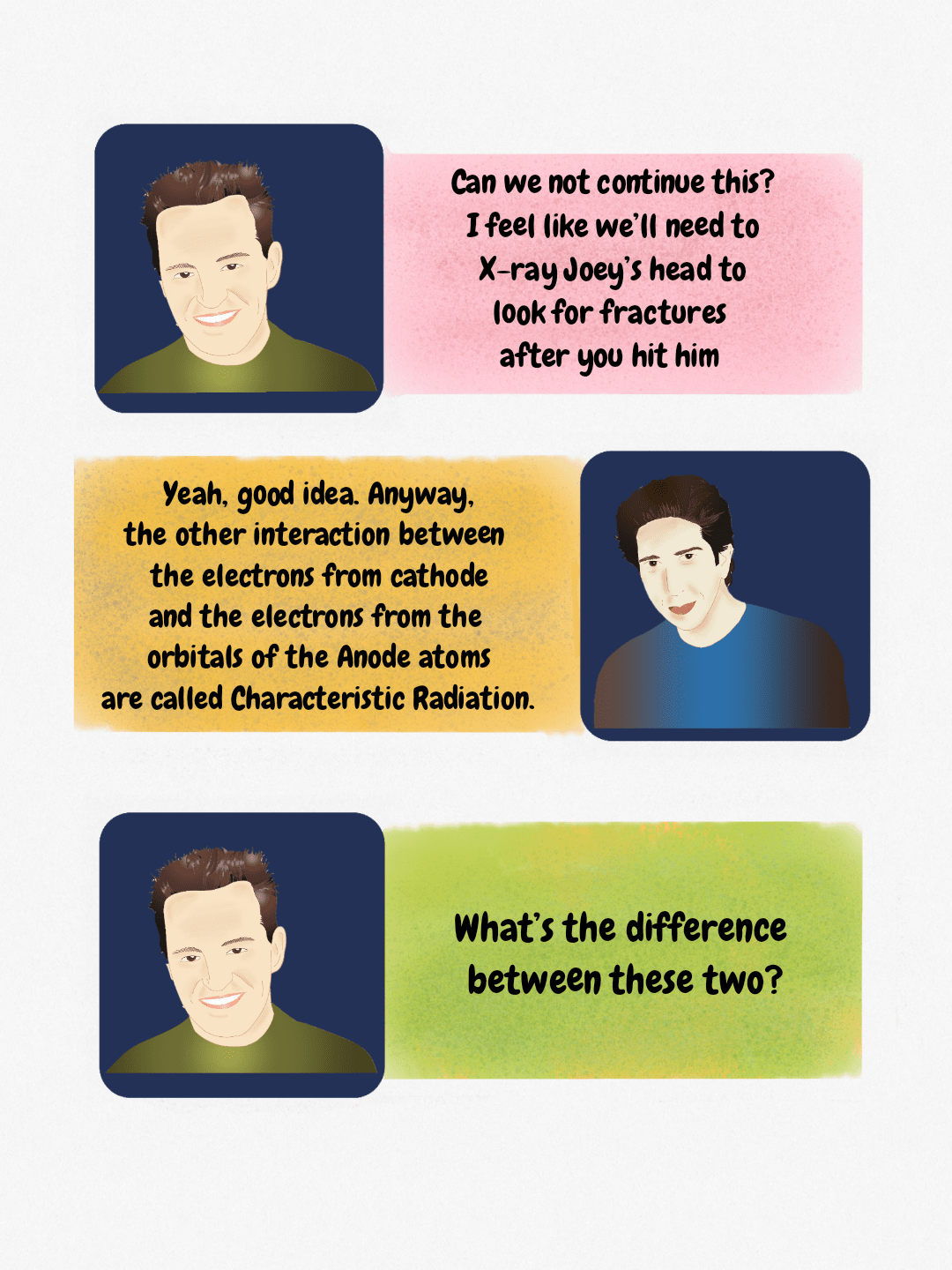 Comic panel explaining the mechanism of Characteristic Radiation in X-ray tube physics.
 Diagram explaining Bremsstrahlung radiation, where electron deceleration near the nucleus produces continuous X-ray radiation.
 Dialogue illustration featuring characters from the TV show Friends, used here as an educational figure.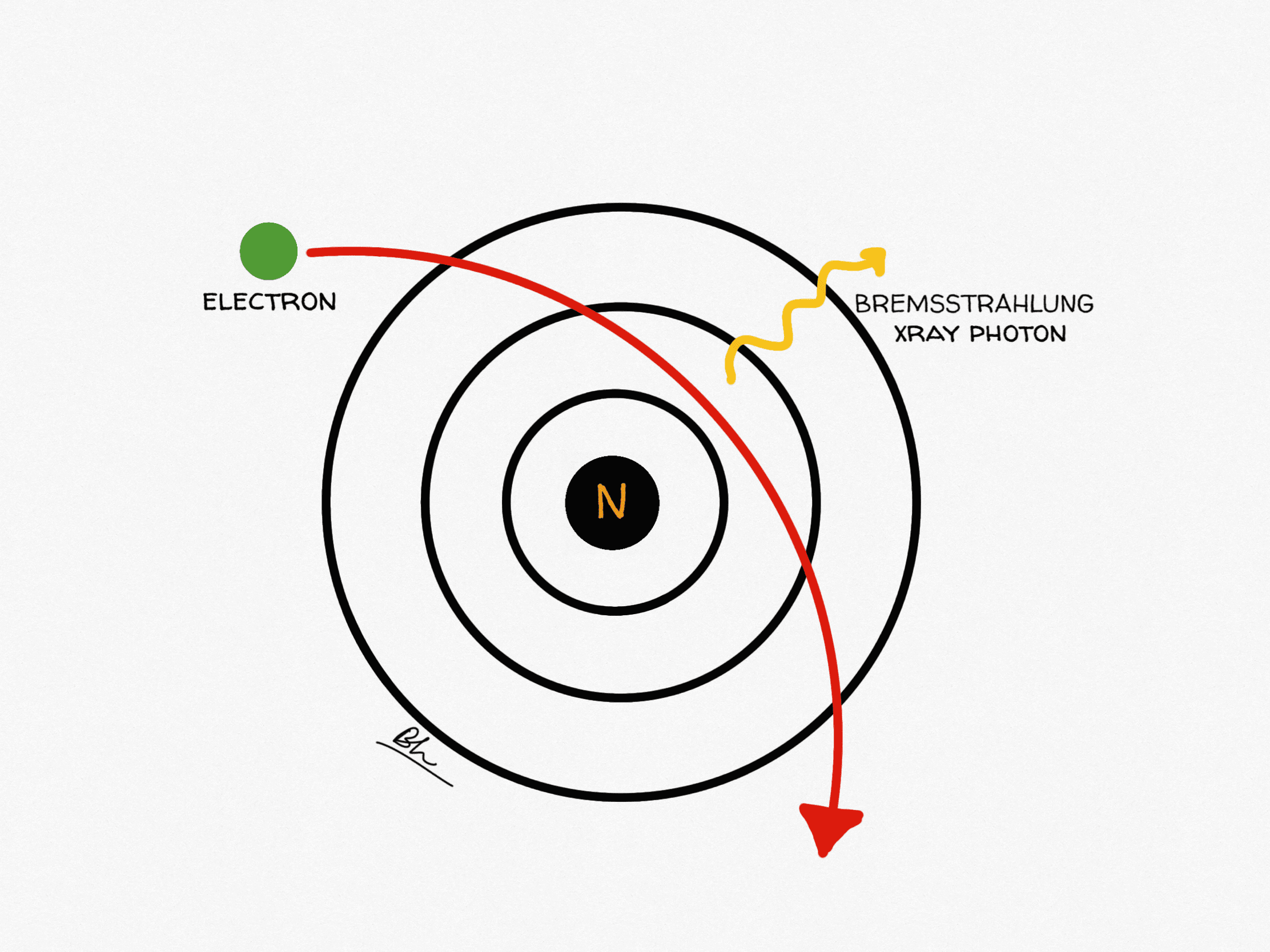
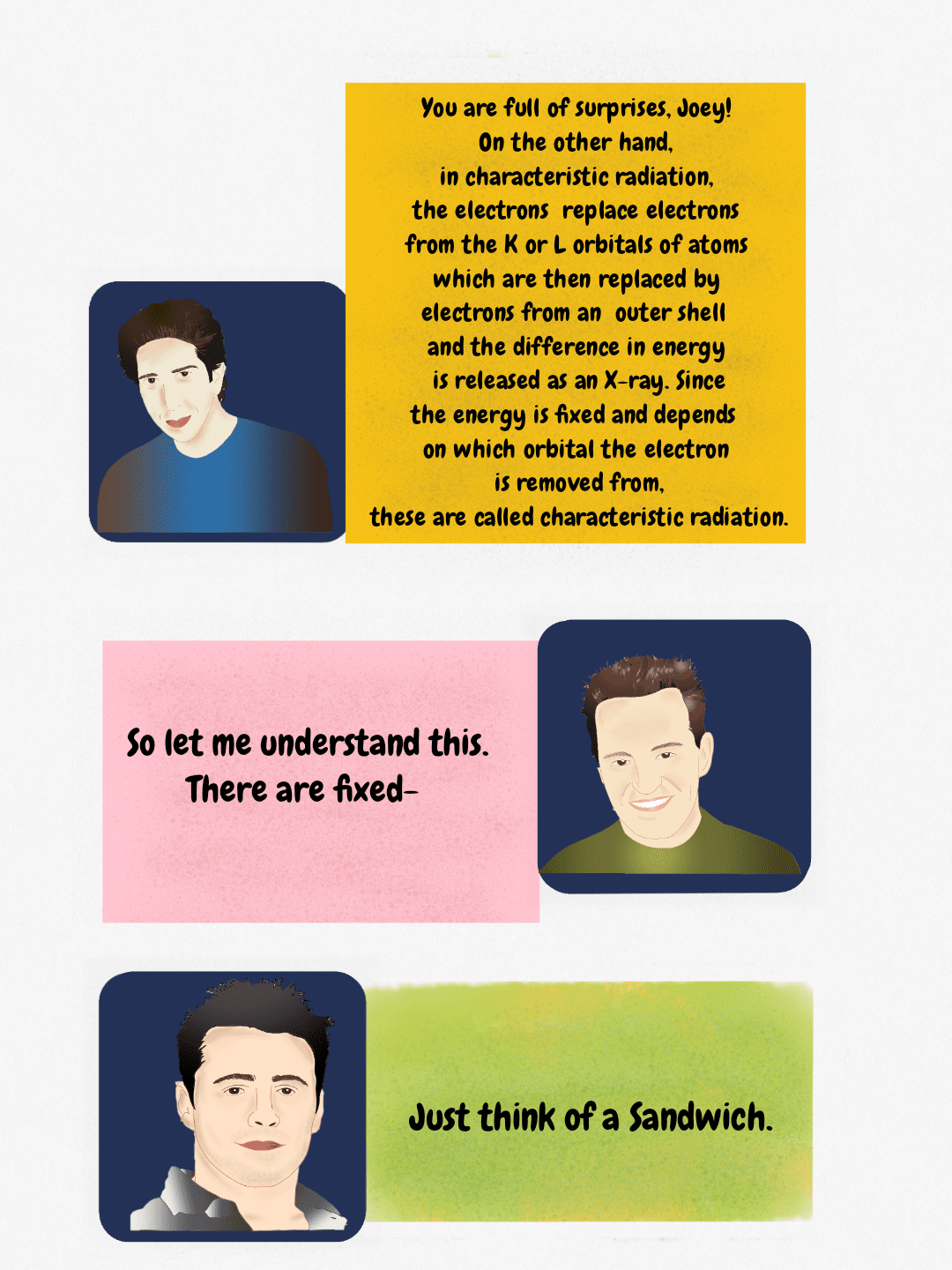 Diagram explaining characteristic radiation: fixed energy X-rays released when outer shell electrons fill vacancies in K or L orbitals.
 A humorous analogy involving sandwich ingredients and tears, used to explain a concept, featuring illustrations of Ross, Joey, and Chandler.
 A teaching diagram using pop culture references to illustrate key steps in X-ray generation, such as emission from the anode and subsequent filtration.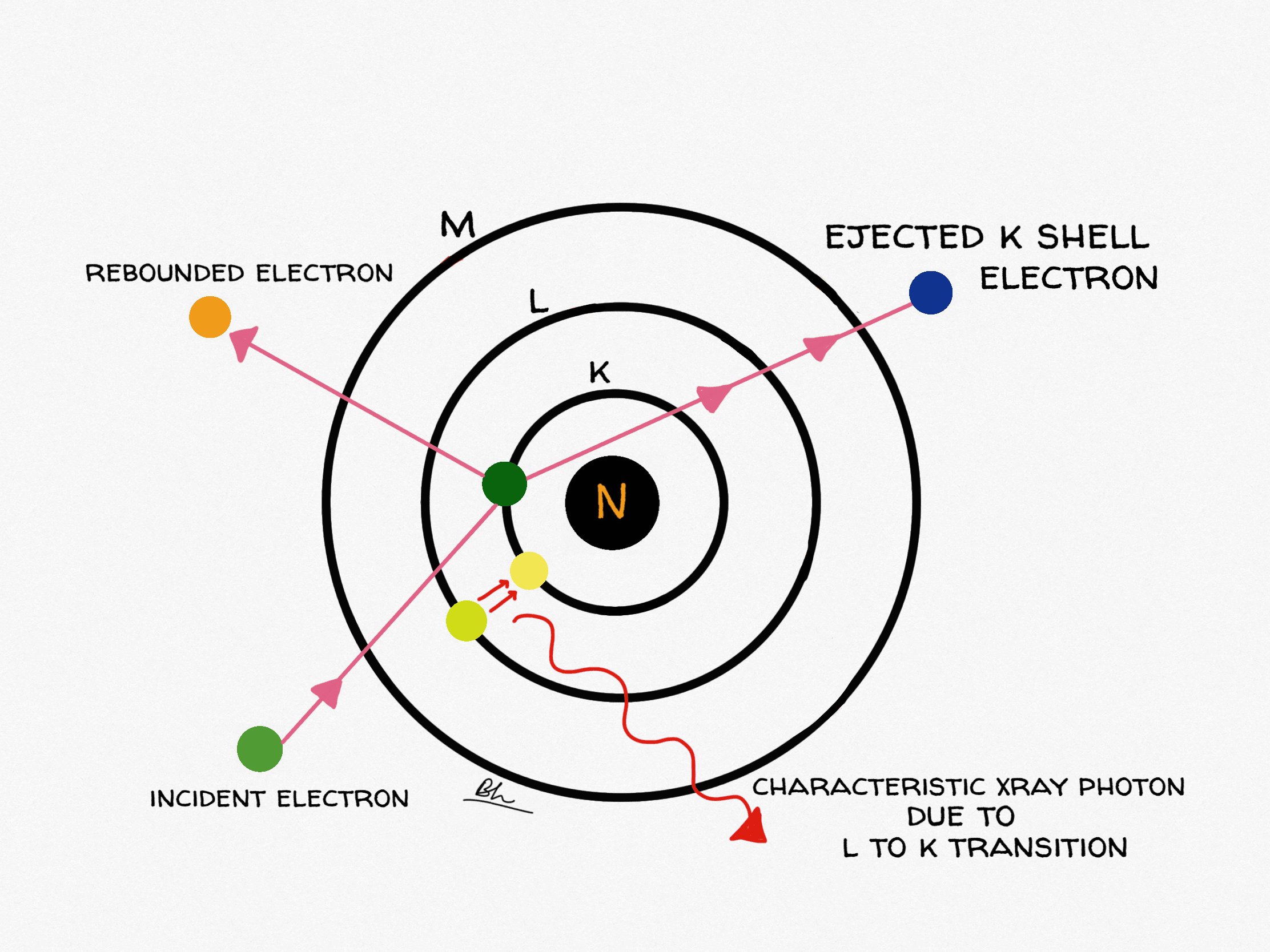
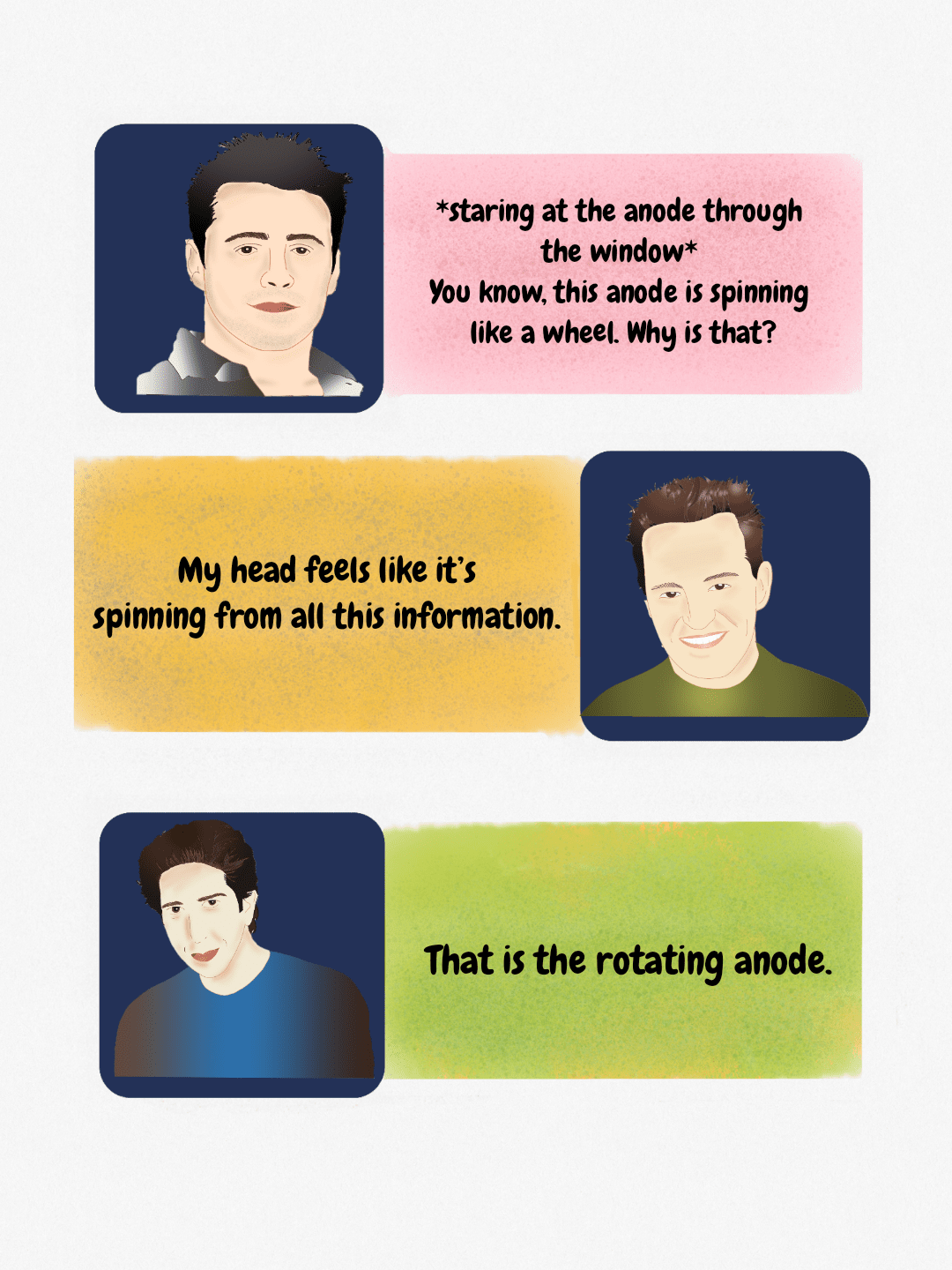 A simplified dialogue explaining the rotating anode component of an X-ray tube, referencing its spinning motion.
 Illustration detailing X-ray tube physics, including the role of the rotating anode and the energy conversion ratio during electron bombardment of the anode.
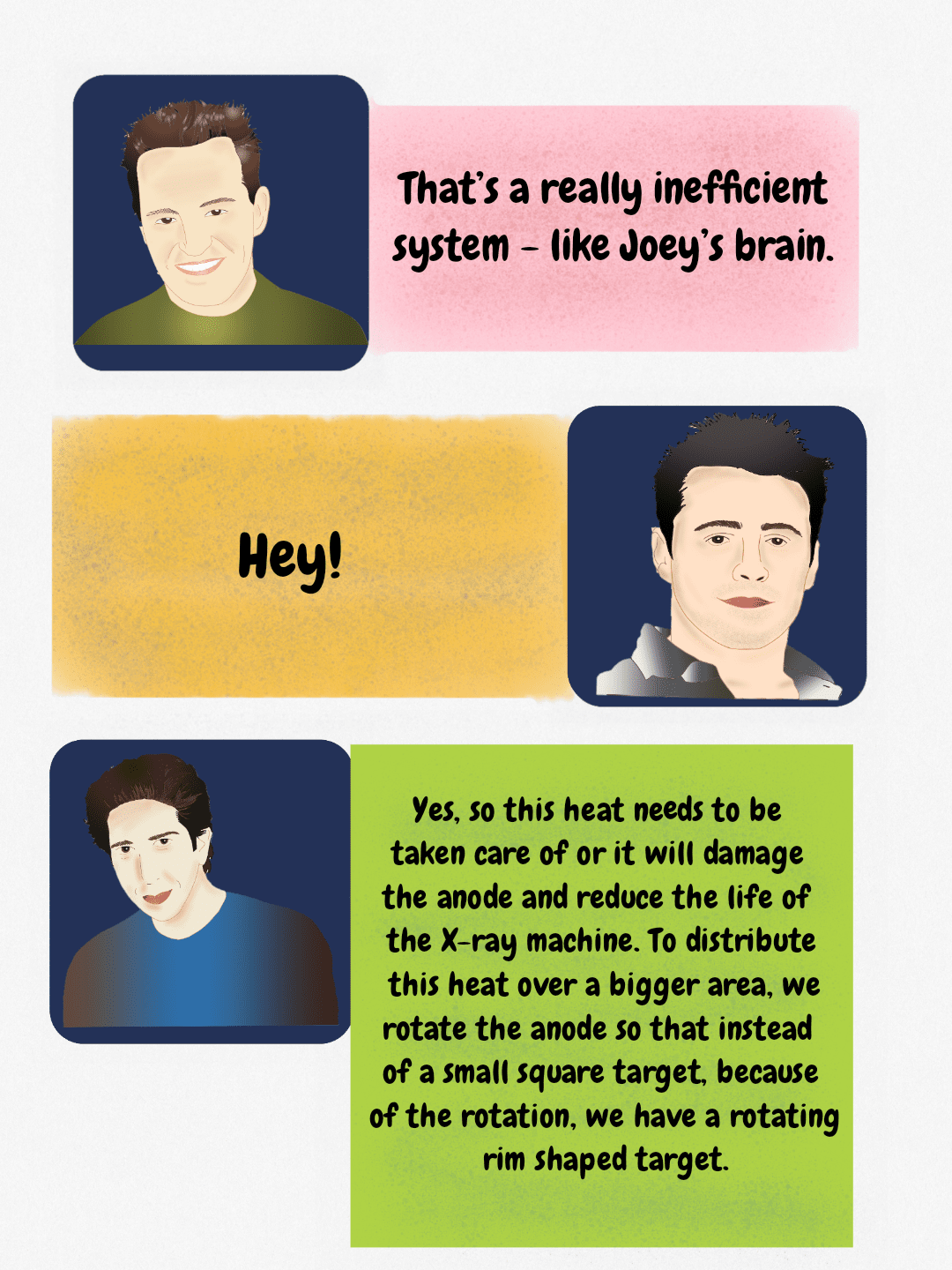 The rotating anode distributes heat generated during X-ray production over a larger surface area to protect the X-ray tube components.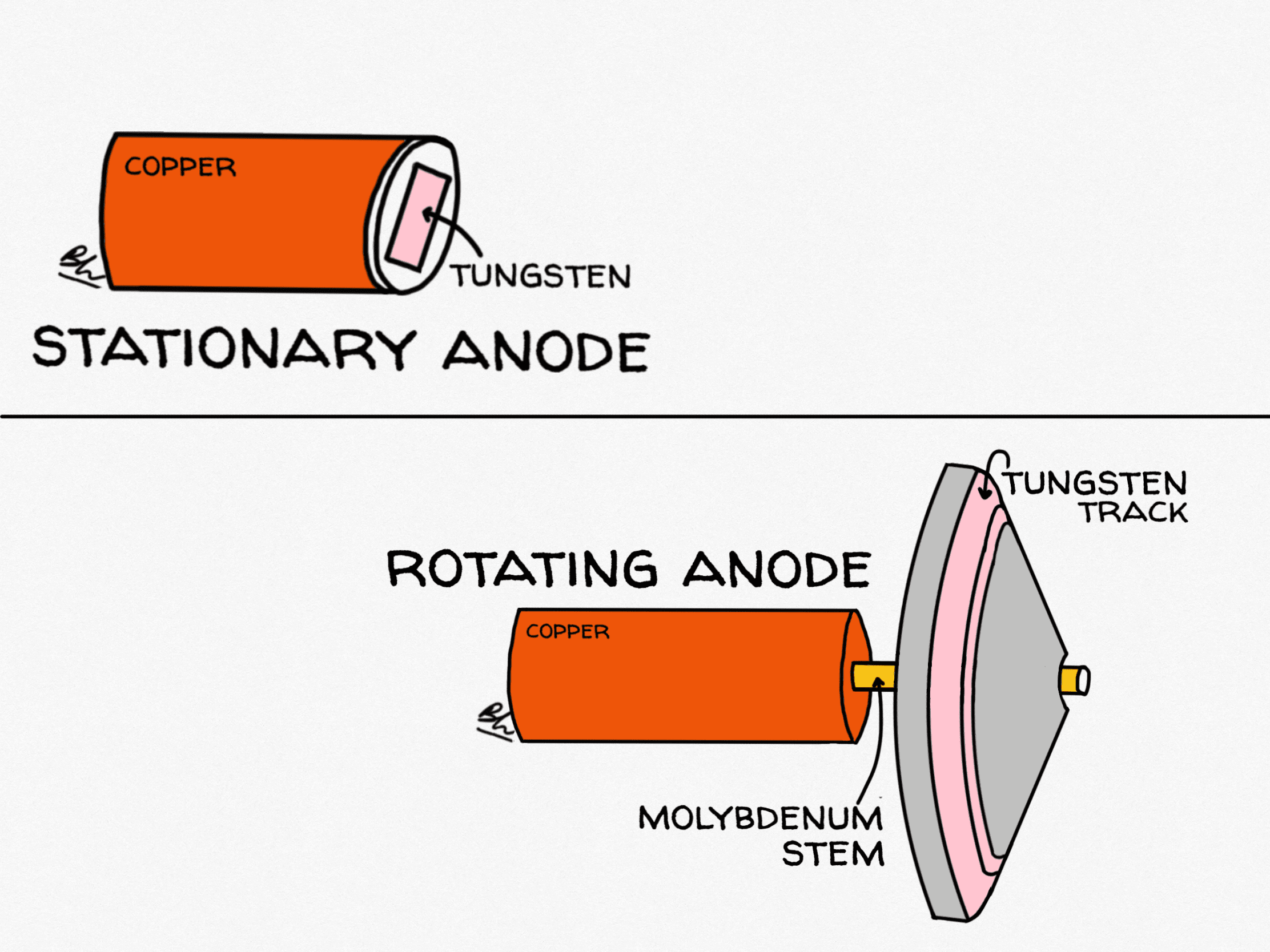

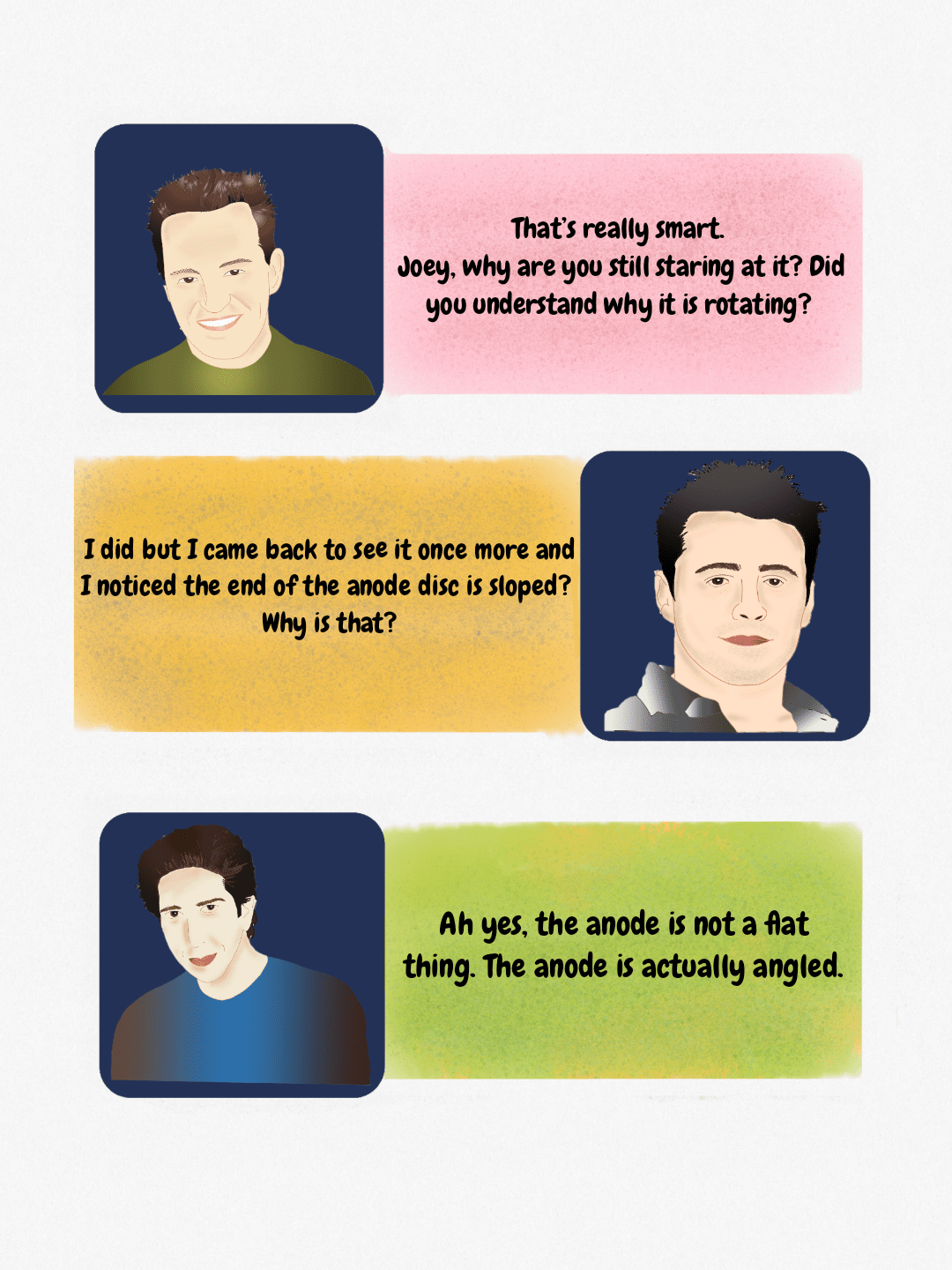 Discussion regarding the angled design of the anode disc in an X-ray tube, which relates to the concept of the actual versus effective focal spot.
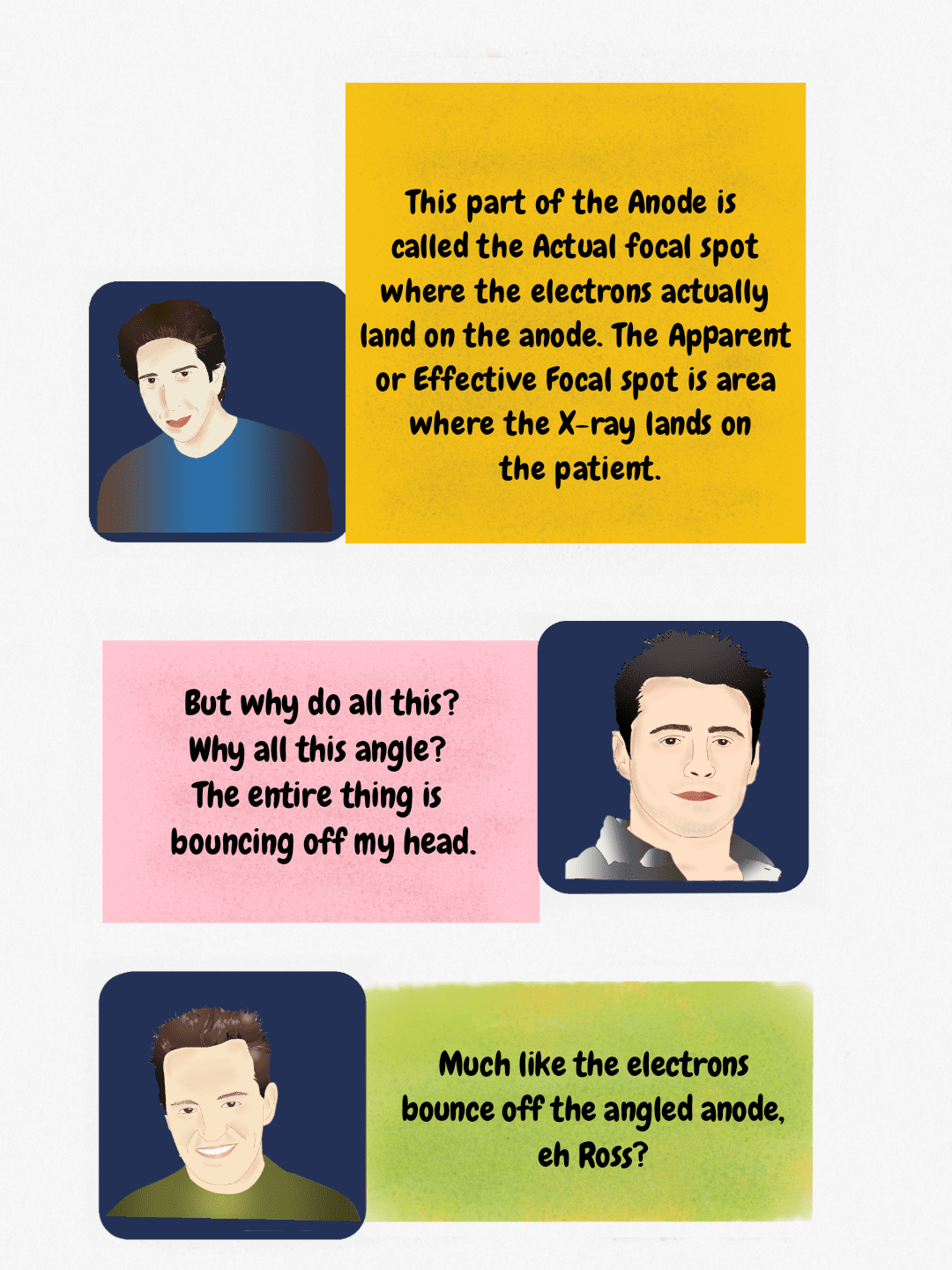 Diagram explaining the relationship between the actual focal spot (where electrons hit the anode) and the apparent/effective focal spot (where X-rays exit toward the patient).
 Teaching concept on X-ray tube physics, highlighting the Line Focus Principle and the angled anode.
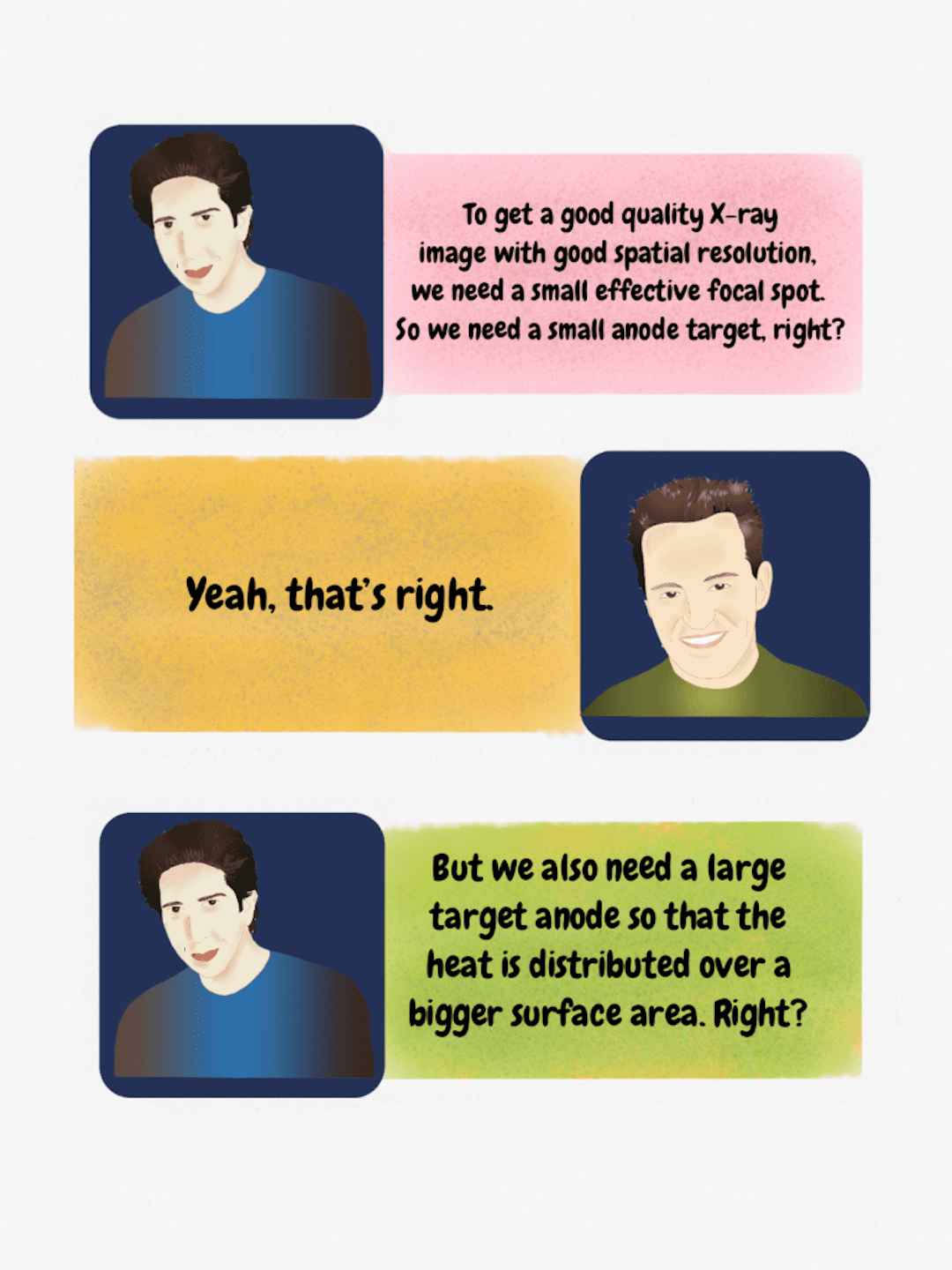 Figure illustrating the inverse relationship between the need for a small effective focal spot (for spatial resolution) and a large anode target (for heat distribution) in X-ray generation.
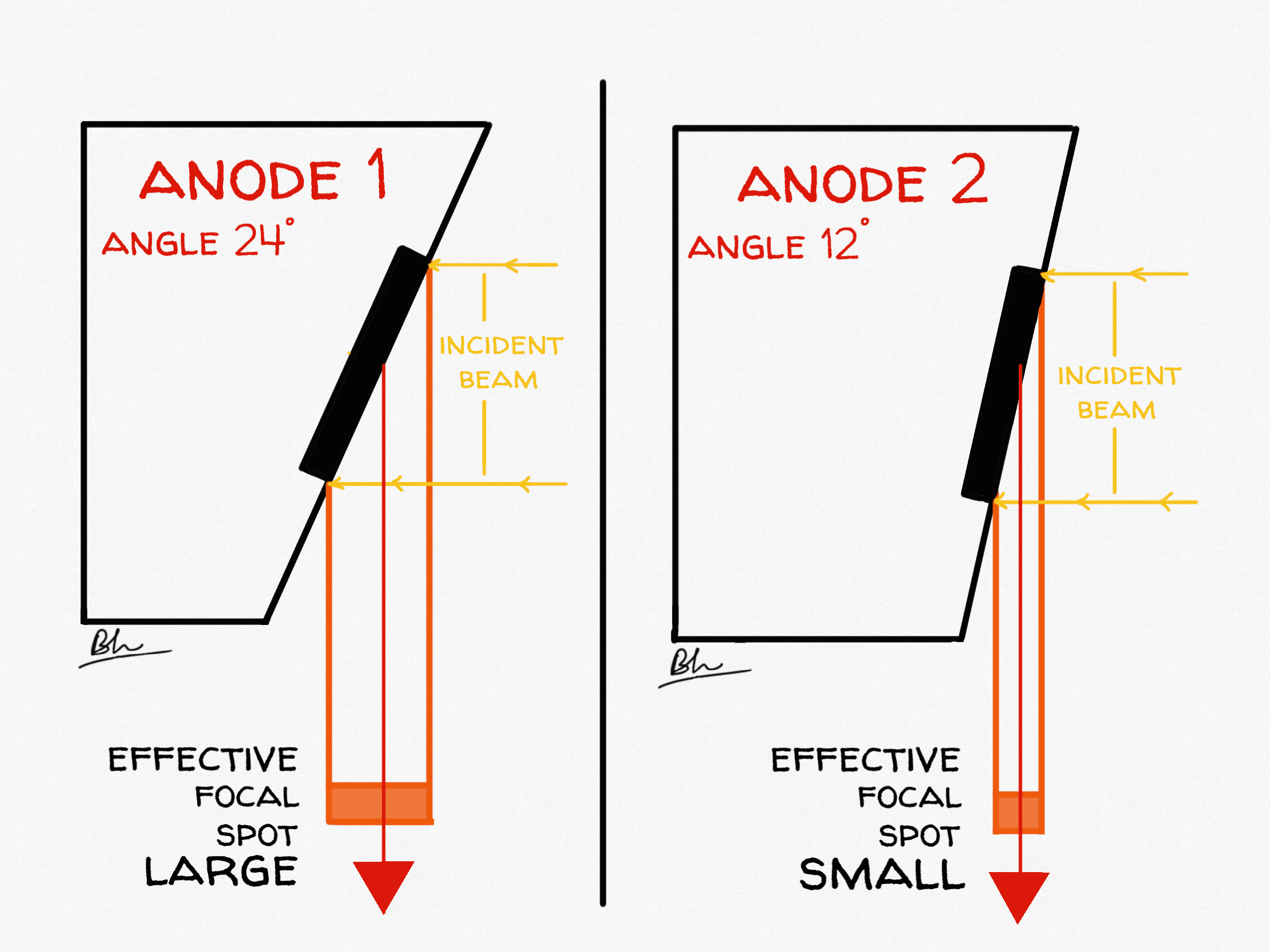
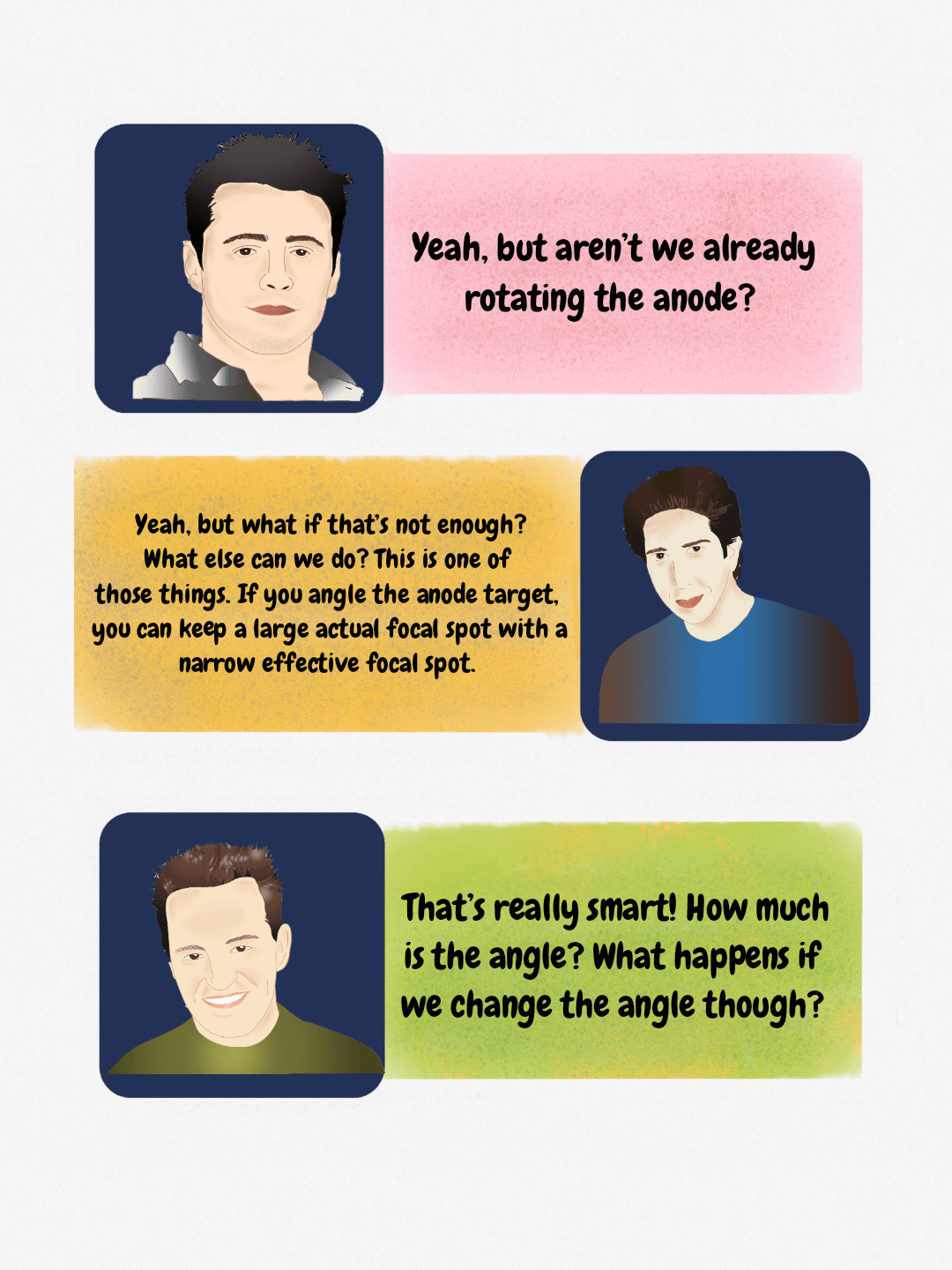 Discussion on X-ray tube focal spot control, emphasizing how anode angle manipulation creates a smaller effective focal spot.
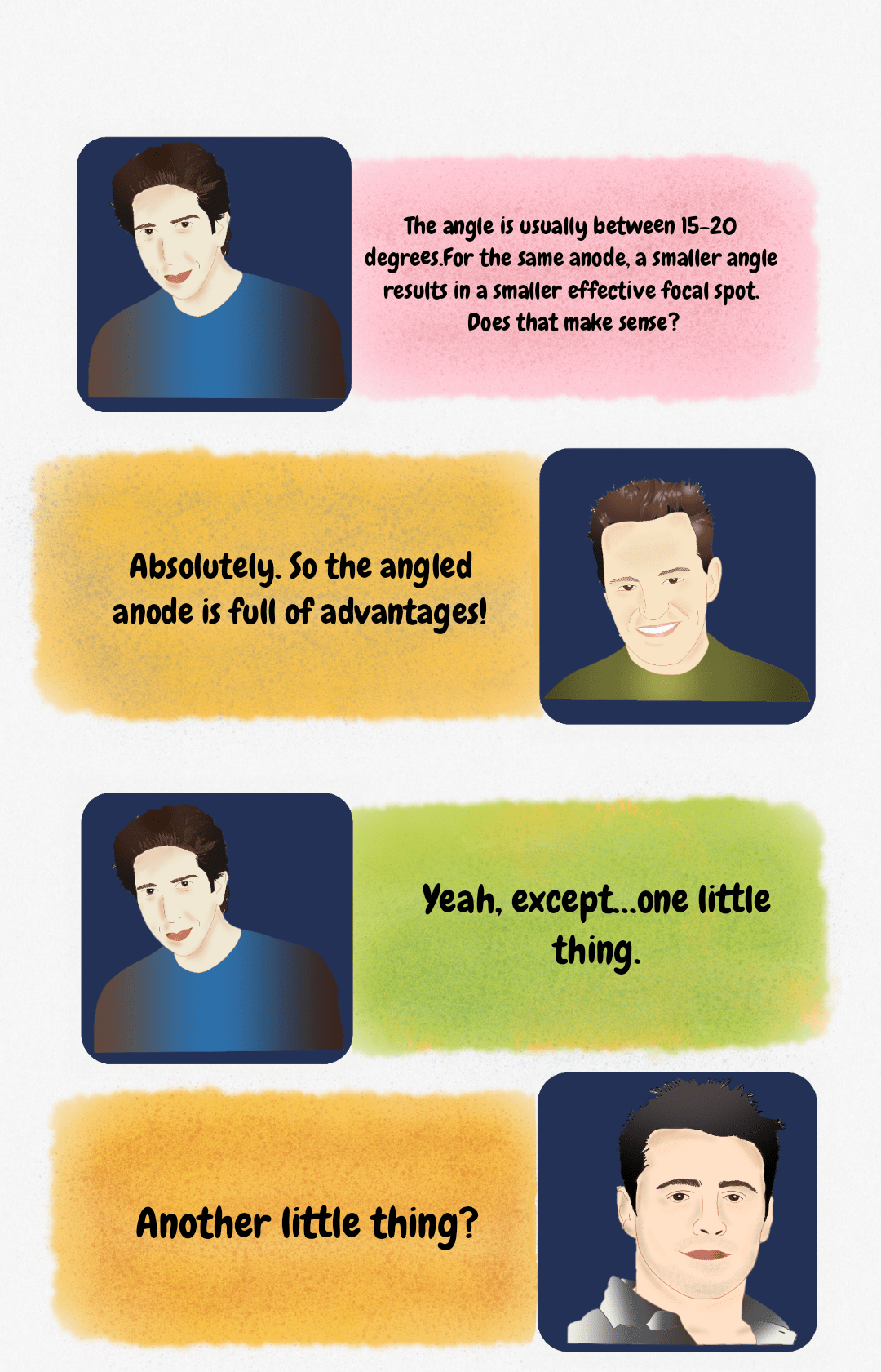 Dialogue discussing X-ray tube physics: a smaller anode angle yields a smaller effective focal spot.
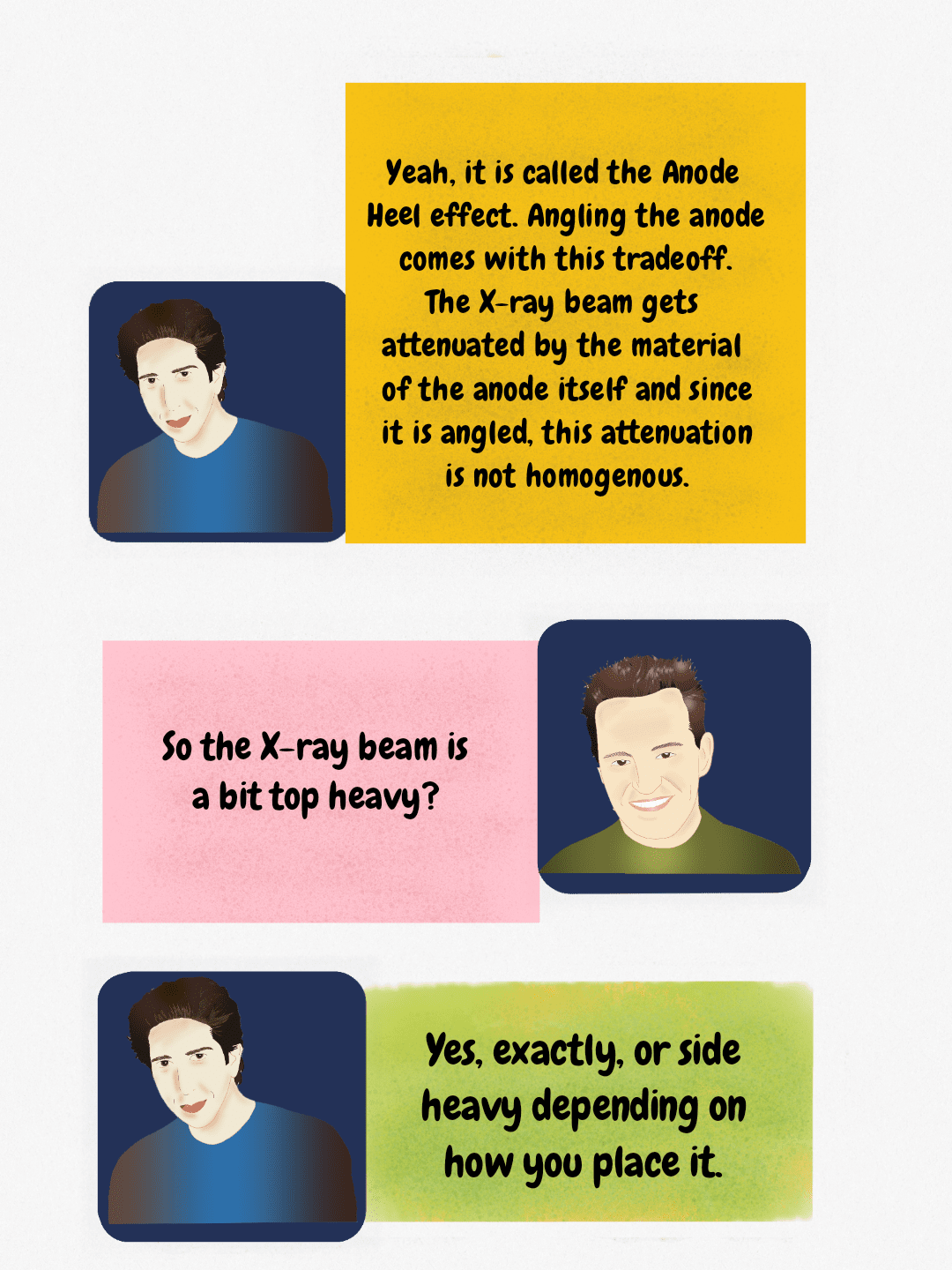 The Anode Heel effect results in non-homogenous X-ray beam intensity due to the angled anode.
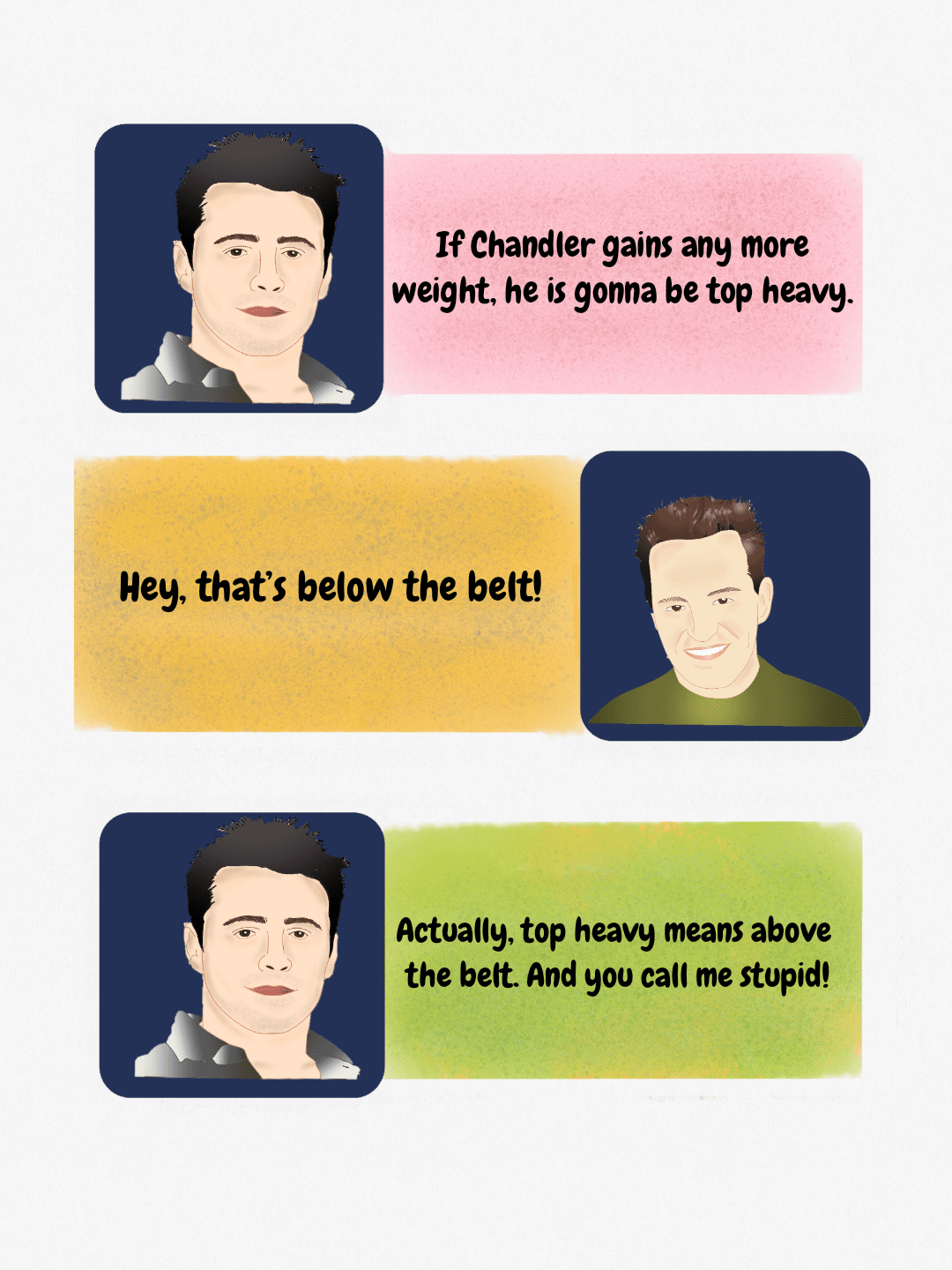 A humorous illustration contrasting the literal interpretation of 'top heavy' with its anatomical or physics-based meaning (above the belt).
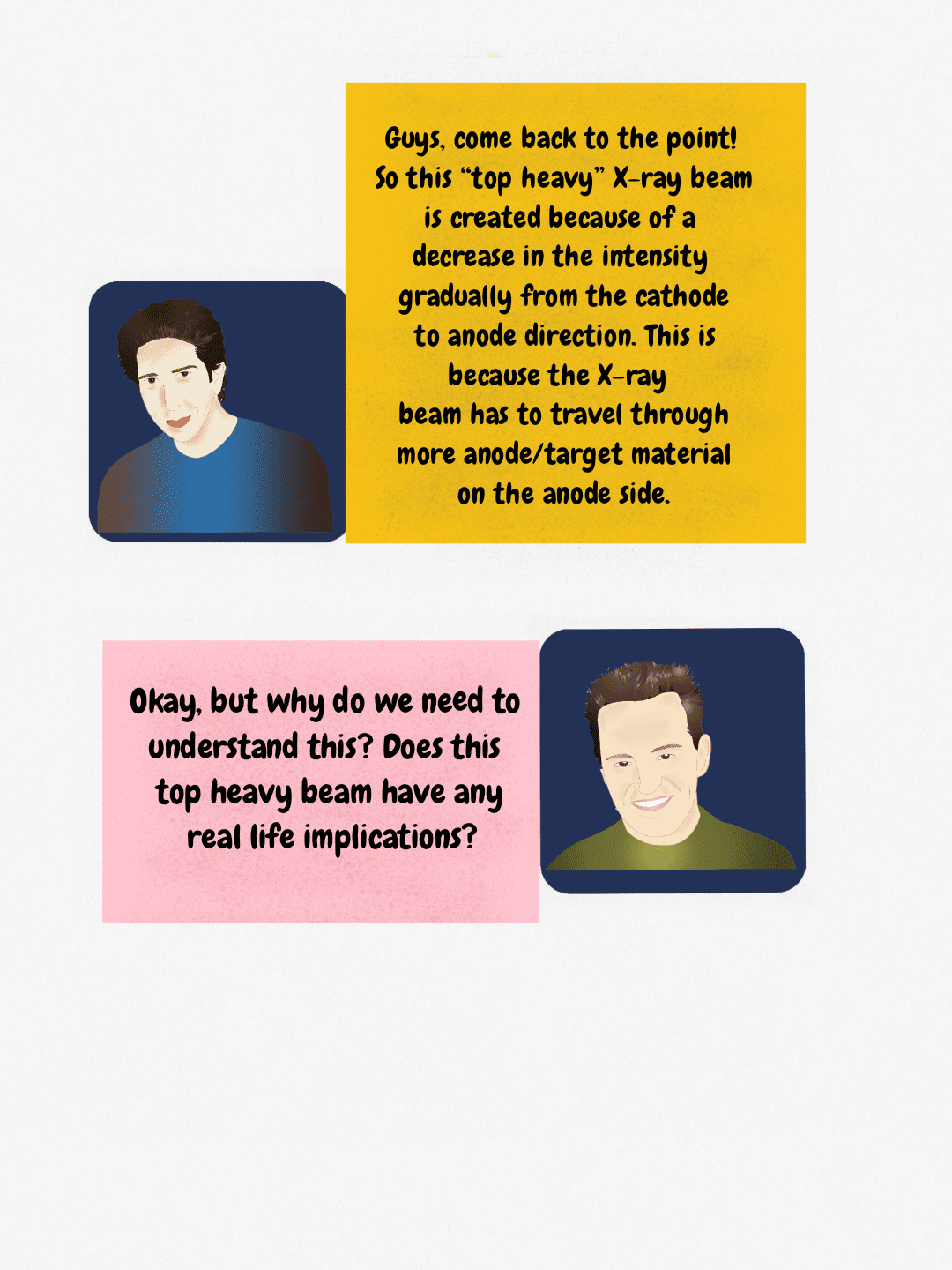 Explanation of the top-heavy X-ray beam phenomenon resulting from increased attenuation through the anode/target material.
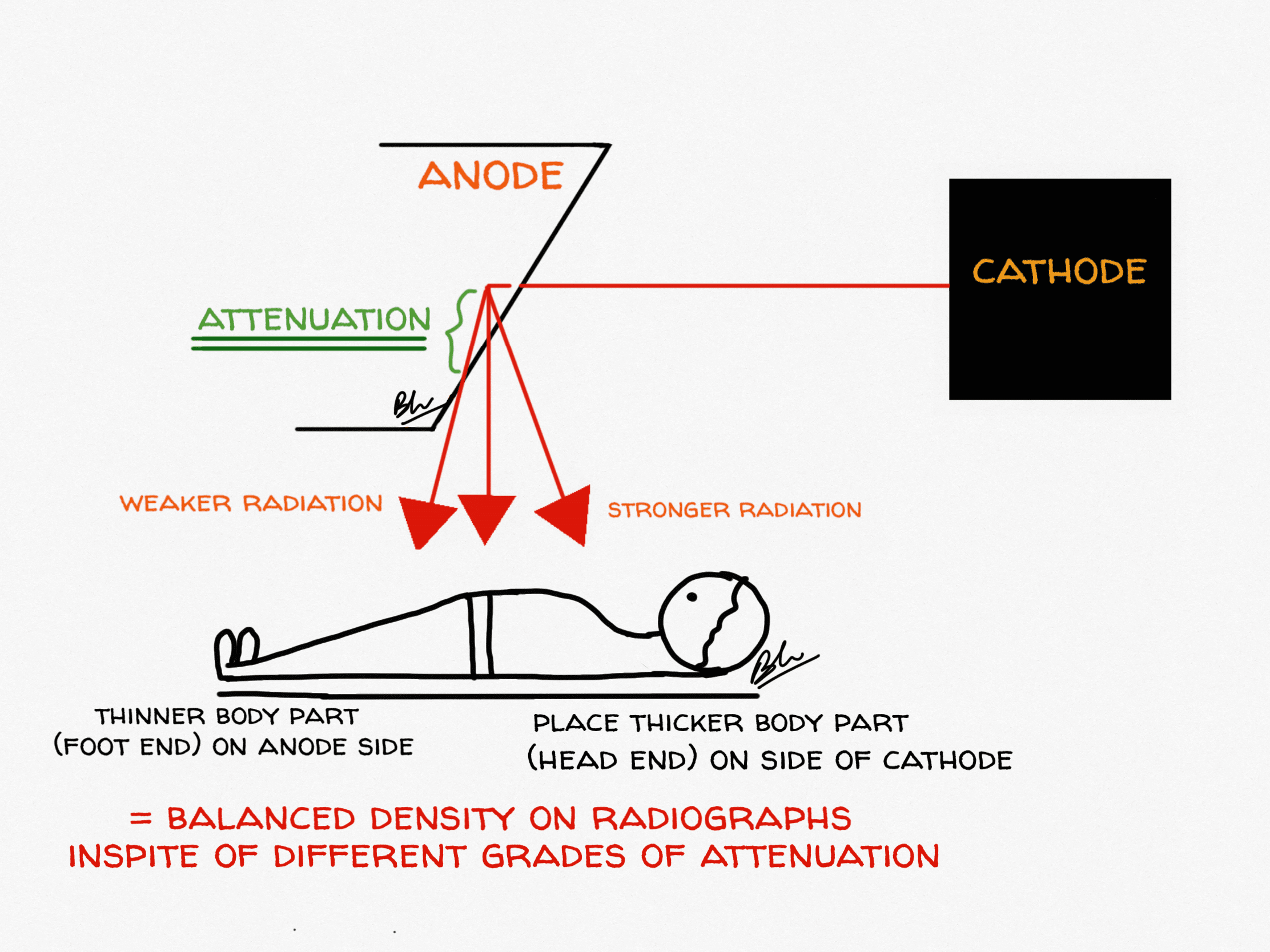
 Radiography principle: Cathode side of the X-ray tube must be positioned toward the thickest part of the patient to ensure uniform exposure.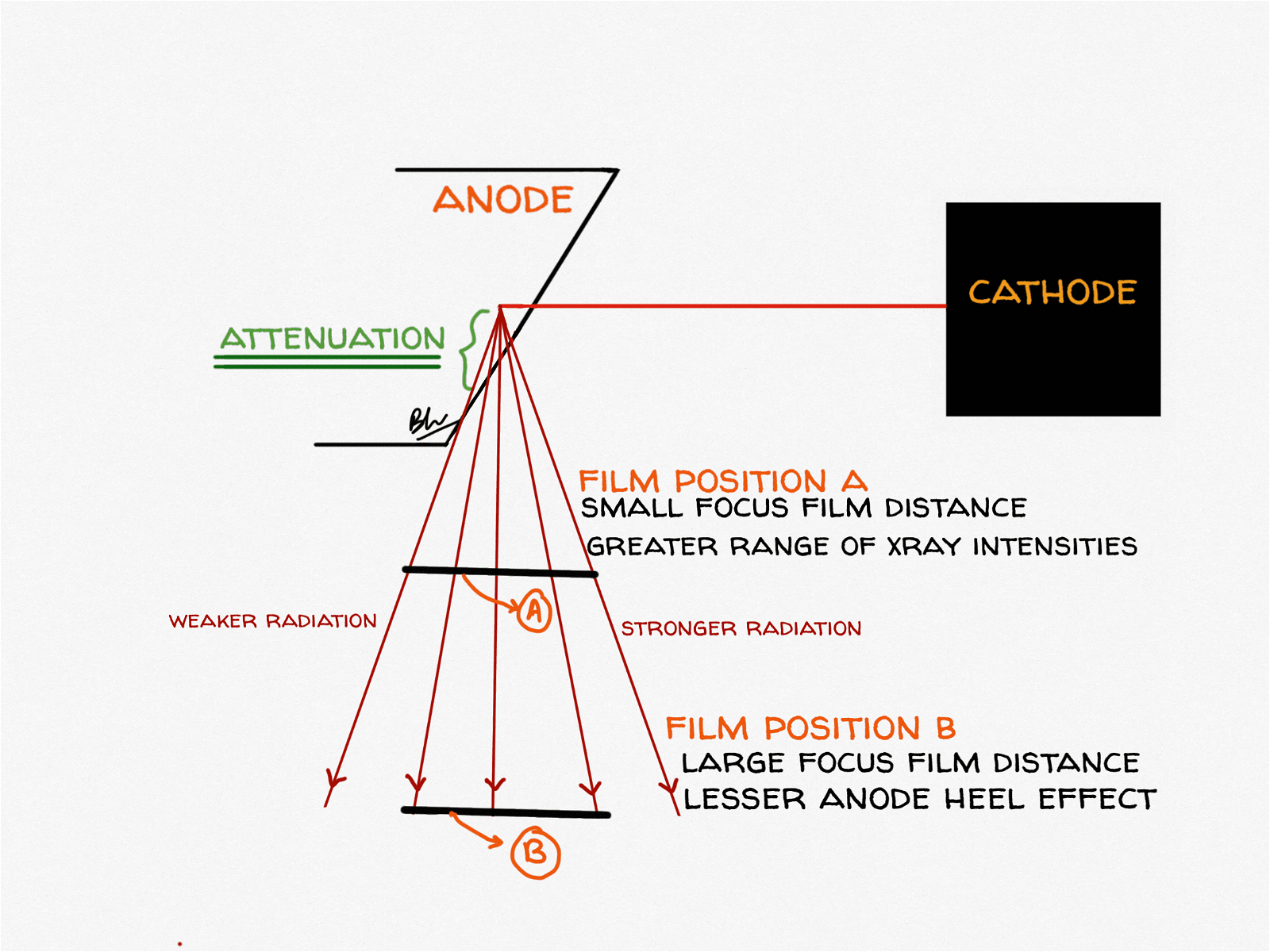
Did you like it? Or as Chandler would ask – Can X-ray Physics BE any more interesting? Let us know your thoughts in the comments section! We will be coming up with more episodes soon! Check the front page for updates!

Improve Content And Help Your Colleagues!
Found an error in the post? Please let us know using our contact page and we will update it with due credits!
If you wish to contribute radiological images for this case (or any other article on the website), you can submit them here and you will be duly credited: Submit radiology case
Good for remembering, please go on with some difficult topics. Please don’t stop this innovative idea.
Sure! Glad you liked it, Dinesh!
I am impressed by how clearly radiology physics is explained, accompanied by excellent diagrams. Thank you to the entire team.
Mohan
Glad you liked it.
It’s a very interesting.
Kindly update for usg ,ct ,Mri and pet-ct ,spect-ct physics.
We are working on it and it should be up soon! Thank you for your feedback, Harsh!
very interesting and informative .
Thank you! Hope you checked the second episode in the series here: https://radiogyan.com/physics/the-one-with-the-x-ray-interactions/
woow amazying ……
Glad you liked it, Praveen.