


What causes Target sign in bowel on US/CT?
Let me know in the comments.
Click to reveal the answer
Answer:
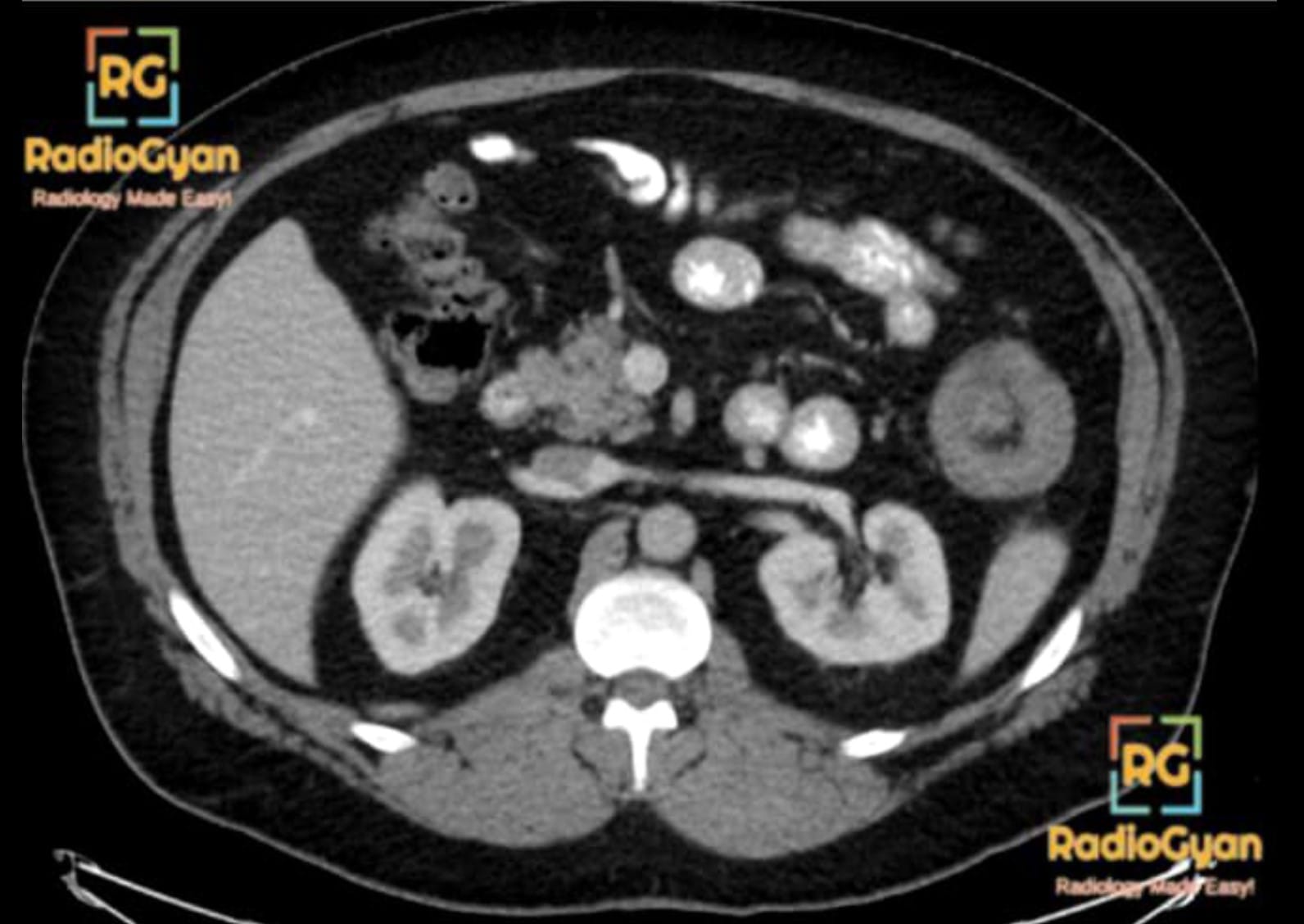
Concentric ring or Target sign/target-like appearance due to intussusception, where a proximal bowel segment (intussusceptum) invaginates into the distal segment (intussuscipiens), commonly ileocolic in children presenting with intermittent abdominal pain, vomiting, and currant jelly stool; also seen with target-like lymphoma deposits. This is a distinct entity from the unrelated breast “target calcification” seen on mammography.
The same ring is described as the doughnut sign on cross-sectional imaging: a peripheral ring of thickened oedematous bowel wall around a central lucency formed by compressed intraluminal fat and mesenteric vessels. Beyond intussusception, circumferential ring thickening of this kind is produced by annular masses, most often colonic carcinoma, which narrow the lumen concentrically and lack the entrapped mesenteric fat and vessels that make the intussusception target multilayered.
Why is it called so?
Named for the multilayered concentric rings resembling a target or bull’s eye, formed by alternating echogenic and hypoechoic layers on ultrasound or ring-enhancing appearance on CT.
Pathophysiology
Intussusception causes the intussusceptum to telescope into the intussuscipiens, drawing in mesenteric fat and vessels; on transverse imaging, this produces central hypoechoic edematous bowel wall surrounded by hyperechoic mesentery/serosa and outer hypoechoic muscularis/submucosa layers.
Alternative names:
Doughnut sign; bull’s eye sign; crescent-in-doughnut sign; multiple-concentric-rings sign
Other associated named signs:
Pseudokidney sign (longitudinal view), crescent sign (gas crescent within the colonic lumen outlining the intussusception apex on plain film)
References
- Maddu KK, et al. Colorectal emergencies and related complications: a comprehensive imaging review. AJR Am J Roentgenol. 2014;203(6):1205-1216.
- Hammond N, et al. Intussusception into the enteroanastomosis after Billroth II gastrectomy and Roux-en-Y jejunostomy: sonographic and CT findings. AJR Am J Roentgenol. 2001;177(3):624.
Access all radiology signs posted so far: https://radiogyan.com/radiology-signs/

Improve Content And Help Your Colleagues!
Found an error in the post? Please let us know using our contact page and we will update it with due credits!
If you wish to contribute radiological images for this case (or any other article on the website), you can submit them here and you will be duly credited: Submit radiology case