


What causes the double PCL sign on knee MRI?
Let me know in the comments.
Click to reveal the answer
Answer:
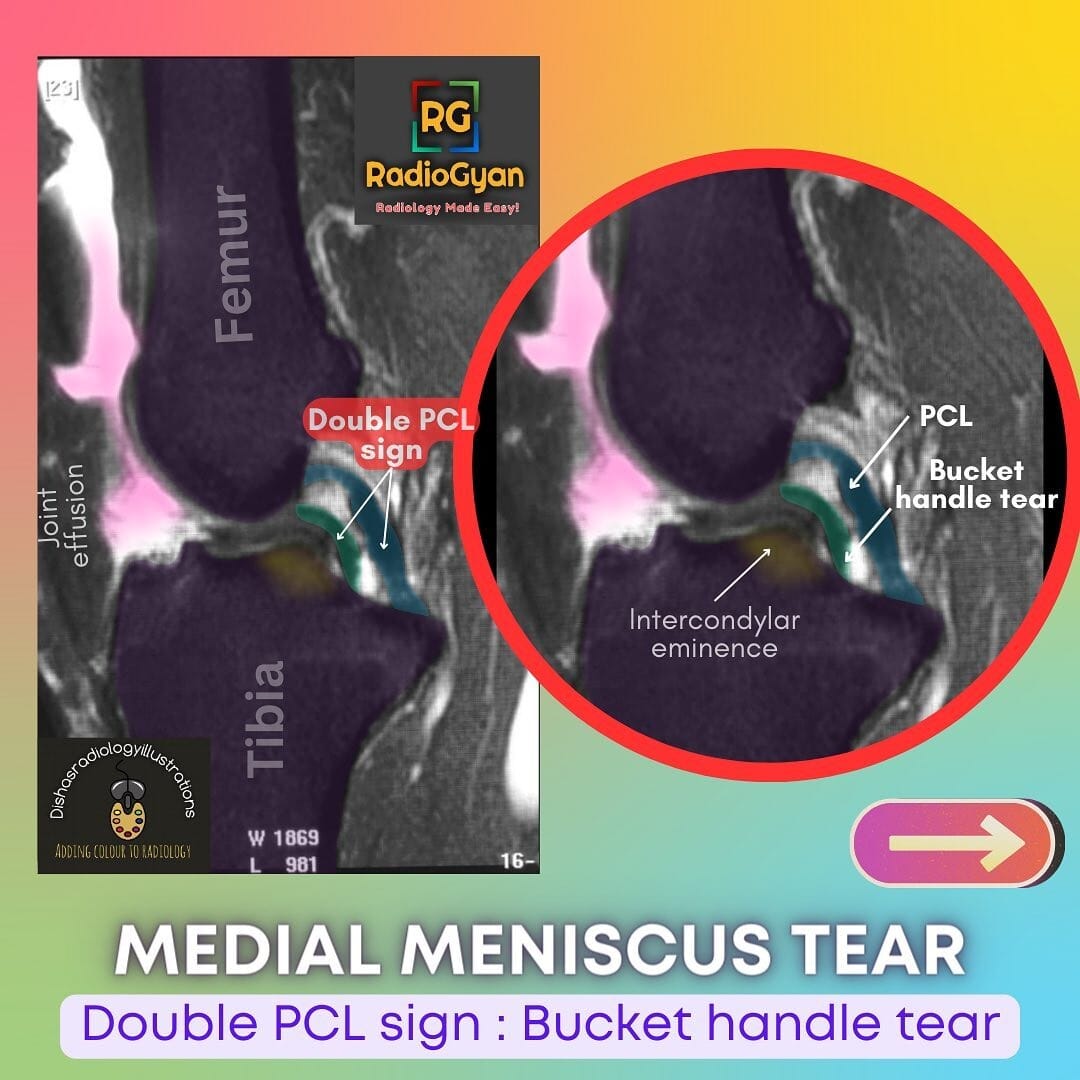
The double PCL sign is a second low-signal band lying anterior and inferior to, and roughly parallel with, the posterior cruciate ligament on a sagittal MRI of the knee. The band is not a ligament but a displaced bucket-handle fragment of the medial meniscus that has flipped into the intercondylar notch and come to rest beneath the PCL. It is highly specific for a displaced bucket-handle tear, reported at 98-100%, but its sensitivity is low and variable, in the region of 27-53%, so its absence does not exclude one. It is essentially a sign of the medial meniscus, because an intact anterior cruciate ligament blocks the lateral meniscus from displacing into the notch; when the ACL is torn, a lateral bucket-handle fragment can occasionally produce the same appearance. It should be sought together with the other signs of the same injury: the absent bow tie sign, the fragment-in-notch sign, the flipped meniscus sign and the double anterior horn sign.
Why is it called so?
The displaced fragment lying parallel to the posterior cruciate ligament looks like a second PCL.
Pathophysiology
A longitudinal vertical tear of the meniscus creates an inner fragment still attached at both its anterior and posterior ends, the handle of the bucket. Under load this handle can flip out of its normal peripheral position and displace centrally into the intercondylar notch, where it comes to lie in the space between the PCL above and the tibial plateau below. Because meniscal fibrocartilage and ligament are both of low signal on all sequences, the fragment is indistinguishable in signal from the PCL and, lying parallel to it, is rendered as a duplicate. The medial meniscus is affected far more often because it is less mobile and more firmly attached peripherally, so it tears in this pattern more readily.
Alternative names: Double posterior cruciate ligament sign
Other associated named signs: Fragment-in-notch sign, absent bow tie sign, flipped meniscus sign, double anterior horn sign, and the disproportional posterior horn sign
References
Access all radiology signs posted so far: https://radiogyan.com/radiology-signs/

Improve Content And Help Your Colleagues!
Found an error in the post? Please let us know using our contact page and we will update it with due credits!
If you wish to contribute radiological images for this case (or any other article on the website), you can submit them here and you will be duly credited: Submit radiology case