


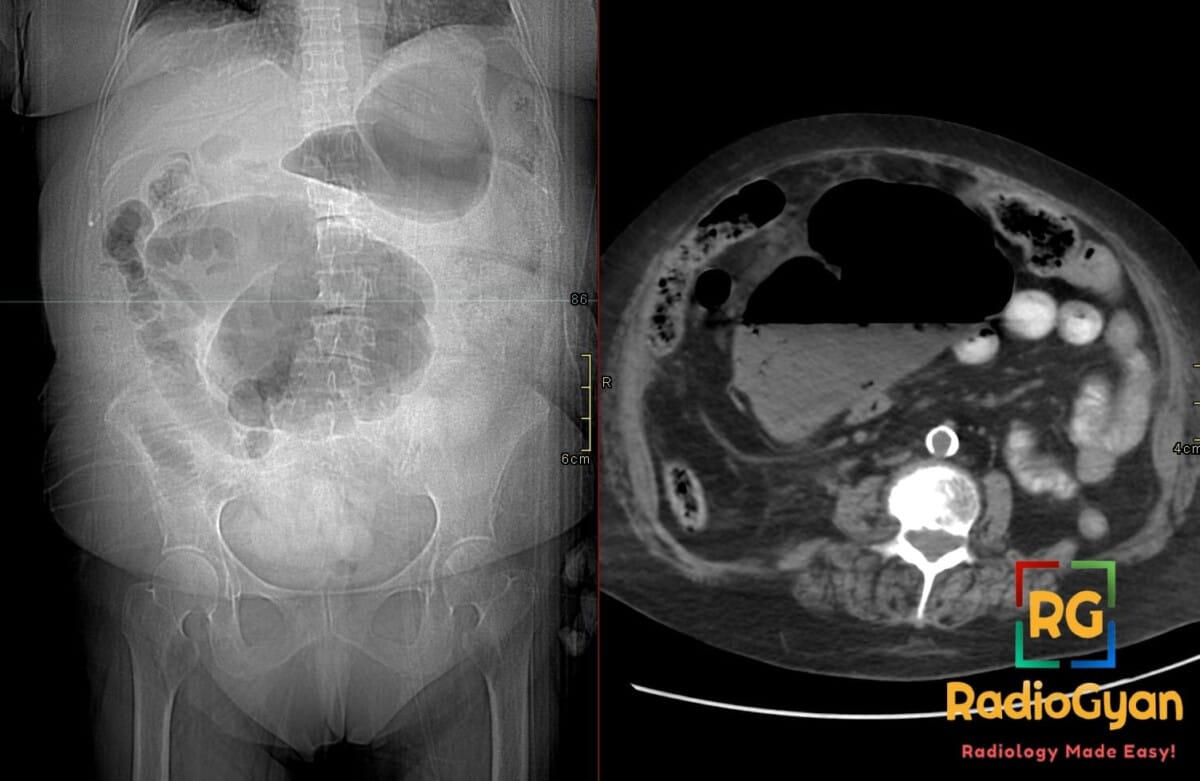
What causes the coffee-bean sign on the abdominal radiograph?
Let me know in the comments.
Click to reveal the answer
Answer:
The coffee-bean sign is a massively distended, gas-filled bowel loop whose two apposed medial walls form a single thick central line, dividing the loop into two halves and reproducing the cleft of a coffee bean. It is the classic radiographic appearance of sigmoid volvulus: the closed loop arises from the pelvis, is typically ahaustral, and extends superiorly towards the right upper quadrant, often above the transverse colon (the northern exposure sign). The outer walls of the loop are thin because gas lies on only one side, while the central line is thick because it is two apposed walls seen together. Caecal volvulus produces a similar bean but the loop originates in the right lower quadrant, retains haustral markings, points towards the left upper quadrant, and typically shows a single long air-fluid level rather than the multiple levels of sigmoid volvulus. A pseudo coffee-bean sign is described without volvulus, notably in ileosigmoid knotting, so CT confirmation is standard.
Why is it called so?
The distended loop divided by a thick central line looks like a coffee bean with its longitudinal cleft.
Pathophysiology
A long, redundant sigmoid on a narrow mesenteric base twists about its mesenteric axis, creating a closed loop obstructed at both ends. Gas and fluid cannot escape and continue to accumulate, so the loop distends enormously. The two limbs of the loop are pressed against each other along the line of the twist; their apposed walls, with no intervening gas, are rendered as one dense line, while the outer surfaces are outlined by intraluminal gas on one side only. Progressive distension and mesenteric torsion compromise venous drainage first, then arterial supply, which is why untreated sigmoid volvulus proceeds to ischaemia and perforation.
Alternative names: Bent inner tube sign, kidney bean sign
Other associated named signs: Whirl sign of the twisted mesentery on CT, bird beak sign at the point of torsion on contrast enema, northern exposure sign, and the pseudo coffee-bean sign
References
Access all radiology signs posted so far: https://radiogyan.com/radiology-signs/

Improve Content And Help Your Colleagues!
Found an error in the post? Please let us know using our contact page and we will update it with due credits!
If you wish to contribute radiological images for this case (or any other article on the website), you can submit them here and you will be duly credited: Submit radiology case