


What causes 1-2-3 sign in chest on chest radiograph?
Let me know in the comments.
Click to reveal the answer
Answer:
The 1-2-3 sign, also known as Garland triad, represents symmetrical bilateral hilar lymphadenopathy (nodes 2 and 3) combined with right paratracheal lymphadenopathy (node 1), classically seen in sarcoidosis due to noncaseating granulomatous inflammation involving mediastinal lymph nodes.
Why is it called so?
It is named the 1-2-3 sign because the enlarged lymph nodes are visually numbered on chest radiograph: 1 for right paratracheal node, 2 for right hilar node, and 3 for left hilar node, mimicking a sequential counting pattern.
Pathophysiology
Noncaseating granulomas form in response to an unknown antigen in genetically susceptible individuals, leading to lymphocytic recruitment and macrophage fusion into epithelioid cells within hilar and mediastinal lymph nodes; the right paratracheal node is prominently visible due to its superficial location, while bilateral hilar potato nodes develop symmetrically without abutting the cardiac border.
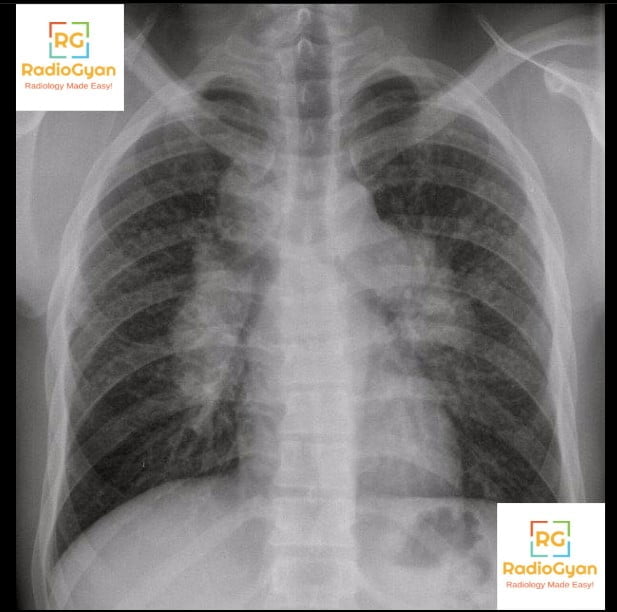
Alternative names: Garland triad, pawnbroker sign
Other associated named signs: Lambda-panda sign on gallium-67 scintigraphy
References
Access all radiology signs posted so far: https://radiogyan.com/radiology-signs/

Improve Content And Help Your Colleagues!
Found an error in the post? Please let us know using our contact page and we will update it with due credits!
If you wish to contribute radiological images for this case (or any other article on the website), you can submit them here and you will be duly credited: Submit radiology case