


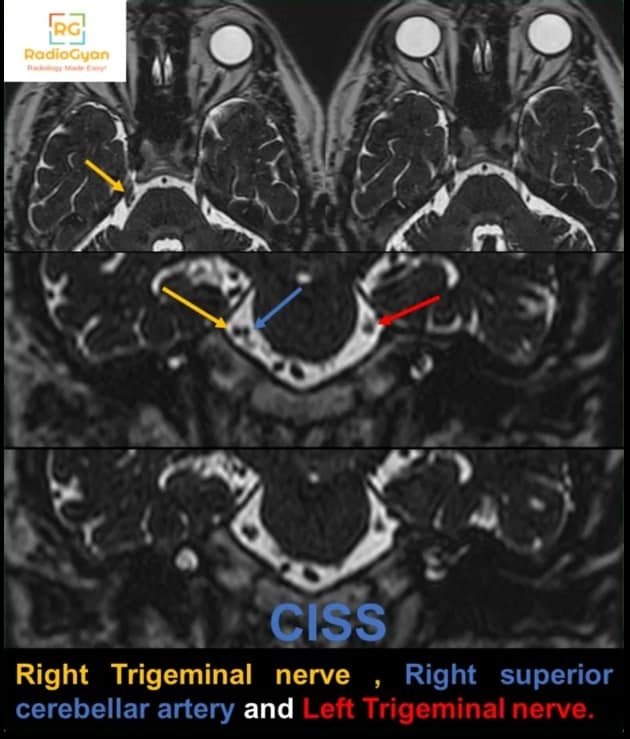
Trigeminal neuralgia is a clinical diagnosis: brief, severe, electric-shock-like unilateral facial pain in one or more trigeminal divisions, provoked by innocuous stimuli such as chewing, talking, shaving or a draught of cold air. MRI does not make that diagnosis. It does two other jobs, and the report should be built around them: exclude a secondary cause, because no clinical feature reliably rules one out, and characterise the neurovascular relationship well enough for a neurosurgeon to decide whether microvascular decompression is worth offering [1].
That distinction matters more than it sounds. Neurovascular contact is so common in people without facial pain that reporting its presence adds almost nothing; what carries information is contact severe enough to deform the nerve. This page covers the trigeminal nerve anatomy you need to describe, the sequences that show it, how to grade a neurovascular conflict, the secondary causes MRI is really there to find, and what to put in the report.
Key points
- MRI is done to exclude secondary trigeminal neuralgia, not to confirm the diagnosis. The EAN guideline states plainly that demonstration of a neurovascular contact should not be used to confirm trigeminal neuralgia [1].
- Use three sequences, not one. A 3D heavily T2-weighted sequence (CISS, FIESTA, DRIVE), a 3D time-of-flight MR angiogram and a 3D post-contrast T1 [1][5]. Prefer 3.0 T: it outperforms 1.5 T for the small vessels that matter [7].
- Contact is normal; deformity is not. Neurovascular contact was present on the symptomatic side in 89 percent of patients with classical trigeminal neuralgia but also on the asymptomatic side in 78 percent. Contact causing displacement or atrophy was present in 53 percent versus 13 percent, odds ratio 11.6 [3].
- In 100 people without facial pain, 71 percent of trigeminal nerves showed contact — but 92 percent of those were simple contact without distortion, mostly distal and mostly venous [6].
- Grade the conflict. Grade I simple contact, grade II distortion or displacement, grade III marked indentation or atrophy; MRI-to-surgery agreement was substantial to almost perfect (kappa 0.75 to 0.86) [5].
- The superior cerebellar artery is the usual offender, and severe contact was arterial in 98 percent of cases [3].
- Secondary causes are the real target. Multiple sclerosis plaques along the intrapontine trigeminal afferents and cerebellopontine angle tumours (epidermoid, meningioma, vestibular schwannoma) account for most [11][13][14].
- Contact with morphological change predicts a good decompression outcome (odds ratio 4.4 for an excellent result at 12 months), which is the practical reason to grade it in the report [15].
Classification: classical, secondary and idiopathic
The 2016 classification adopted by the International Classification of Headache Disorders and by the EAN guideline replaced the old “typical versus symptomatic” language, and the new terms are radiological in all but name. The category a patient falls into is decided largely by what the MRI shows, and it drives which operation is offered [1][2].
| Category | Definition | What the MRI shows | Surgical implication |
|---|---|---|---|
| Classical trigeminal neuralgia | Trigeminal neuralgia with demonstrated morphological change in the trigeminal root from vascular compression [2] | Neurovascular contact with displacement, distortion or atrophy of the nerve (grade II or III) | Microvascular decompression is recommended as first-line surgery [1] |
| Secondary trigeminal neuralgia | Caused by an identifiable underlying neurological disease other than neurovascular contact [2] | Multiple sclerosis plaque, cerebellopontine angle tumour, vascular malformation, brainstem lesion, skull base disease | Treat the cause; medical management otherwise follows the same principles [1] |
| Idiopathic trigeminal neuralgia | Clinical trigeminal neuralgia with no cause found, or contact without morphological change [2] | Normal study, or grade I simple contact only | No recommendation between neuroablative options; neuroablation preferred if MRI shows no contact at all [1] |
Classical trigeminal neuralgia is the commonest of the three and accounts for about 75 percent of cases, secondary trigeminal neuralgia for roughly 15 percent and idiopathic trigeminal neuralgia for the remaining 10 percent [19].
Each category is further divided into purely paroxysmal trigeminal neuralgia and trigeminal neuralgia with concomitant continuous pain. That second form is not rare, reported in 14 to 50 percent of patients [19]: in a prospective series of 158 patients, 49 percent had continuous background pain in addition to the paroxysms, 31 percent had autonomic symptoms and 29 percent of unoperated patients had objective sensory abnormalities [10]. Sensory signs alone therefore do not prove a secondary cause, although they should lower your threshold for looking harder.
The same series is a useful reference for the demographic pattern: mean age at onset 52.9 years, 60 percent female, 56 percent right-sided, and involvement confined to V2, V3 or both in 69 percent, with V1 alone in only 4 percent [10]. Bilateral pain, onset under 40, V1 involvement or objective sensory loss are the classic pointers away from a purely vascular cause.
Trigeminal nerve MRI anatomy: the six segments to check
The trigeminal nerve is long, and pain can be generated anywhere along it. A report that only looks at the cisternal segment will miss perineural spread at the foramen ovale or a plaque in the pons. Work through the pathway in order.
| Segment | Anatomy | Best sequence | Pathology to look for |
|---|---|---|---|
| 1. Brainstem nuclei | Mesencephalic, principal sensory and spinal trigeminal nuclei, with the spinal tract descending to C2; motor nucleus in the pons | Axial T2, FLAIR, DWI | Demyelinating plaque along the intrapontine afferents, lateral medullary infarct, pontine glioma, cavernoma |
| 2. Root entry zone and transition zone | Nerve-pons junction at the lateral pons; the central-to-peripheral myelin transition lies a few millimetres distal to it | 3D CISS or FIESTA, 3D TOF | Neurovascular conflict, most often superior cerebellar artery |
| 3. Cisternal segment | Runs anterolaterally through the prepontine and cerebellopontine angle cisterns to the petrous apex; 8 to 15 mm long, mean 12.3 mm [8] | 3D CISS or FIESTA | Neurovascular conflict, epidermoid cyst, meningioma, vestibular schwannoma, arachnoid cyst |
| 4. Meckel cave and trigeminal ganglion | Dural recess at the petrous apex containing cerebrospinal fluid and the crescentic gasserian ganglion | 3D CISS plus post-contrast fat-suppressed T1 | Loss of the normal cerebrospinal fluid signal, enhancing tumour, trigeminal schwannoma, perineural spread, meningioma, lymphoma |
| 5. Cavernous sinus segment | V1 (ophthalmic) and V2 (maxillary) run in the lateral dural wall; V3 does not enter the sinus | Coronal post-contrast fat-suppressed T1 | Cavernous meningioma, Tolosa-Hunt inflammation, carotid-cavernous fistula, metastasis |
| 6. Skull base exit and branches | V1 through the superior orbital fissure, V2 through foramen rotundum then pterygopalatine fossa, V3 through foramen ovale | Coronal post-contrast fat-suppressed T1, thin bone CT for foraminal widening | Perineural tumour spread, foraminal widening, denervation atrophy of the muscles of mastication with V3 disease |
Root entry zone versus transition zone: not the same thing
Textbook accounts (including the earlier version of this page) say that the proximal, centrally myelinated part of the nerve is vulnerable because the oligodendrocyte-derived central myelin is thinner and more fragile than the Schwann-cell peripheral myelin distally. The mechanism is right; the geography is often stated wrongly. In 100 cadaveric trigeminal nerves the extent of central myelin from the pons averaged 1.13 mm medially and 2.47 mm laterally, occupying only the initial quarter of a cisternal segment that itself averaged 12.3 mm. The authors conclude the root entry zone (the nerve-pons junction) and the transition zone are distinct sites and the terms should never be used interchangeably [8].
A second cadaveric study put the most distal part of the transition zone at 4.19 mm (SD 0.81) from the brainstem, and calculated the volume of centrally myelinated nerve at 24.5 mm3 for the trigeminal nerve against 4.4 mm3 for the facial nerve — a difference that tracks the relative incidence of trigeminal neuralgia and hemifacial spasm [9]. Two practical consequences: measure and state the distance of the contact from the pons rather than writing “at the REZ”, and remember that decompression at more distal sites can still relieve pain, which argues that central myelin vulnerability is not the whole mechanism [8].

MRI protocol for trigeminal neuralgia
The EAN guideline recommends a combination of three high-resolution sequences and does not mandate specific vendor names [1]. The combination with the best published validation against operative findings — 100 consecutive microvascular decompression patients, blinded reader — was 3D high-resolution T2, 3D time-of-flight MR angiography and 3D post-contrast T1, which reached a sensitivity of 96.7 percent and a specificity of 100 percent for detecting neurovascular compression [5]. A 2026 systematic review of 143 studies confirmed the same triad and found imaging at 3.0 T superior to 1.5 T for the small vessels responsible for compression [7].
| Sequence | Vendor names | Why it is there | Limitation |
|---|---|---|---|
| 3D heavily T2-weighted, sub-millimetre | CISS (Siemens), FIESTA (GE), DRIVE or bFFE (Philips), 3D SPACE or CUBE for the T2 SE variant | The anatomical backbone. Black nerve against bright cerebrospinal fluid; shows the cisternal segment, Meckel cave and any adjacent structure, reformattable in any plane | A vessel and a nerve look identical (both dark). Cannot classify the offending structure on its own |
| 3D time-of-flight MR angiography | 3D TOF, sometimes with a T1 FFE readout | Identifies the offending structure as an artery and names it: superior cerebellar artery, anterior inferior cerebellar artery, vertebrobasilar system | Flow-dependent, so veins and slow-flowing vessels are poorly seen |
| 3D post-contrast T1 | 3D T1 gradient echo (MPRAGE, BRAVO, TFE), fat-suppressed through the skull base | Veins, enhancing tumours, Meckel cave and cavernous sinus disease, perineural spread | Adds contrast and time; some centres reserve it for suspected secondary causes |
| Whole-brain axial T2 and FLAIR | Standard | The demyelinating plaque along the intrapontine trigeminal afferents, and the rest of the brain | Easily omitted if the request only says trigeminal protocol, and then the multiple sclerosis diagnosis is missed |
| Fusion or overlay reconstructions | CISS-TOF fusion, multiplanar and curved reformats | Makes the site, direction and degree of compression far easier to communicate to the surgeon | Post-processing time; not standardised across centres [7] |
| Diffusion tensor imaging (optional, research) | DTI of the cisternal segment | Reduced fractional anisotropy and raised diffusivity in the compressed nerve; correlates with compression grade and may predict outcome | Small nerve, susceptibility at the skull base, no validated threshold for clinical use [7] |
Practical points that make the difference between a useful and a useless study: slices of 1 mm or thinner through the posterior fossa, isotropic voxels so the nerve can be reformatted along its own axis, coverage from the midbrain to below the foramen ovale, and 3.0 T where available [7]. A whole-brain FLAIR is not optional — the commonest secondary cause is a pontine plaque that a cisternal-only protocol will never show.
Neurovascular conflict: why contact alone means little
This is the single most important thing to get right in the report, and the evidence is unambiguous. Contact between the trigeminal nerve and a vessel is a normal-population finding. Contact that deforms the nerve is not.
| Study | Population | Contact of any degree | Contact with morphological change |
|---|---|---|---|
| Maarbjerg 2015, 3 T, blinded [3] | 135 patients with unilateral classical trigeminal neuralgia; each patient acted as their own control | 89 percent symptomatic side vs 78 percent asymptomatic side (odds ratio 2.4) | 53 percent vs 13 percent (odds ratio 11.6, p less than 0.001); arterial in 98 percent |
| Antonini 2014, meta-analysis [4] | 24 patients and 24 age-matched controls, plus pooled literature | Root entry zone contact in 76 percent of symptomatic vs 17 percent of asymptomatic nerves | Anatomical change in 52 percent vs 9 percent; root entry zone contact plus atrophy gave 100 percent specificity and positive predictive value |
| Ruiz-Juretschke 2019, 3 T FIESTA [6] | 100 people with no known trigeminal neuralgia (200 nerves) | 71 percent of nerves; bilateral in 75 percent of those | Only 7.7 percent showed anything beyond simple contact; 66 percent of contacts were venous, 78 percent distal, no atrophy detected |
| Darrow 2022, blinded, four expert readers [17] | 47 patients and 47 controls | Reader agreement on diagnosis fair to moderate (ICC 0.32 to 0.68) | Readers performed no better than chance at diagnosing trigeminal neuralgia from MRI (accuracy 0.57) |
Read those four rows together and the reporting rule writes itself. Never report “vascular loop in contact with the trigeminal nerve” as though it explains the pain. Report whether the nerve is deformed, by what, where, and from which direction — and if it is not deformed, say so, because that finding pushes the patient towards the idiopathic category and away from microvascular decompression [1].
Grading the degree of compression
The three-grade scheme validated against operative findings in 100 decompressions is the one to use. Agreement between the preoperative MRI grade and what the surgeon found was substantial to almost perfect, with kappa coefficients of 0.746, 0.767 and 0.86 for grades I, II and III [5].
| Grade | MRI appearance | Category | Meaning |
|---|---|---|---|
| Grade I | Simple contact. The vessel touches the nerve; the nerve keeps its normal calibre and straight course | Contact without morphological change | Common in asymptomatic people (92 percent of contacts in controls) [6]. On its own it supports an idiopathic classification |
| Grade II | Distortion. The vessel displaces, angulates or indents the nerve out of its expected course | Contact with morphological change | Associated with the symptomatic side and with a good outcome after decompression [3][15] |
| Grade III | Marked indentation with flattening, grooving or visible atrophy of the root | Contact with morphological change | The strongest imaging correlate of classical trigeminal neuralgia; combined with root entry zone location it had 100 percent specificity [4] |
Alongside the grade, four other features change the operation or its expected outcome, and each belongs in the report:
- Which vessel. The superior cerebellar artery is the usual offender in symptomatic conflicts; the anterior inferior cerebellar artery, the vertebrobasilar system (including a dolichoectatic basilar artery) and the petrosal venous complex are the others.
- Artery or vein. Severe contact was arterial in 98 percent of symptomatic cases [3]. It matters after surgery too: venous compression of the root entry zone was one of four significant predictors of recurrence after decompression in the 1185-patient long-term series [16].
- Distance from the pons. Give it in millimetres. It is more informative than the phrase root entry zone, which is routinely used to mean two different sites [8].
- Direction of compression. Superomedial, superolateral, inferior or caudal. The surgeon plans the approach and the position of the Teflon interposition around this.
Secondary trigeminal neuralgia: what MRI is really looking for
About 15 percent of trigeminal neuralgia is secondary [19], and the EAN guideline is explicit that no clinical characteristic can exclude it, which is precisely why imaging is recommended in everyone rather than only in patients with red flags [1]. Younger age at onset is the most consistent clue: mean onset was 39.5 years in secondary cases against 53 years in classical trigeminal neuralgia in one surgical series [13].
| Cause | Frequency and context | Imaging findings | Management consequence |
|---|---|---|---|
| Multiple sclerosis | Trigeminal neuralgia occurs in about 3.4 percent of people with multiple sclerosis (pooled, 30,348 patients) [12]. It is the commonest secondary cause, and is more often bilateral | Demyelinating plaque along the intrapontine trigeminal afferents, present on the symptomatic side in 58 percent vs 22 percent asymptomatic (odds ratio 10.6). Neurovascular contact with morphological change was equally uncommon on both sides, 14 vs 9 percent [11] | Microvascular decompression should generally not be offered [11]. Percutaneous and ablative procedures are used instead |
| Epidermoid cyst | Frequently the commonest cerebellopontine angle tumour in trigeminal neuralgia series; 7.4 percent of 134 patients in one cohort, 75 percent of the tumours found [13] | Insinuating, non-enhancing cerebellopontine angle mass that follows cerebrospinal fluid on T1 and T2 but is bright on DWI and incompletely suppressed on FLAIR. Encases and wraps the nerve rather than displacing it [14] | Resection; look for an additional vascular conflict, present in 43 percent of tumour cases, after tumour removal [14] |
| Meningioma | 16 of 35 tumour-related cases in one series [14] | Dural-based enhancing mass with a dural tail, often at the petrous apex or petroclival junction; hyperostosis on CT | Resection plus decompression; meningioma-associated trigeminal neuralgia tends to have a coexisting offending vessel [14] |
| Vestibular schwannoma | 4 of 35 tumour cases [14]; facial pain is a late symptom | Enhancing mass centred on the internal auditory canal, extending into the cerebellopontine angle to reach the trigeminal nerve | Resection or radiosurgery |
| Vertebrobasilar dolichoectasia | Elderly, hypertensive; often with brainstem compression | Elongated, ectatic, tortuous basilar artery displacing the pons and stretching the nerve | Technically demanding decompression; consider ablative options |
| Arteriovenous malformation, aneurysm, cavernoma | Uncommon but important | Flow voids in the cerebellopontine angle, saccular aneurysm on angiographic sequences, popcorn lesion with a haemosiderin rim on susceptibility-weighted imaging | Endovascular or surgical treatment of the lesion |
| Brainstem infarct or glioma | Rare | Restricted diffusion in a vascular territory, or an expansile non-enhancing T2 hyperintense pontine mass | Treat the underlying disease |
| Perineural tumour spread and skull base disease | Head and neck squamous carcinoma, adenoid cystic carcinoma, lymphoma, skull base osteomyelitis | Nerve thickening and enhancement, obliteration of fat in the pterygopalatine fossa, foraminal widening, loss of Meckel cave cerebrospinal fluid, denervation change in the muscles of mastication | Oncological staging; a diagnosis missed entirely by a posterior-fossa-only protocol |
The multiple sclerosis finding deserves emphasis because it changes the operation. A prospective study of 63 patients with trigeminal neuralgia secondary to multiple sclerosis found no association between neurovascular contact with morphological changes and the painful side, but a strong association with a pontine plaque (odds ratio 10.6). The authors conclude that the primary cause is demyelination along the intrapontine trigeminal afferents and that microvascular decompression should generally not be offered to this group [11]. If you report a vascular loop in a patient with multiple sclerosis without also reading the pons, you may send them to the wrong operation.
How to report trigeminal neuralgia MRI
The neurosurgical questions have not changed since this page was first written; the evidence for how to answer them has. A structured report should cover:
- Side and divisions. Confirm the imaged abnormality corresponds to the clinically painful side and divisions.
- Secondary cause: present or absent. Explicitly state that the pons, cerebellopontine angle, Meckel cave, cavernous sinus and skull base foramina have been reviewed. This is the sentence the referrer is looking for.
- Neurovascular contact and its grade. Simple contact (grade I), distortion (grade II) or marked indentation and atrophy (grade III) [5]. If there is no contact, say so — it argues for a neuroablative procedure rather than decompression [1].
- The offending vessel, named, and artery versus vein. Venous compression predicts a higher recurrence rate after decompression [16].
- Location and direction. Distance from the pons in millimetres and the direction of compression, rather than the ambiguous phrase root entry zone [8].
- Surgically relevant anatomy of the approach. The petrosal venous complex, transverse and sigmoid sinus dominance, degree of pneumatisation of the mastoid, and any low-lying tentorium.
- Postoperative studies: after decompression, the Teflon pledget appears as a small hypointense structure interposed between vessel and nerve; do not mistake it for recurrent conflict or for a mass.
One caution to carry into the report. Blinded expert readers, given high-quality MRI of 47 patients and 47 controls, diagnosed trigeminal neuralgia no better than chance [17]. The imaging is there to classify and to plan, not to adjudicate whether the patient has the condition. If the clinical history is convincing and the scan is unremarkable, the correct conclusion is idiopathic trigeminal neuralgia, not “no evidence of trigeminal neuralgia”.
Treatment, and what the imaging grade predicts
Medical treatment comes first in every category. The EAN guideline recommends carbamazepine or oxcarbazepine as drugs of first choice for long-term treatment, with lamotrigine, gabapentin, botulinum toxin type A, pregabalin, baclofen and phenytoin used alone or as add-ons, and intravenous fosphenytoin or lidocaine for acute exacerbations. Surgery is recommended when pain is not adequately controlled medically or the drugs are poorly tolerated [1]. A 2023 multidisciplinary guideline makes the same case for a team pathway with prompt diagnosis and early referral [18].
| Option | Who it is for | Outcome data |
|---|---|---|
| Microvascular decompression | First-line surgery in classical trigeminal neuralgia, that is, contact with morphological change [1] | 70 percent of 1185 patients were pain-free without medication at 10 years by Kaplan-Meier analysis; 30 percent recurred, most within 2 years; after 10 years the annual recurrence rate was under 1 percent. Major complications: 0.2 percent perioperative death, 0.1 percent brainstem infarction, 1 percent ipsilateral hearing loss [16]. In a prospective independently assessed cohort, 69 percent had an excellent outcome at 12 months [15] |
| Neuroablative procedures (percutaneous glycerol, radiofrequency or balloon compression of the ganglion; stereotactic radiosurgery; partial sensory rhizotomy) | Idiopathic trigeminal neuralgia, patients unfit for posterior fossa surgery, and trigeminal neuralgia secondary to multiple sclerosis | The EAN guideline gives no recommendation choosing between individual neuroablative treatments or between them and decompression in idiopathic trigeminal neuralgia, but states neuroablation should be preferred when MRI shows no neurovascular contact [1] |
| Treat the secondary cause | Tumour, vascular malformation, skull base disease | Pain relief followed total or subtotal tumour removal, with decompression added where a vessel was also found, in all but one of 35 patients [14] |
The reason to grade the conflict carefully is here. In a prospective series with independent outcome assessors, neurovascular contact with morphological changes carried an odds ratio of 4.4 for an excellent 12-month result after decompression, and male sex an odds ratio of 11.4 [15]. A grade II or III conflict on the preoperative scan is therefore a genuine prognostic statement, not a descriptive flourish — and reporting only “contact” throws that information away.
For a walk-through of the anatomy and the conflict on real images, see our video discussion, Imaging of Neurovascular Conflict.
Related reading on RadioGyan
- Meningioma: imaging findings, differential diagnosis and management — the second commonest cerebellopontine angle tumour to cause secondary trigeminal neuralgia.
- Persistent trigeminal artery — the carotid-basilar anastomosis that runs alongside the nerve, and the tau sign.
- Brain vascular territories — including the superior cerebellar artery territory.
- Neurofibromatosis type 2 — bilateral vestibular schwannomas and other cerebellopontine angle masses.
Frequently asked questions
References
- Bendtsen L, Zakrzewska JM, Abbott J, Braschinsky M, Di Stefano G, Donnet A, et al. European Academy of Neurology guideline on trigeminal neuralgia. Eur J Neurol. 2019;26(6):831-849. PMID 30860637.
- Cruccu G, Finnerup NB, Jensen TS, Scholz J, Sindou M, Svensson P, et al. Trigeminal neuralgia: new classification and diagnostic grading for practice and research. Neurology. 2016;87(2):220-228. PMID 27306631.
- Maarbjerg S, Wolfram F, Gozalov A, Olesen J, Bendtsen L. Significance of neurovascular contact in classical trigeminal neuralgia. Brain. 2015;138(Pt 2):311-319. PMID 25541189.
- Antonini G, Di Pasquale A, Cruccu G, Truini A, Morino S, Saltelli G, et al. Magnetic resonance imaging contribution for diagnosing symptomatic neurovascular contact in classical trigeminal neuralgia: a blinded case-control study and meta-analysis. Pain. 2014;155(8):1464-1471. PMID 24785270.
- Leal PR, Hermier M, Froment JC, Souza MA, Cristino-Filho G, Sindou M. Preoperative demonstration of the neurovascular compression characteristics with special emphasis on the degree of compression, using high-resolution magnetic resonance imaging: a prospective study, with comparison to surgical findings, in 100 consecutive patients who underwent microvascular decompression for trigeminal neuralgia. Acta Neurochir (Wien). 2010;152(5):817-825. PMID 20108106.
- Ruiz-Juretschke F, Gonzalez-Quarante LH, Garcia-Leal R, Martinez de Vega V. Neurovascular relations of the trigeminal nerve in asymptomatic individuals studied with high-resolution three-dimensional magnetic resonance imaging. Anat Rec (Hoboken). 2019;302(4):639-645. PMID 29659161.
- Henssen D, van Grinsven M, Vissers K, van Goethem J. Magnetic resonance imaging in the diagnosis of trigeminal neuralgia: a systematic review of the imaging protocol and diagnostic accuracy. Eur Radiol. 2026;36(5):3501-3514. PMID 41307659.
- Peker S, Kurtkaya O, Uzun I, Pamir MN. Microanatomy of the central myelin-peripheral myelin transition zone of the trigeminal nerve. Neurosurgery. 2006;59(2):354-359. PMID 16883175.
- Guclu B, Sindou M, Meyronet D, Streichenberger N, Simon E, Mertens P. Cranial nerve vascular compression syndromes of the trigeminal, facial and vago-glossopharyngeal nerves: comparative anatomical study of the central myelin portion and transitional zone. Acta Neurochir (Wien). 2011;153(12):2365-2375. PMID 21947457.
- Maarbjerg S, Gozalov A, Olesen J, Bendtsen L. Trigeminal neuralgia: a prospective systematic study of clinical characteristics in 158 patients. Headache. 2014;54(10):1574-1582. PMID 25231219.
- Noory N, Smilkov EA, Frederiksen JL, Heinskou TB, Andersen ASS, Bendtsen L, et al. Neurovascular contact plays no role in trigeminal neuralgia secondary to multiple sclerosis. Cephalalgia. 2021;41(5):593-603. PMID 33249870.
- Houshi S, Tavallaei MJ, Barzegar M, Afshari-Safavi A, Vaheb S, Mirmosayyeb O, et al. Prevalence of trigeminal neuralgia in multiple sclerosis: a systematic review and meta-analysis. Mult Scler Relat Disord. 2022;57:103472. PMID 34986455.
- Khan Afridi EA, Khan SA, Qureshi WU, Bhatti SN, Muhammad G, Mahmood S, et al. Frequency of cerebellopontine angle tumours in patients with trigeminal neuralgia. J Ayub Med Coll Abbottabad. 2014;26(3):331-333. PMID 25671940.
- Liu P, Liao C, Zhong W, Yang M, Li S, Zhang W. Symptomatic trigeminal neuralgia caused by cerebellopontine angle tumors. J Craniofac Surg. 2017;28(3):e256-e258. PMID 28468211.
- Heinskou TB, Rochat P, Maarbjerg S, Wolfram F, Brennum J, Olesen J, et al. Prognostic factors for outcome of microvascular decompression in trigeminal neuralgia: a prospective systematic study using independent assessors. Cephalalgia. 2019;39(2):197-208. PMID 29896973.
- Barker FG 2nd, Jannetta PJ, Bissonette DJ, Larkins MV, Jho HD. The long-term outcome of microvascular decompression for trigeminal neuralgia. N Engl J Med. 1996;334(17):1077-1083. PMID 8598865.
- Darrow DP, Mulford KL, Quinn C, Spano A, Nixdorf DR, Grande A, et al. The practical limits of high-quality magnetic resonance imaging for the diagnosis and classification of trigeminal neuralgia. Clin Neurol Neurosurg. 2022;221:107403. PMID 35933966.
- Chong MS, Bakhshi M, Zakrzewska JM. Guidelines for the management of trigeminal neuralgia. Cleve Clin J Med. 2023;90(6):355-362. PMID 37263669.
- Lambru G, Zakrzewska J, Matharu M. Trigeminal neuralgia: a practical guide. Pract Neurol. 2021;21(5):392-402. PMID 34108244.

Improve Content And Help Your Colleagues!
Found an error in the post? Please let us know using our contact page and we will update it with due credits!
If you wish to contribute radiological images for this case (or any other article on the website), you can submit them here and you will be duly credited: Submit radiology case
Excellent… thanks a lot
You are welcome Hussam. Feedback and suggestions are welcome! Contact