


Horseshoe Kidney – Radiology Board Review
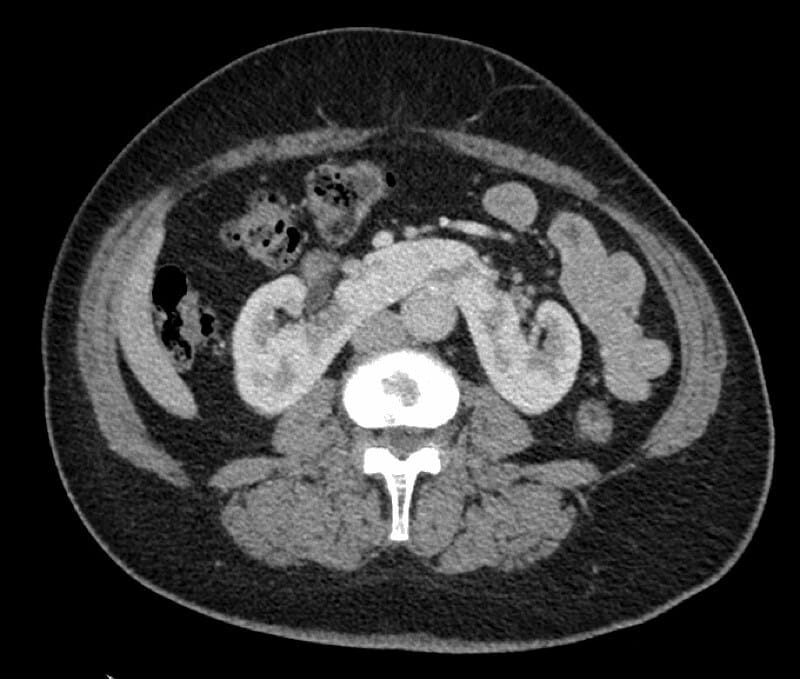
This is an axial CT image showing a horseshoe kidney, characterized by fusion of the lower poles of both kidneys across the midline anterior to the aorta.
- Clinical: Usually discovered incidentally at any age; no sex predilection; may present with abdominal pain, urinary tract infections, hematuria, or palpable mass; congenital anomaly from fetal development
- Etiology/Pathophys: Congenital fusion anomaly caused by abnormal migration and fusion of the lower renal poles across midline anterior to aorta during embryogenesis; isthmus composed of functioning parenchyma or fibrous tissue
- Radiograph: Soft tissue mass on either side of midline with central isthmus visible; kidneys oriented with lower poles medially (reverse rotation); possible visualization of altered renal axis and ectopic location lower in abdomen
- US: Fusion of lower poles forming a midline isthmus anterior to aorta; abnormal renal orientation with inferior and medial displacement; isthmus seen as renal parenchyma anterior to aorta; may be confused with retroperitoneal masses if unrecognized; scanning supine with multiple positions recommended for optimal visualization
- CT: Demonstrates fused lower poles across midline with enhancing renal parenchyma isthmus anterior to aorta; abnormal kidney orientation with medial lower poles; excretory phase shows malrotated pelvicalyceal systems; possible identification of accessory vessels and assessment of complications like PUJ obstruction, stones
- MRI: Similar to CT with clear depiction of fused renal parenchyma across midline and malrotated collecting systems; useful in patients needing radiation avoidance or contrast contraindication; can evaluate surrounding vascular anatomy
- Nuc Med: Radionuclide renal scans detect differential function between moieties; useful for assessing obstruction versus dilation; helps diagnose ureteropelvic junction (UPJ) obstruction and monitor renal function
- Signs: Isthmus sign—renal tissue band crossing the midline anterior to the aorta; Reverse renal rotation—lower poles oriented medially rather than laterally; abnormal renal axis and low position in abdomen
- Frameworks: No formal classification; assessment focuses on anatomy, renal function, and presence of complications such as PUJ obstruction or reflux for management decisions
- DDx: Midline retroperitoneal masses (lymphoma, metastatic nodes) distinguished by lack of continuous renal tissue; solitary ectopic kidney (no isthmus); duplex kidney (no fusion); renal neoplasm in horseshoe kidney distinguished by mass characteristics on imaging
- Tx: Usually no treatment for asymptomatic cases; management of complications including obstruction, stones, infections as per standard protocols; surgical intervention for PUJ obstruction or trauma; recognition important before abdominal surgery or interventions to avoid vascular/structural injury

Improve Content And Help Your Colleagues!
Found an error in the post? Please let us know using our contact page and we will update it with due credits!
If you wish to contribute radiological images for this case (or any other article on the website), you can submit them here and you will be duly credited: Submit radiology case