


Adenomyomatosis of the gallbladder is a benign, acquired hyperplastic change in which proliferating mucosal epithelium invaginates into a thickened muscularis to form intramural diverticula, the Rokitansky-Aschoff sinuses. It is one of the commonest causes of non-inflammatory gallbladder wall thickening, and recognising it on ultrasound matters because the alternative on the differential list is gallbladder carcinoma. The diagnostic currency is the intramural cyst: echogenic intramural foci with V-shaped comet-tail artefacts and a twinkling artefact on ultrasound, the rosary and cotton ball signs on CT, and the pearl necklace sign on T2-weighted MRI. When those features are typical, no follow-up imaging and no surgery are needed.
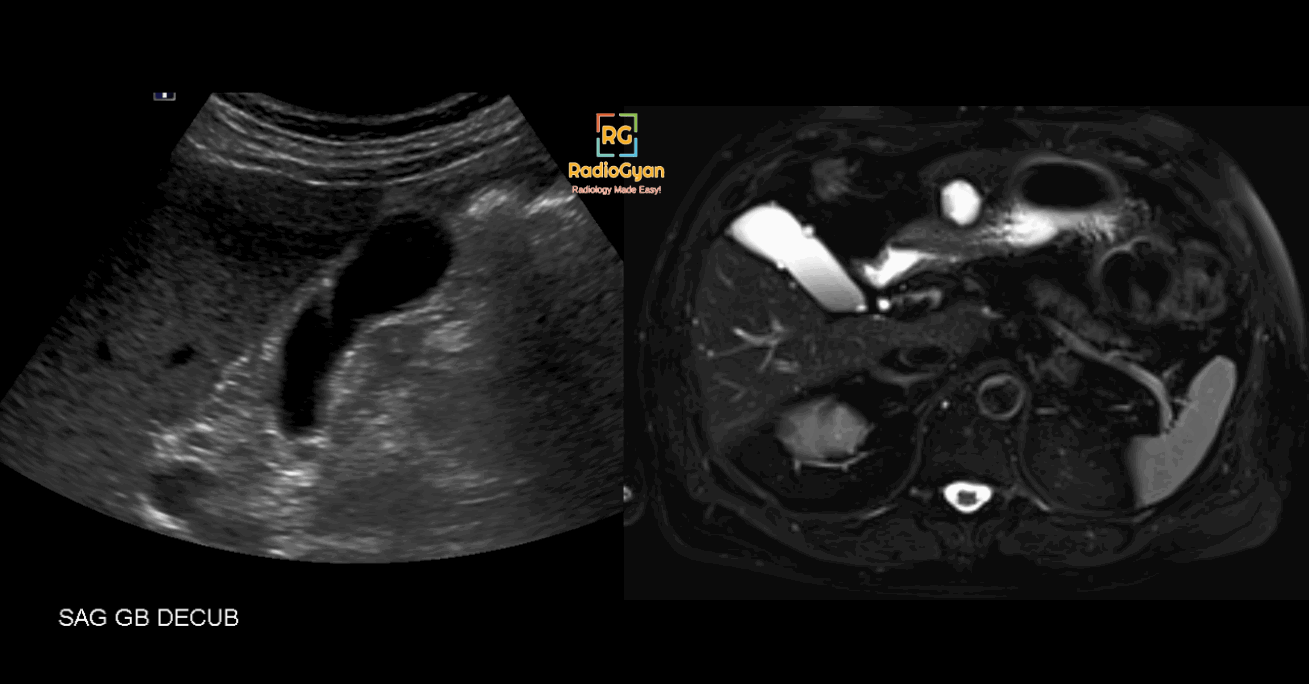
Gallbladder adenomyomatosis at a glance
| Feature | Detail |
|---|---|
| Definition | Benign hyperplasia of gallbladder mucosa plus muscularis with intramural diverticula (Rokitansky-Aschoff sinuses) |
| Synonyms | Adenomyomatous hyperplasia, hyperplastic cholecystosis, gallbladder adenomyoma (focal form) |
| Prevalence | About 1 to 9 percent of cholecystectomy specimens; 1.2 percent of an unselected Western ultrasound cohort |
| Typical patient | Middle-aged or older adult, mean age around 60 years, slight female predominance |
| Symptoms | Usually incidental and asymptomatic; may cause biliary-type pain or dyspepsia |
| Gallstones | Coexist in about one third of ultrasound-detected cases and in most surgical series |
| Best test | Transabdominal ultrasound with a high-frequency transducer; accuracy about 91 to 95 percent |
| Problem-solving test | MRI with heavily T2-weighted sequences; CT is the least reliable modality |
| Malignant potential | Not premalignant; adenomyomatosis does not exclude a coexisting carcinoma |
| Management | No follow-up for typical features; cholecystectomy if symptomatic or if malignancy cannot be excluded |
Quiz
Which of the following signs is NOT seen in gallbladder adenomyomatosis?
- Rosary bead sign
- Comet-tail artefact
- Pearl necklace sign
- None of the above
Answer: None of the above.

Pathophysiology: why Rokitansky-Aschoff sinuses form
Chronically raised intraluminal pressure, most often from impaired gallbladder emptying, drives hyperplasia of the surface epithelium together with hypertrophy of the muscularis propria. The proliferating epithelium herniates through the thickened muscle layer as blind-ending intramural diverticula, the Rokitansky-Aschoff sinuses. Bile stagnates inside these sinuses, cholesterol crystals and microliths precipitate, and it is this crystalline content, not the epithelium itself, that produces almost every imaging sign of the disease.
- Dilated Rokitansky-Aschoff sinuses filled with fluid produce the anechoic intramural cysts on ultrasound and the T2-bright cysts on MRI.
- Sinuses filled with cholesterol crystals or microliths produce echogenic intramural foci, comet-tail artefacts and the twinkling artefact.
- The hypertrophied, poorly enhancing muscle coat surrounding the enhancing mucosal invaginations produces the rosary and cotton ball signs on contrast-enhanced CT.
- Because the process is mucosal and muscular rather than invasive, the gallbladder wall keeps its layered architecture and the interface with the liver remains sharp.
Types of gallbladder adenomyomatosis
Three morphological patterns are described. The distinction is worth making in the report because the segmental form is the only one with a reported association with gallbladder carcinoma, and because a segmental hourglass gallbladder is the pattern most often mistaken for malignancy.
| Subtype | Morphology | Frequency on ultrasound | Practical point |
|---|---|---|---|
| Fundal (focal, adenomyoma) | Focal fundal wall thickening, often a rounded mural nodule with intramural cysts | About 44 percent | Commonest incidental form; no reported increase in cancer risk |
| Segmental (annular, hourglass) | Circumferential thickening of a mid-body segment producing an hourglass gallbladder with a separate fundal compartment | About 9 percent | Distal compartment often contains calculi; associated with carcinoma in older Japanese surgical series |
| Diffuse (generalised) | Wall thickening involving the whole gallbladder with scattered intramural diverticula | About 47 percent | Can closely mimic chronic cholecystitis and diffusely infiltrating carcinoma |
Ultrasound features of adenomyomatosis
Transabdominal ultrasound is the imaging modality of choice, with a reported accuracy of about 91 to 95 percent. Scan the thickened segment with the highest frequency transducer that reaches it: the intramural cysts that make the diagnosis are often 1 to 3 mm and are simply not resolved at 3.5 MHz.
| Finding | What you see | Why it happens |
|---|---|---|
| Intramural cysts | Tiny anechoic spaces of 1 to 10 mm inside a thickened wall | Dilated Rokitansky-Aschoff sinuses filled with bile |
| Echogenic intramural foci | Bright punctate foci within the wall, not in the lumen | Cholesterol crystals and microliths inside the sinuses |
| Comet-tail artefact | Short, V-shaped, tapering echogenic band that widens away from the transducer | Reverberation between closely spaced crystal interfaces |
| Twinkling artefact | Rapidly alternating red and blue Doppler signal behind the echogenic foci | Phase noise from a rough crystalline reflector on colour Doppler |
| Preserved wall layering | Thickened but stratified wall with a smooth mucosal contour | Hyperplasia rather than infiltration |
| Sharp liver interface | Clean plane between gallbladder fossa and adjacent liver | No transmural invasion |
| Hourglass deformity | Circumferential mid-body waist separating two compartments | Segmental subtype |
The single most useful negative finding is the absence of internal vascularity. Colour or power Doppler flow within the thickened wall was detected in only about 20 percent of focal adenomyomatosis compared with about 59 percent of gallbladder carcinomas in one contrast-enhanced ultrasound series.
Contrast-enhanced ultrasound when the wall is indeterminate
Contrast-enhanced ultrasound is not routine. The 2025 Korean Society of Abdominal Radiology recommendations position it as optional, to be considered when the greyscale study is inconclusive and CT or MRI are unavailable or contraindicated. When it is performed, the discriminator is the integrity of the gallbladder wall: an intact wall was seen in about 81 percent of focal adenomyomatosis versus about 18 percent of gallbladder cancers, and unenhanced intramural anechoic spaces corresponding to Rokitansky-Aschoff sinuses were seen in about 56 percent of adenomyomatosis versus about 21 percent of cancers.
CT features: rosary sign and cotton ball sign
CT is the weakest modality for this diagnosis, with reported accuracy between about 40 and 75 percent, because sub-centimetre intramural cysts fall below the practical contrast resolution of the study. When adenomyomatosis is visible on CT it is on the portal venous phase, and it takes one of two forms.
| CT sign | Appearance | Reported frequency in proven adenomyomatosis |
|---|---|---|
| Rosary sign | A row of enhancing mucosal epithelium within intramural diverticula, surrounded by the poorly enhancing hypertrophied muscle coat | Classic but insensitive; requires resolvable cysts |
| Cotton ball sign | Fuzzy grey dots within the thickened wall, or a dotted outer border of the inner enhancing layer | 74 percent (25 of 34 patients) |
| Smooth mucosal contour with double-layer enhancement | Inner enhancing mucosa and outer hypoattenuating muscle, enhancing less than renal cortex | Independent predictor of benign wall thickening |
In that study the cotton ball sign separated adenomyomatosis from malignant and premalignant wall thickening with an accuracy of 81 percent, higher than the 74 percent achieved by the pearl necklace sign on MRI in the same patients. If you read a CT reported as non-specific gallbladder wall thickening, look specifically for fuzzy grey dots before recommending further imaging.
MRI features: the pearl necklace sign
MRI is the best problem-solving test, with a reported accuracy of about 93 percent. Heavily T2-weighted sequences, including single-shot fast spin echo and thin-section MRCP source images, exploit the fluid content of the Rokitansky-Aschoff sinuses.
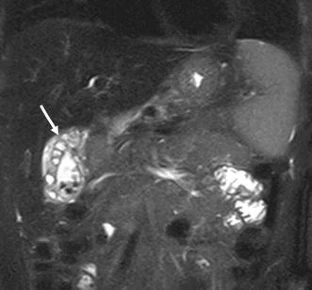
- Pearl necklace sign: a curvilinear string of rounded, markedly T2-hyperintense intramural cysts in the thickened wall. Highly specific, but present in only about 44 percent of proven cases, so its absence never excludes the diagnosis.
- Rokitansky-Aschoff sinuses are T2-hyperintense and T1-hypointense, and they do not enhance.
- On dynamic contrast-enhanced imaging the mucosal layer enhances early while the intramural cysts remain signal-void, giving the same double-layer pattern seen on CT.
- On diffusion-weighted imaging adenomyomatosis does not restrict diffusion. Restricted diffusion in a thickened gallbladder wall should raise concern for carcinoma, although reported cases of intracholecystic papillary neoplasm without restriction mean DWI cannot be used alone.
- MRCP is worth reviewing for an anomalous pancreaticobiliary junction, which is itself a risk factor for gallbladder carcinoma and changes surgical thinking.
Where adenomyomatosis sits in GB-RADS
The Gallbladder Reporting and Data System, published as an international expert consensus in 2022, standardises the ultrasound description of gallbladder wall thickening in the non-acute setting. Typical adenomyomatosis is a GB-RADS 2 finding: symmetric or focal thickening with intramural features, a layered appearance and a clear interface with the liver, carrying a malignancy risk under 2 percent.
| Category | Ultrasound criteria | Malignancy risk |
|---|---|---|
| GB-RADS 0 | Not evaluable: obesity, poor window, porcelain gallbladder, luminal gas | Cannot be assessed |
| GB-RADS 1 | Normal, adequately distended gallbladder, wall 3 mm or less | Normal |
| GB-RADS 2 | Symmetric circumferential thickening with or without intramural features, or focal thickening with intramural features; layered appearance; clear liver interface | Under 2 percent (benign) |
| GB-RADS 3 | Circumferential thickening without layering, no intramural features, clear liver interface | 2 to 50 percent (indeterminate) |
| GB-RADS 4 | Asymmetric circumferential or focal thickening without layering, with a vague or lost liver interface | 50 to 90 percent (probably malignant) |
| GB-RADS 5 | GB-RADS 4 features plus definite liver or extrahepatic invasion, biliary or vascular involvement, or an adjacent liver mass | Over 90 percent |
Two caveats. GB-RADS applies to the non-acute setting, so it is not the framework for a tender gallbladder with pericholecystic fluid. And the intramural features that place a gallbladder in category 2 are precisely the Rokitansky-Aschoff sinuses of adenomyomatosis, so confidently identifying them is what keeps a patient out of an unnecessary cholecystectomy.
Adenomyomatosis versus its mimics
| Diagnosis | Discriminating features | Wall layering | Liver interface |
|---|---|---|---|
| Gallbladder adenomyomatosis | Intramural cysts, echogenic foci, comet-tail and twinkling artefacts, avascular wall | Preserved | Sharp |
| Gallbladder carcinoma | Asymmetric irregular thickening, focal solid hypervascular mass, restricted diffusion, lymphadenopathy, biliary obstruction | Lost | Lost or infiltrated |
| Xanthogranulomatous cholecystitis | Intramural hypoattenuating or T2-hyperintense nodules, continuous mucosal line, marked pericholecystic inflammation, no comet-tail artefact | Often preserved but disrupted focally | Often blurred, a major pitfall |
| Chronic cholecystitis | Contracted gallbladder, uniform thin-to-moderate wall thickening, calculi, no intramural cysts | Preserved | Sharp |
| Acute cholecystitis | Distended gallbladder, striated oedematous wall, pericholecystic fluid, sonographic Murphy sign, impacted neck stone | Striated | Blurred by oedema |
| Cholesterolosis and cholesterol polyps | Non-shadowing echogenic luminal polyps under 10 mm, sometimes with comet-tail artefact, arising from the mucosa rather than within the wall | Preserved | Sharp |
| Intracholecystic papillary neoplasm | Papillary intraluminal mass with a fibrovascular core; reported to mimic dilated Rokitansky-Aschoff sinuses | Variable | Usually preserved until invasive |
| Wall thickening from systemic causes | Hypoalbuminaemia, heart failure, cirrhosis, hepatitis; striated non-distended wall, ascites, no intramural cysts | Striated | Sharp |
The two traps worth memorising are xanthogranulomatous cholecystitis, whose intramural nodules can be mistaken for Rokitansky-Aschoff sinuses but never generate comet-tail artefacts, and an intracholecystic papillary neoplasm, which has been reported to produce cyst-like intramural spaces indistinguishable from adenomyomatosis on cross-sectional imaging.
Does adenomyomatosis cause gallbladder cancer?
Adenomyomatosis is not classified as a premalignant lesion, and no current guideline recommends prophylactic cholecystectomy for it. The debate is confined to the segmental subtype, and it rests on two older Japanese surgical series.
- Ootani and colleagues found gallbladder carcinoma in 12 of 188 patients with segmental adenomyomatosis, or 6.4 percent, significantly higher than in patients without it. Tumours arose in the fundal compartment distal to the annular stricture.
- Nabatame and colleagues found carcinoma in 22 of 334 patients with segmental adenomyomatosis, or 6.6 percent, versus 181 of 4226 without it, or 4.3 percent, with the excess concentrated in elderly patients.
- Neither series demonstrated malignant transformation of adenomyomatosis itself. The favoured explanation is chronic mucosal inflammation and bile stasis in the obstructed distal compartment, the same mechanism that links gallstones to gallbladder cancer.
- Contemporary Western cohorts have not reproduced a meaningful excess risk. In a 2026 series of 2674 unselected patients only one adenomyomatosis patient required surgery, for symptoms rather than for suspicion of cancer.
The clinically useful formulation, and the one stated explicitly in the 2025 Korean Society of Abdominal Radiology recommendations, is that the presence of adenomyomatosis does not preclude coexisting gallbladder cancer. Diagnose the adenomyomatosis, then look separately at every focal solid area, every zone of lost layering and every hypervascular nodule.
Management and follow-up
| Scenario | Recommended action |
|---|---|
| Typical adenomyomatosis, asymptomatic | No imaging follow-up required and no surgery |
| Adenomyomatosis and carcinoma cannot be confidently separated | Follow-up with ultrasound, CT or MRI; endoscopic ultrasound is an acceptable alternative |
| Indeterminate gallbladder wall thickening | Repeat ultrasound at 3 to 6 months, or cross-sectional imaging depending on individual malignancy risk |
| Inconclusive ultrasound or a limited acoustic window | CT or MRI; high-frequency transducer imaging first if the gallbladder is superficial |
| Symptomatic disease: biliary colic or dyspepsia attributable to the gallbladder | Laparoscopic cholecystectomy |
| Coexisting anomalous pancreaticobiliary junction | Surgical referral, independent of the adenomyomatosis |
| Any suspicion of malignancy that imaging cannot resolve | Cholecystectomy, with an oncological operation planned if cancer is likely |
The Korean recommendations also formalise the threshold that most reports use loosely: wall thickening of 3 to 4 mm is equivocal, while 5 mm or more, or localised thickening over 3 mm, is definite gallbladder wall thickening. Those numbers describe the degree of thickening, not the risk of malignancy, which is what GB-RADS is for.
How to report gallbladder adenomyomatosis
A useful report answers three questions: is this adenomyomatosis, is it the segmental subtype, and is there anything in the gallbladder that adenomyomatosis does not explain.
- State the subtype and location: fundal, segmental or diffuse, and the segment involved.
- Give the maximum wall thickness in millimetres and say whether layering is preserved.
- Name the finding that made the diagnosis: intramural cysts, echogenic foci with comet-tail artefact, twinkling artefact, pearl necklace sign or cotton ball sign.
- State that the interface with the liver is maintained and that no focal hypervascular soft-tissue nodule is present.
- Record coexisting calculi, particularly calculi trapped in the fundal compartment of a segmental adenomyomatosis.
- Assign a GB-RADS category if your department uses it.
- Close with the management statement so the referrer does not order a follow-up scan by reflex.
Sample impression: Focal fundal gallbladder wall thickening measuring 8 mm, containing anechoic intramural cysts and echogenic foci with comet-tail artefacts and a twinkling artefact on colour Doppler. Wall layering is preserved, the interface with the adjacent liver is maintained and there is no focal vascularised mural nodule. Findings are typical of fundal adenomyomatosis (GB-RADS 2). No imaging follow-up is required.
Clinical features and treatment
- Most patients are asymptomatic and the finding is incidental on an ultrasound performed for another reason.
- When symptoms occur they are biliary-type right upper quadrant pain or postprandial dyspepsia, frequently confounded by coexisting gallstones.
- Gallstones coexist in about a third of ultrasound-detected cases and in the majority of surgically resected specimens.
- Adenomyomatosis is rare in children, in whom the diffuse form predominates and cholecystectomy is usually performed for symptoms.
- Laparoscopic cholecystectomy is curative when the gallbladder is genuinely the source of symptoms. Asymptomatic disease is left alone.
Etymology and synonyms
- Adeno, gland; myo, muscle; matosis, a condition of diffuse formation. The name describes glandular tissue within hypertrophied muscle.
- Also called adenomyomatous hyperplasia and hyperplastic cholecystosis. The focal fundal form is often called a gallbladder adenomyoma.
- Rokitansky-Aschoff sinuses are named after Carl von Rokitansky, who described them in 1842, and Ludwig Aschoff, who characterised them in 1905.
- Gallbladder adenomyosis is a frequent misnomer. Adenomyosis is a uterine disease.
Related reading on RadioGyan
- Gallbladder polyp follow-up calculator based on the SRU consensus guidelines, for the intraluminal counterpart of this problem.
- Radiology case of the day 52, a worked adenomyomatosis case with ultrasound and MRI correlation.
- Normal radiology measurements, including normal gallbladder wall thickness.
- Radiology signs index, for the comet-tail, pearl necklace and rosary signs alongside the rest.
Frequently asked questions
References
- Lee KF, Hung EHY, Leung HHW, Lai PBS. A narrative review of gallbladder adenomyomatosis: what we need to know. Ann Transl Med. 2020;8(23):1600. PMID: 33437799.
- Golse N, Lewin M, Rode A, Sebagh M, Mabrut JY. Gallbladder adenomyomatosis: diagnosis and management. J Visc Surg. 2017;154(5):345-353. PMID: 28844704.
- Gupta P, Dutta U, Rana P, et al. Gallbladder reporting and data system (GB-RADS) for risk stratification of gallbladder wall thickening on ultrasonography: an international expert consensus. Abdom Radiol (NY). 2022;47(2):554-565. PMID: 34851429.
- Chang W, Lee S, Kim YY, et al. Interpretation, reporting, imaging-based workups, and surveillance of incidentally detected gallbladder polyps and gallbladder wall thickening: 2025 recommendations from the Korean Society of Abdominal Radiology. Korean J Radiol. 2025;26(2):102-134. PMID: 39898393.
- Yang HK, Lee JM, Yu MH, et al. CT diagnosis of gallbladder adenomyomatosis: importance of enhancing mucosal epithelium, the cotton ball sign. Eur Radiol. 2018;28(9):3573-3582. PMID: 29633001.
- Yu MH, Kim YJ, Park HS, Jung SI. Benign gallbladder diseases: imaging techniques and tips for differentiating with malignant gallbladder diseases. World J Gastroenterol. 2020;26(22):2967-2986. PMID: 32587442.
- Neumann M, Kallenbach M, Morgera U, et al. Differentiation of gallbladder adenomyomatosis and polyps in a Western cohort: prevalence, ultrasound characteristics, and diagnostic challenges. JGH Open. 2026;10(1):e70343. PMID: 41567859.
- Ootani T, Shirai Y, Tsukada K, Muto T. Relationship between gallbladder carcinoma and the segmental type of adenomyomatosis of the gallbladder. Cancer. 1992;69(11):2647-2652. PMID: 1571894.
- Nabatame N, Shirai Y, Nishimura A, Yokoyama N, Wakai T, Hatakeyama K. High risk of gallbladder carcinoma in elderly patients with segmental adenomyomatosis of the gallbladder. J Exp Clin Cancer Res. 2004;23(4):593-598. PMID: 15743029.
- Yuan HX, Wang WP, Guan PS, et al. Contrast-enhanced ultrasonography in differential diagnosis of focal gallbladder adenomyomatosis and gallbladder cancer. Clin Hemorheol Microcirc. 2018;70(2):201-211. PMID: 29630529.
- Jenssen C, Lorentzen T, Dietrich CF, et al. Incidental findings of gallbladder and bile ducts, management strategies: general aspects, gallbladder polyps and gallbladder wall thickening. A World Federation of Ultrasound in Medicine and Biology (WFUMB) position paper. Ultrasound Med Biol. 2022;48(12):2355-2378. PMID: 36058799.
- Bonatti M, Vezzali N, Lombardo F, et al. Gallbladder adenomyomatosis: imaging findings, tricks and pitfalls. Insights Imaging. 2017;8(2):243-253. PMID: 28127678.

Improve Content And Help Your Colleagues!
Found an error in the post? Please let us know using our contact page and we will update it with due credits!
If you wish to contribute radiological images for this case (or any other article on the website), you can submit them here and you will be duly credited: Submit radiology case