


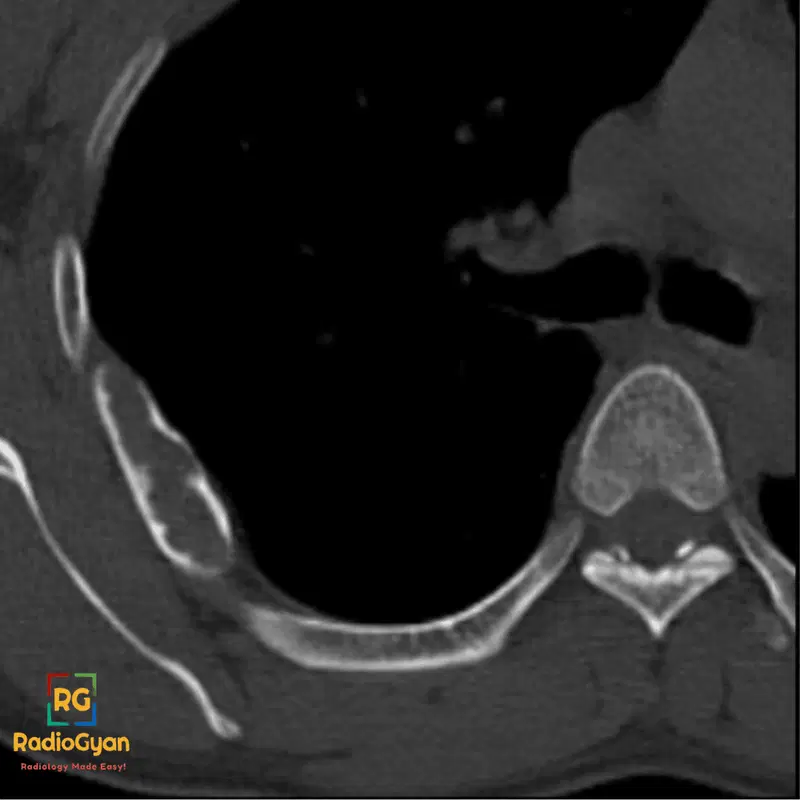
Fibrous Dysplasia – Radiology Board Review
- Clinical: Affects children and young adults; no sex predilection; usually asymptomatic or presents with localized pain or swelling; ribs are common site of monostotic fibrous dysplasia; etiology from abnormal bone maturation
- Etiology/Pathophys: Noninherited disorder with abnormal differentiation of osteoblasts causing replacement of normal bone and marrow by immature woven bone and fibrous stroma
- Radiograph: Lesions display ground-glass matrix, well-defined borders, cortical thinning with maintained smooth outer cortex, expansile remodeling of rib, possible bubbly or cystic lucency, no periosteal reaction unless fracture present
- CT: Intramedullary expansile lesion with ground-glass opacity, cortical thinning or endosteal scalloping, well-defined margins, no soft-tissue mass, may show expansion and possible fusiform rib enlargement
- MRI: Typically low to intermediate T1 signal, intermediate to high T2 signal, heterogeneous enhancement post-gadolinium; low T2 signal may help differentiate from other lesions in ribs
- Nuc Med: Increased nonspecific radiotracer uptake on bone scan reflecting active bone remodeling
- Signs: Ground-glass sign: homogenous hazy bone matrix; Rind sign: thick sclerotic margin in some lesions, especially in long bones but less common in ribs
- Frameworks: Classification into monostotic (single bone) versus polyostotic forms; associated syndromes include McCune-Albright and Mazabraud syndromes
- DDx: Enchondroma (chondroid calcifications), aneurysmal bone cyst (fluid levels), metastasis (aggressive features, soft-tissue mass), osteofibrous dysplasia (typically tibia), rib hemangioma (vascular channels)
- Tx: Observation if asymptomatic; surgical curettage or resection for symptomatic lesions or fracture risk; bisphosphonates may reduce bone pain and turnover

Improve Content And Help Your Colleagues!
Found an error in the post? Please let us know using our contact page and we will update it with due credits!
If you wish to contribute radiological images for this case (or any other article on the website), you can submit them here and you will be duly credited: Submit radiology case