


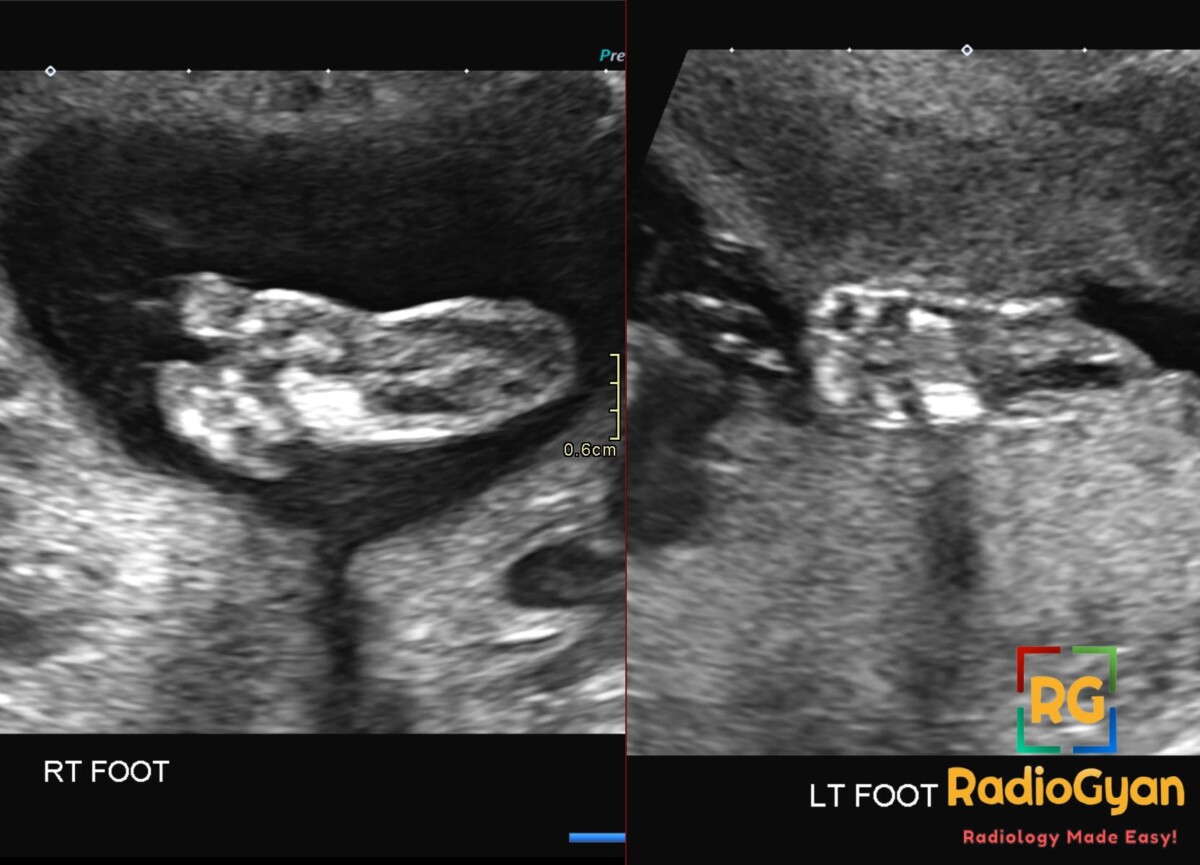
Pregnant female with negative first-trimester screening presenting for routine prenatal evaluation. What is your diagnosis?
Diagnosis and teaching points:
Diagnosis: Unilateral sandal gap deformity of the fetal foot. Isolated finding. Negative first-trimester screening.
Key facts for board exams:
- Sandal gap is a widened first interdigital space between the hallux and second toe, caused by medial displacement of the great toe.
- It is a nonspecific soft marker for trisomy 21. About 45% of children with Down syndrome have it, but that figure is not the predictive value of the ultrasound finding.
- Reimage the foot at rest to confirm the gap persists. A single image can overcall a fixed deformity.
- Calling the finding “isolated” requires a detailed anatomic survey showing no structural anomaly, no growth restriction and no second soft marker.
- After a negative serum or cfDNA screen, an isolated soft marker alone does not justify diagnostic aneuploidy testing.
Detailed teaching points:
- Clinical: Seen both prenatally and in newborns. It is often a normal familial variant. Rare reported associations include triploidy, CLOVES/PIK3CA-related overgrowth and pycnodysostosis. When isolated, it has no functional consequence and a good prognosis.
- US: A plantar view shows the hallux-to-second-toe separation directly. Record laterality and count all digits. Look for short rays, clefting or extra digits, which change the significance of the finding.
- Signs: Sandal gap toe – a descriptive term, not an eponym, comparing the first web space to the opening of a sandal. Do not use it interchangeably with hallux varus, which is a fixed orthopedic deformity.
- DDx: Transient toe abduction – the gap disappears when the foot is at rest. Trisomy 18 first-toe abduction – short first metatarsal plus other fetal anomalies. Ectrodactyly – central cleft with missing rays. Polydactyly – abnormal digit number rather than simple widened spacing.
- Tx: No treatment, serial imaging or fetal echocardiography is needed for the isolated finding. A negative screen lowers risk but does not exclude aneuploidy. Counseling should weigh the specific screening test, prior risk and patient preference. Further workup depends only on associated anomalies.
OSCE Questions
Question: Which aneuploidy is most classically associated with this soft marker?
Trisomy 21, though the finding is nonspecific and is common in normal fetuses.
Question: Which ultrasound plane best demonstrates this finding?
A plantar view of the fetal foot, showing a widened space between the hallux and second toe.
Question: What transient positional fetal finding most commonly mimics this condition?
Transient toe abduction or flaring, excluded by confirming the gap persists with the foot at rest.
Question: Is invasive diagnostic testing indicated for this isolated marker after negative screening?
No, diagnostic testing is not recommended solely for an isolated soft marker after a negative screen.
Question: What postnatal treatment does this isolated finding require?
None, because an isolated gap is a benign spacing variant with a good prognosis.
MCQ Questions
1. On fetal ultrasound, which morphologic finding defines sandal-gap deformity of the foot?
A. Fusion of second and third toes
B. Medial displacement of the great toe
C. Absence of central metatarsal rays
D. Lateral deviation of the fifth toe
Answer: B. Medial displacement of the great toe. Sandal gap is a widened first interdigital space between the hallux and second toe, classically from medial hallux displacement, and a plantar view shows it directly.
2. When a unilateral sandal gap is suspected on fetal ultrasound, which technique best avoids overcalling the finding?
A. Color Doppler of digital arteries
B. Fetal MRI with T2-weighted sequences
C. Three-view fetal radiographs
D. Reimaging the foot at rest
Answer: D. Reimaging the foot at rest. Transient fetal toe abduction or flaring can mimic a gap, so the foot should be observed at rest to confirm the gap persists.
3. Which sonographic feature best distinguishes ectrodactyly (split foot) from sandal-gap deformity?
A. Cleft with absent central rays
B. Widened first interdigital space
C. Medially displaced hallux
D. Gap disappearing with toe movement
Answer: A. Cleft with absent central rays. Ectrodactyly changes digit and ray number and has a central cleft, whereas sandal gap is simple widening of the first web space with all digits present.
4. Under SMFM criteria, a sandal gap counts as an isolated soft marker only when detailed ultrasound shows what?
A. Gap persisting on two separate scans
B. Bilateral symmetric first web spaces
C. No structural anomaly, FGR, or other marker
D. Normal first-trimester nuchal translucency
Answer: C. No structural anomaly, FGR, or other marker. SMFM defines an isolated soft marker as one with no structural anomaly, no growth restriction, and no second soft marker after a detailed obstetric ultrasound.
5. Which accompanying sonographic foot finding suggests trisomy 18-associated toe abduction rather than an isolated sandal gap?
A. Normal toe count
B. Short metatarsal
C. Gap resolving at rest
D. Unilateral gap with intact rays
Answer: B. Short metatarsal. First-toe abduction with a short metatarsal has been described in trisomy 18, so this finding points to a broader anomaly pattern rather than isolated toe spacing.
Check out more such cases:




Improve Content And Help Your Colleagues!
Found an error in the post? Please let us know using our contact page and we will update it with due credits!
If you wish to contribute radiological images for this case (or any other article on the website), you can submit them here and you will be duly credited: Submit radiology case