


What causes the Vessel through Strait sign on contrast-enhanced CT and CT angiography?
Let me know in the comments.
Click to reveal the answer
Answer:
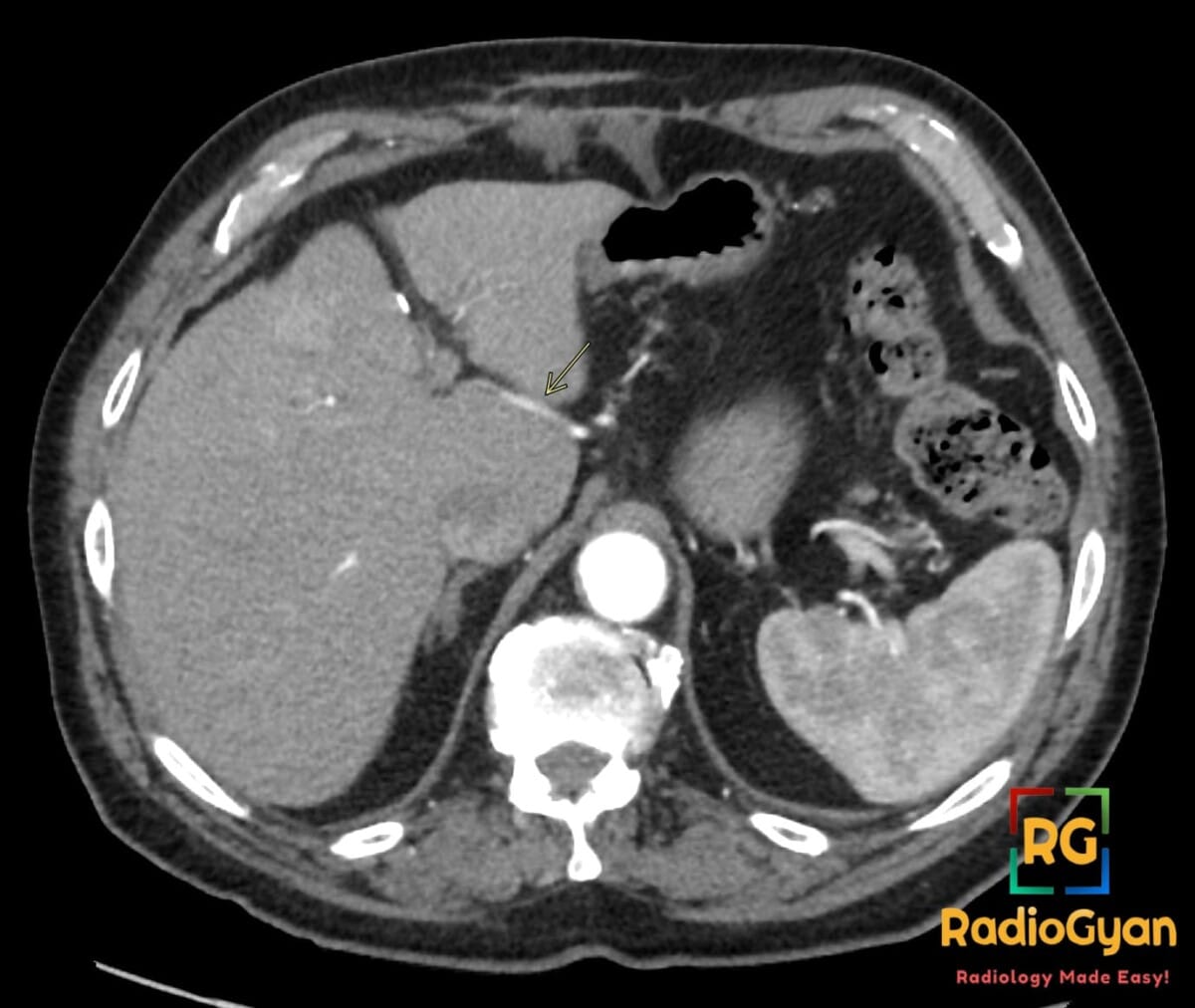
The Vessel through Strait sign is an artery seen coursing through the fissure for the ligamentum venosum, the narrow strait between hepatic segments I and II, where no artery normally runs. Its presence indicates a replaced or accessory left hepatic artery arising from the left gastric artery, which reaches the liver through the lesser omentum and enters the fissure rather than travelling in the hepatoduodenal ligament. In the original series the sign was highly accurate for this variant, with sensitivity and specificity reported above 96% and 98%. Such variants correspond to Michels types II, IV, V, VII, VIII and X and occur in roughly 15-20% of people. The surgical importance is substantial: during gastrectomy with D2 nodal dissection the left gastric artery is routinely divided, and inadvertent division of a replaced left hepatic artery can produce left lobe ischaemia or hepatic dysfunction; in living-donor and deceased-donor liver transplantation, failure to recognise the variant risks incomplete graft arterialisation and biliary necrosis. Preoperative CT angiography is standard for mapping the anatomy.
Why is it called so?
The vessel is seen sailing through the narrow strait formed by the fissure for the ligamentum venosum, between the caudate lobe and the left lateral section.
Pathophysiology
The embryonic liver is supplied by three arteries: left gastric, coeliac and superior mesenteric. Normal development retains the coeliac contribution and regresses the others, but persistence of the left gastric arterial supply leaves a replaced left hepatic artery, in which the whole left lobe is fed from the left gastric artery, or an accessory one, in which it supplements a normal left hepatic artery. Because that vessel approaches from the lesser curve through the lesser omentum, its anatomical route into the liver is the fissure for the ligamentum venosum, which carries the remnant of the ductus venosus and the lesser omental attachment, rather than the porta hepatis. An artery within that fissure is therefore, by its course alone, diagnostic of the variant.
Alternative names: VTSS, vessel through the strait sign
Other associated named signs: Hepatic artery variants of the Michels classification, and the hot quadrate lobe sign as a separate variant-related hepatic finding
References
Access all radiology signs posted so far: https://radiogyan.com/radiology-signs/

Improve Content And Help Your Colleagues!
Found an error in the post? Please let us know using our contact page and we will update it with due credits!
If you wish to contribute radiological images for this case (or any other article on the website), you can submit them here and you will be duly credited: Submit radiology case