


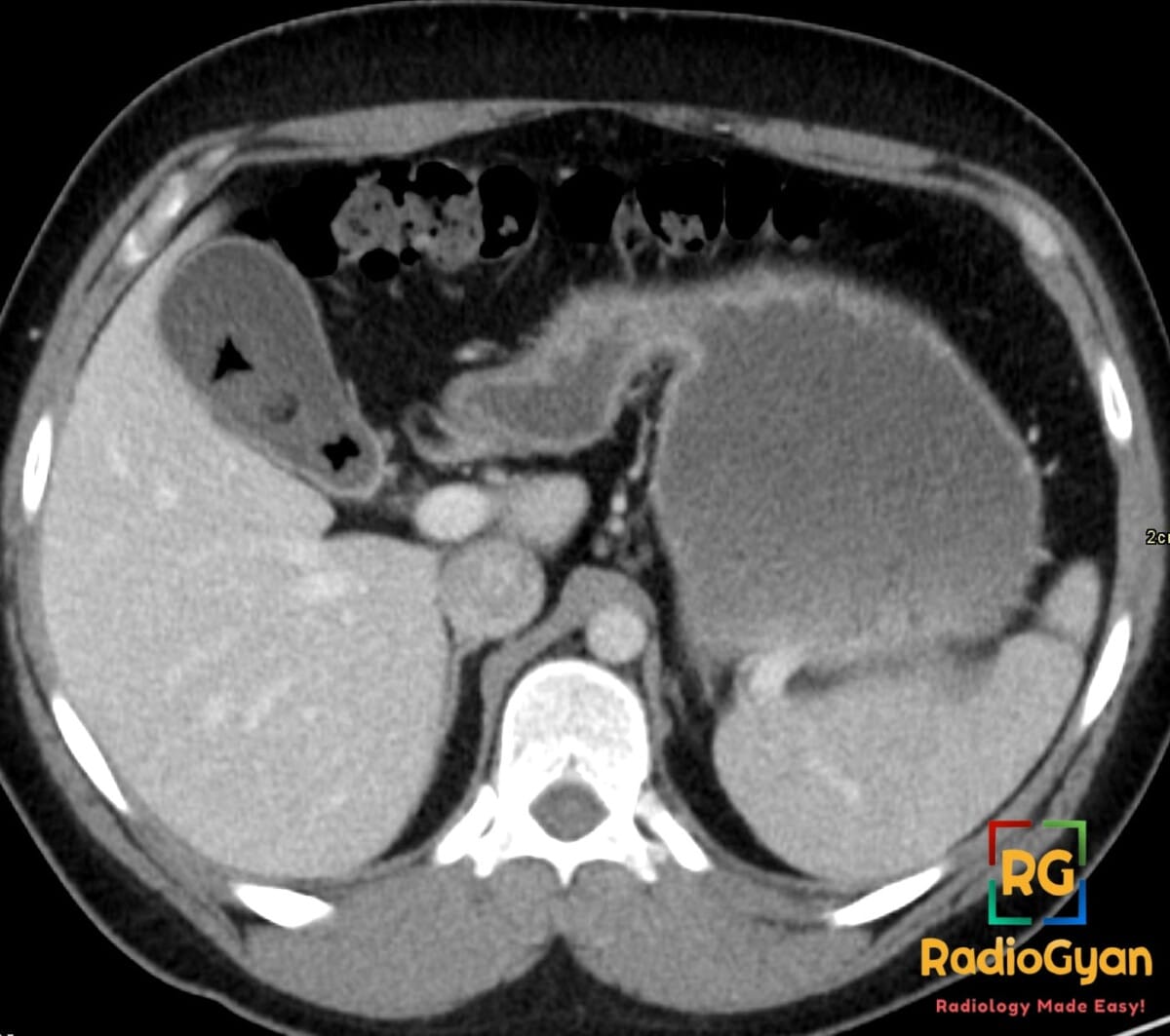
What causes the Mercedes-Benz sign on abdominal radiography and CT?
Let me know in the comments.
Click to reveal the answer
Answer:
The Mercedes-Benz sign is a triradiate, star-shaped pattern of radiolucent gas-filled fissures within a gallstone, reproducing the three-pointed emblem of the car marque. Older names for the same appearance are the crow’s foot and star-shaped sign. If the beam is not aligned with the long axis of the stone, only one limb of the triradiate cleft may be projected, which is called the seagull sign. The gas within the fissures is predominantly nitrogen, with small amounts of carbon dioxide and negligible oxygen. It is characteristic of cholesterol stones, though only a minority contain gas, and it is far better shown on CT than on the radiograph. Its practical importance is twofold: it confirms that a calcified or gas-containing right upper quadrant density is a gallstone rather than gas in the biliary tree or bowel, and it should not be mistaken for emphysematous cholecystitis, in which gas lies in the gallbladder wall or lumen rather than in discrete radiating clefts within a stone.
Why is it called so?
The three radiating gas-filled clefts within the stone reproduce the three-pointed star of the Mercedes-Benz badge.
Pathophysiology
As a cholesterol gallstone matures, its centre dehydrates and the crystalline cholesterol contracts, so shrinkage clefts open up radially from the core. These clefts are sealed low-pressure voids within a solid stone. Dissolved gases in the surrounding bile, chiefly nitrogen, diffuse down the pressure gradient into these voids and accumulate there, and bacterial decomposition of stone constituents may contribute in some cases. Because the clefts propagate along the radial planes of crystallisation, they typically number three and meet centrally at approximately equal angles, which is what produces the triradiate figure.
Alternative names: Crow’s foot sign, star-shaped sign, seagull sign (when only one limb is seen)
Other associated named signs: Emphysematous cholecystitis and its gas in the gallbladder wall, the WES (wall-echo-shadow) sign, and porcelain gallbladder
References
Access all radiology signs posted so far: https://radiogyan.com/radiology-signs/

Improve Content And Help Your Colleagues!
Found an error in the post? Please let us know using our contact page and we will update it with due credits!
If you wish to contribute radiological images for this case (or any other article on the website), you can submit them here and you will be duly credited: Submit radiology case