


What causes the Throckmorton sign (John Thomas sign) on a pelvic X-ray?
Let me know in the comments.
Click to reveal the answer
Answer:
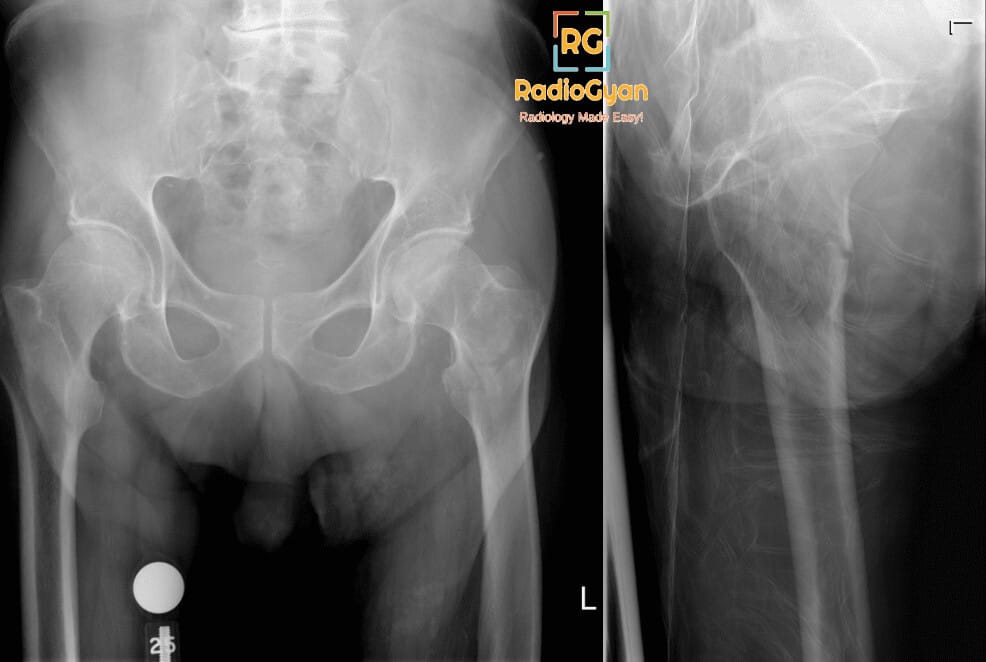
The Throckmorton sign, also called the John Thomas sign, is the claim that the penile shadow on an AP pelvic radiograph points toward the side of a unilateral hip or pelvic injury. It is called positive when the shadow lies toward the abnormality. Tested formally, it does not reliably predict the fractured side, and it should never appear in a report.
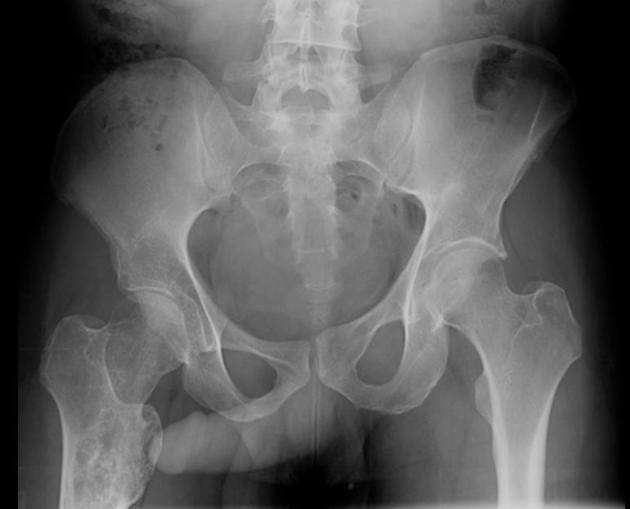
Why is it called so?
“John Thomas” is a British euphemism for the penis, and the sign is simply the orientation of the penile shadow. The indexed literature carries three names for the same observation: John Thomas sign in the English-language reports, Throckmorton sign in the North American ones, and Oram’s sign in the Danish series. Who Throckmorton was, and when the name was first attached to this radiographic finding, is not documented in any PubMed-indexed source: the papers that use the name give no origin and cite no original description.
Does the Throckmorton sign actually work?
It has been tested four times, and the results do not hold together.
| Study | Design | Result |
|---|---|---|
| Gerber 2019, pooled analysis | 9 studies, 1,942 participants; 6 studies (1,439 patients) pooled | Sign positive in 1,089 of 1,439. Pooled sensitivity 75.7% (95% CI 73.4 to 77.9). Summary log odds ratio -0.03, not significant: insufficient evidence that the sign predicts laterality |
| Murphy 2014 | 200 male AP pelvis films: 100 hip fracture, 100 controls | Accuracy below a coin toss. Fracture side unrelated to penile length or angle. Left lie and left fractures were both commoner overall |
| Brink 2009 (Oram’s sign) | 51 men with hip or pelvic disorders, 11 normal films | Sensitivity 55%, specificity 14%. Only 32.1% sensitive for femoral neck fracture. The sign could not be defined at all in 16.3%, with poor observer agreement |
| Skura 2021 | 360 men, retrospective, single centre | The one positive result: relative risk 4.24 for the peritrochanteric fracture side. But also 4.63 for tibial shaft and 9.88 for distal radius fractures |
Two things make the pooled sensitivity of 75.7% misleading. Sensitivity alone rewards a sign that is positive often, and Brink measured the matching specificity at 14%, meaning the shadow lay toward the abnormal side in most normal films too. And the odds ratio, which is the statistic that actually tests laterality, was flat.
Pathophysiology
There is none established. The usual explanation, that pain makes the patient lie toward the injured side and the shadow follows, has never been tested in an indexed study. The only published alternative is Murphy’s: that the direction of lie reflects handedness or ordinary body asymmetry rather than the injury, which fits their finding that left-sided lie and left-sided fracture were each commoner independently. Treat the mechanism as unverified.
Alternative names: John Thomas sign, Oram’s sign
Other associated named signs: None. The Throckmorton name is also used in neurology for an unrelated toe reflex, but that usage has no indexed source either, and there is no disease called Throckmorton syndrome.
Why is the penile shadow on the film at all?
Because gonadal contact shielding has been withdrawn. The 2019 American Association of Physicists in Medicine position statement recommended discontinuing routine gonadal and fetal shielding for abdominal and pelvic radiography, a position since echoed in the British Institute of Radiology guidance and in national practice reviews. The reasons are practical: digital detectors need far less dose, no heritable genetic risk has been demonstrated from diagnostic exposure, misplaced shields obscure anatomy, and a shield in the field can confuse automatic exposure control into raising the dose it was meant to reduce.
What to do when the hip radiograph looks normal
- Do not use the shadow, and do not report it. It is not a validated finding, and a comment on the patient’s genitalia in a fracture report is indefensible.
- Assume a negative film means little in an elderly patient. In the pooled series, 39% of patients with no definite fracture on radiographs had a surgical hip fracture on MRI (1,110 of 2,835; 95% CI 35 to 43).
- An isolated greater trochanter fracture is the highest-yield referral there is: 92% of those patients had an occult intertrochanteric component on MRI.
- Go to MRI, and a short protocol is enough. Limited sequences, T1 with or without STIR, gave a pooled sensitivity and specificity of 99% each in under five minutes of scan time. CT sensitivity is 79% and bone scintigraphy 87%, so use CT when MRI is unavailable or contraindicated, not in preference to it.
Frequently asked questions
Is the Throckmorton sign the same as the John Thomas sign?
Yes. Throckmorton sign, John Thomas sign and Oram’s sign all describe one observation: the side the penile shadow points on an AP pelvic radiograph, compared with the side of a hip or pelvic abnormality. The three names come from different national literatures, not from different findings.
Does the Throckmorton sign reliably show which hip is fractured?
No. The 2019 pooled analysis of 1,439 patients found a summary log odds ratio of -0.03, which is not significant, and concluded there is insufficient evidence that the sign predicts laterality. One series measured its accuracy as worse than a coin toss, and another measured a specificity of 14%.
Who was Throckmorton, and is there a Throckmorton syndrome?
Neither question has a documented answer. No PubMed-indexed paper states who the name honours or when it was first used for this sign, and there is no condition called Throckmorton syndrome in the indexed literature. Searches for the term are almost always looking for this radiographic sign.
Why is the penis visible on a pelvic X-ray?
Because routine gonadal contact shielding has been discontinued since the 2019 American Association of Physicists in Medicine position statement. Modern digital radiography uses low doses, shields frequently obscure the anatomy under examination, and a misplaced shield can trick automatic exposure control into delivering more dose, not less.
References
- Gerber L, Laher AE, Enyuma COA, McDowall J, Aigbodion SJ, Buchanan S, Adam A. The ‘John Thomas’ sign and pelvic fractures: Fact or humorous myth? A systematic review and meta-analysis. J Clin Orthop Trauma. 2019;10(1):161-166.
- Murphy IG, Murphy CG, Heffernan EJ. John Thomas sign: a memorable but misleading sign in hip fractures. Orthop Traumatol Surg Res. 2014;100(2):199-202.
- Brink O, Borris LC, Andersen K, Hougaard K. Oram’s sign for hip or pelvic disorder. Ugeskr Laeger. 2009;171(51):3760-3763.
- Skura B, Ebaugh MP, Passias BJ, DeGenova D, Hoffman A, Scheschuk J, Taylor BC. Pelvic shadowing as a diagnostic predictor of orthopedic pathology in orthopedic trauma patients. Cureus. 2021;13(9):e17873.
- Thomas MC, Lyons BD, Walker RJ. John Thomas sign: common distraction or useful pointer? Med J Aust. 1998;169(11-12):670.
- Haj-Mirzaian A, Eng J, Khorasani R, Raja AS, Levin AS, Smith SE, Johnson PT, Demehri S. Use of advanced imaging for radiographically occult hip fracture in elderly patients: a systematic review and meta-analysis. Radiology. 2020;296(3):521-531.
- Wilson MP, Nobbee D, Murad MH, Dhillon S, McInnes MDF, Katlariwala P, Low G. Diagnostic accuracy of limited MRI protocols for detecting radiographically occult hip fractures: a systematic review and meta-analysis. AJR Am J Roentgenol. 2020;215(3):559-567.
- Marsh RM, Silosky M. Patient shielding in diagnostic imaging: discontinuing a legacy practice. AJR Am J Roentgenol. 2019;212(4):755-757.
- Stearns BK, Seitz K, Folck QM. Exploring past to present shielding guidelines. Radiol Technol. 2023;95(2):84-93.
- Ahern M, McEntee MF, Moore N. Radiographers’ attitudes toward the use of lead contact shielding. J Med Imaging Radiat Sci. 2023;54(3):415-420.
Access all radiology signs posted so far: https://radiogyan.com/radiology-signs/

Improve Content And Help Your Colleagues!
Found an error in the post? Please let us know using our contact page and we will update it with due credits!
If you wish to contribute radiological images for this case (or any other article on the website), you can submit them here and you will be duly credited: Submit radiology case