


What causes Honda sign in sacrum on bone scan?
Let me know in the comments.
Click to reveal the answer
Answer:
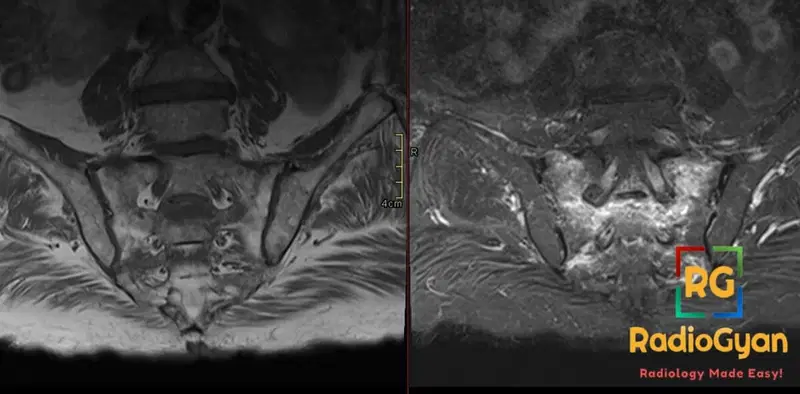
The Honda sign represents an H-shaped pattern of increased radiotracer uptake on technetium-99m bone scintigraphy due to bilateral sacral insufficiency fractures, typically occurring in osteoporotic postmenopausal women or patients with other metabolic bone diseases predisposing to fragility fractures. The same H-shaped fracture distribution can also be appreciated as bone marrow edema on MRI, though the eponym “Honda sign” was originally coined for the scintigraphic pattern.
Why is it called so?
The Honda sign is named for its resemblance to the H-shaped logo of the Honda car manufacturer, with vertical uptake in both sacral alae medial to the sacroiliac joints connected by a horizontal band of uptake across the sacrum.

Pathophysiology
Sacral insufficiency fractures arise from normal stress on weakened bone in the setting of osteoporosis or other conditions reducing bone density; fractures propagate vertically through the sacral alae paralleling the sacroiliac joints and horizontally through the sacral body at S2-S3 level, resulting in increased osteoblastic activity and radiotracer accumulation outlining the classic H configuration.
Alternative names: H sign, H pattern
Other associated named signs: None
References
Access all radiology signs posted so far: https://radiogyan.com/radiology-signs/

Improve Content And Help Your Colleagues!
Found an error in the post? Please let us know using our contact page and we will update it with due credits!
If you wish to contribute radiological images for this case (or any other article on the website), you can submit them here and you will be duly credited: Submit radiology case