



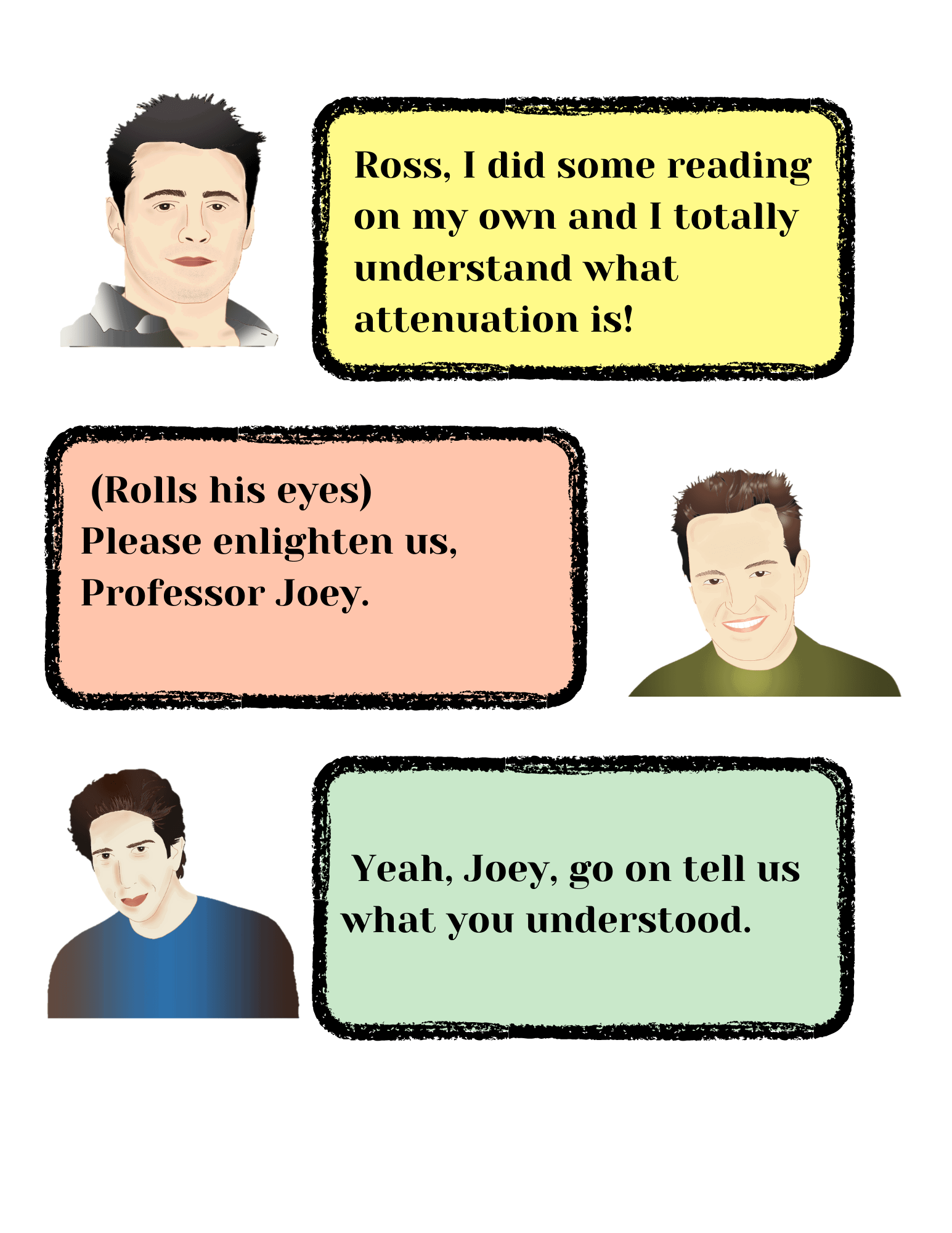
 Humorous diagram referencing the interaction of X-rays with matter, specifically focusing on the concept of attenuation.
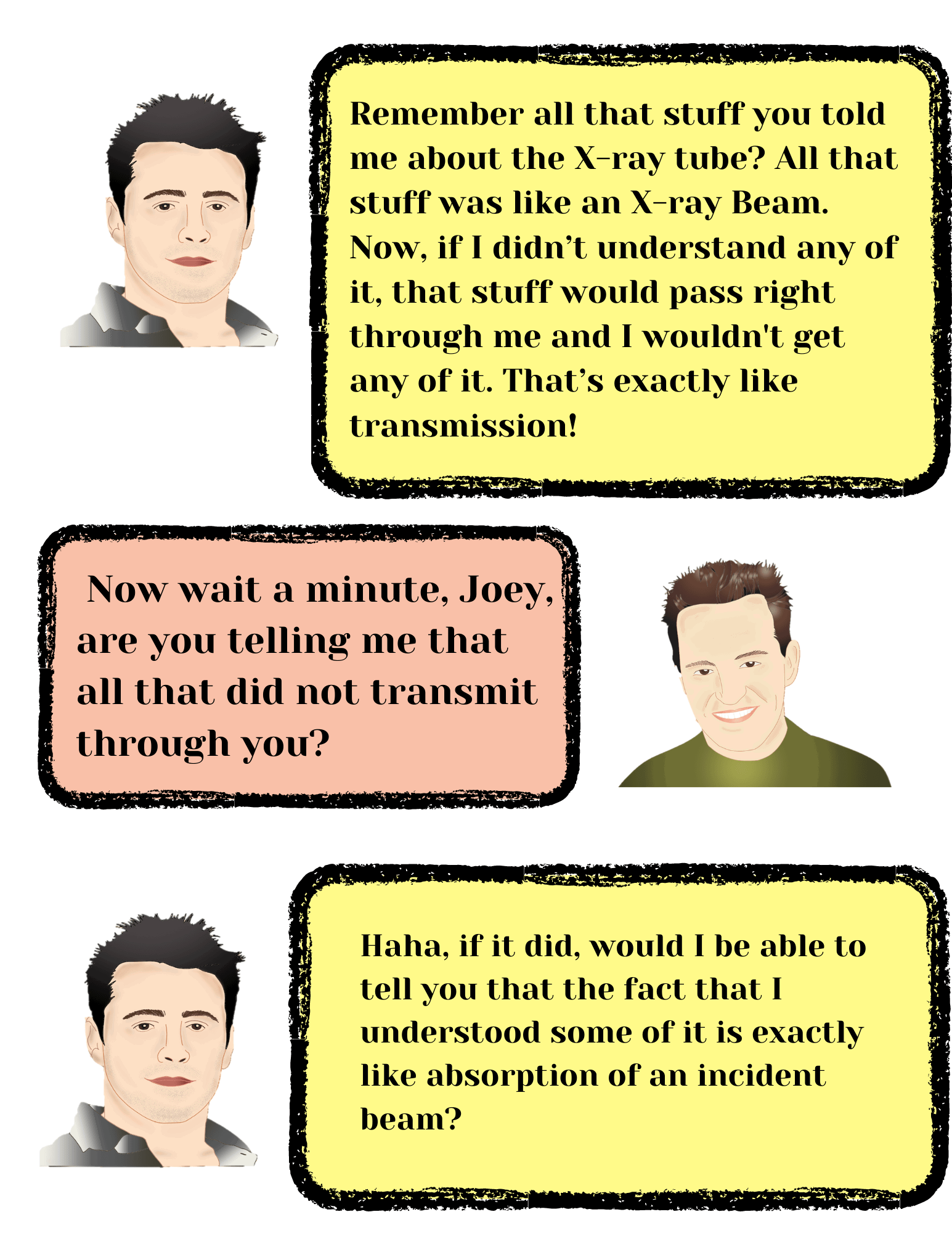 Humorous diagram explaining X-ray transmission and absorption, key concepts in understanding radiographic image formation.
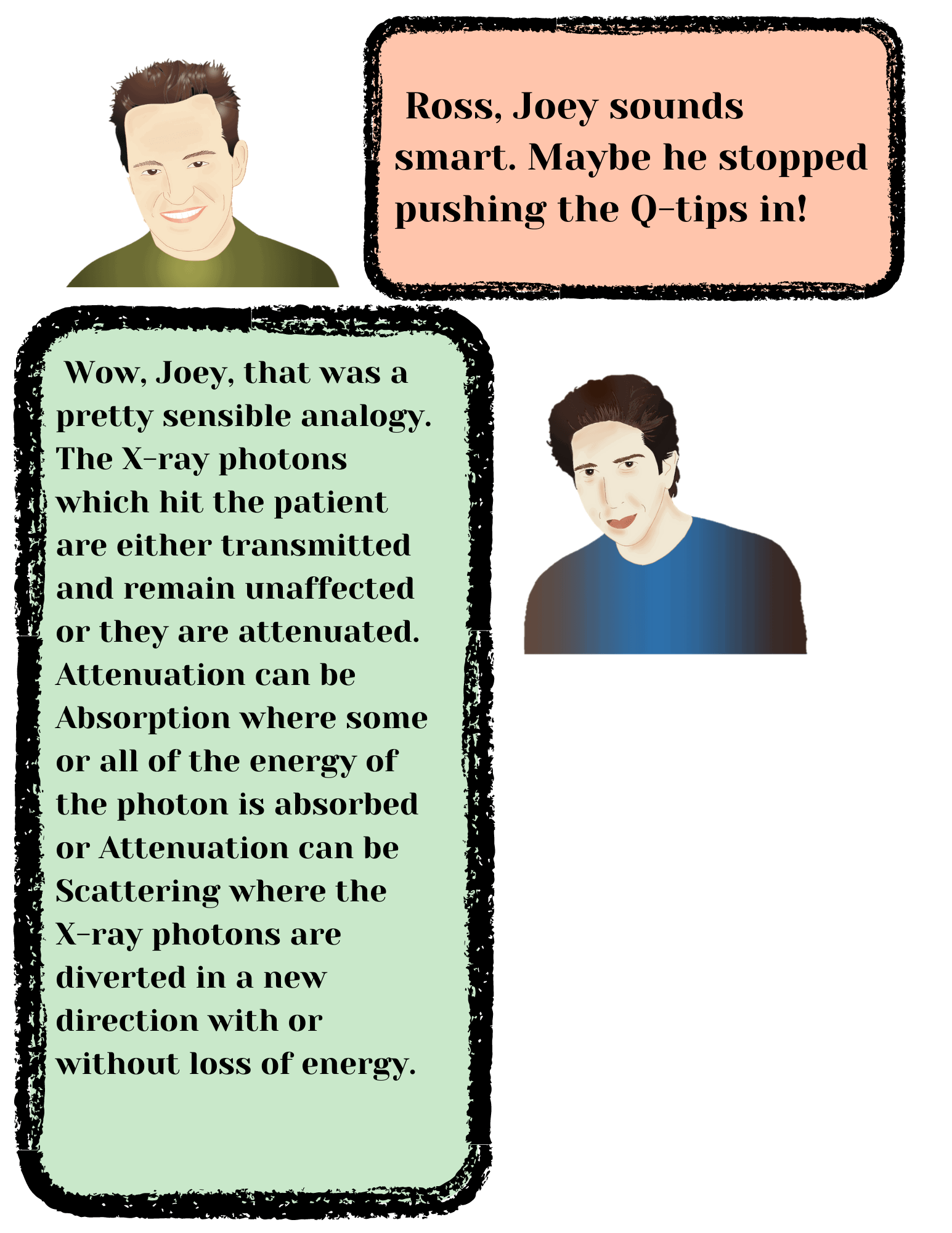 Explanation of X-ray photon attenuation, including absorption and scattering, presented in a case-based teaching style.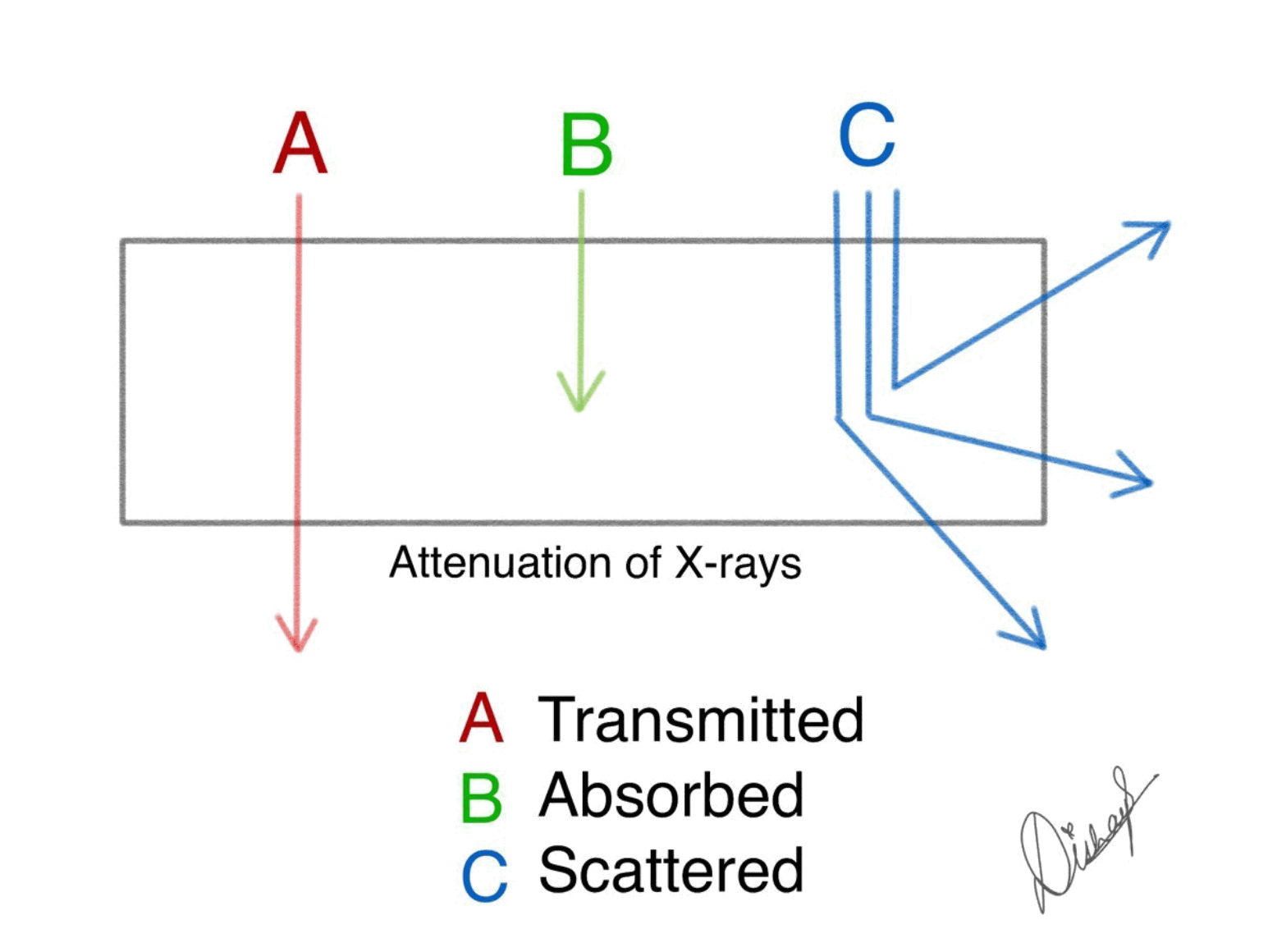
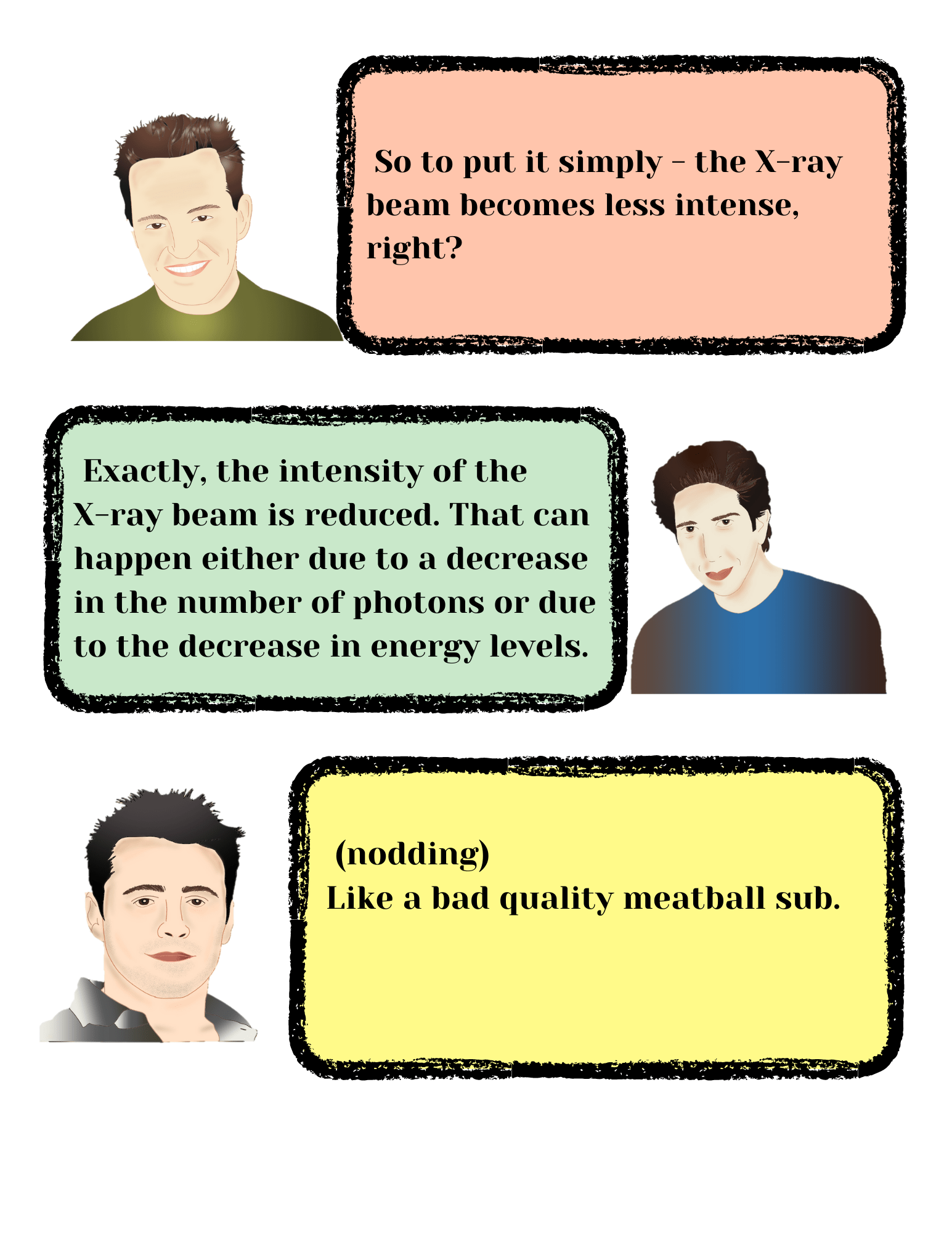 Cartoon dialogue explaining that X-ray beam intensity reduction results from a decrease in the number of photons or a decrease in energy levels.
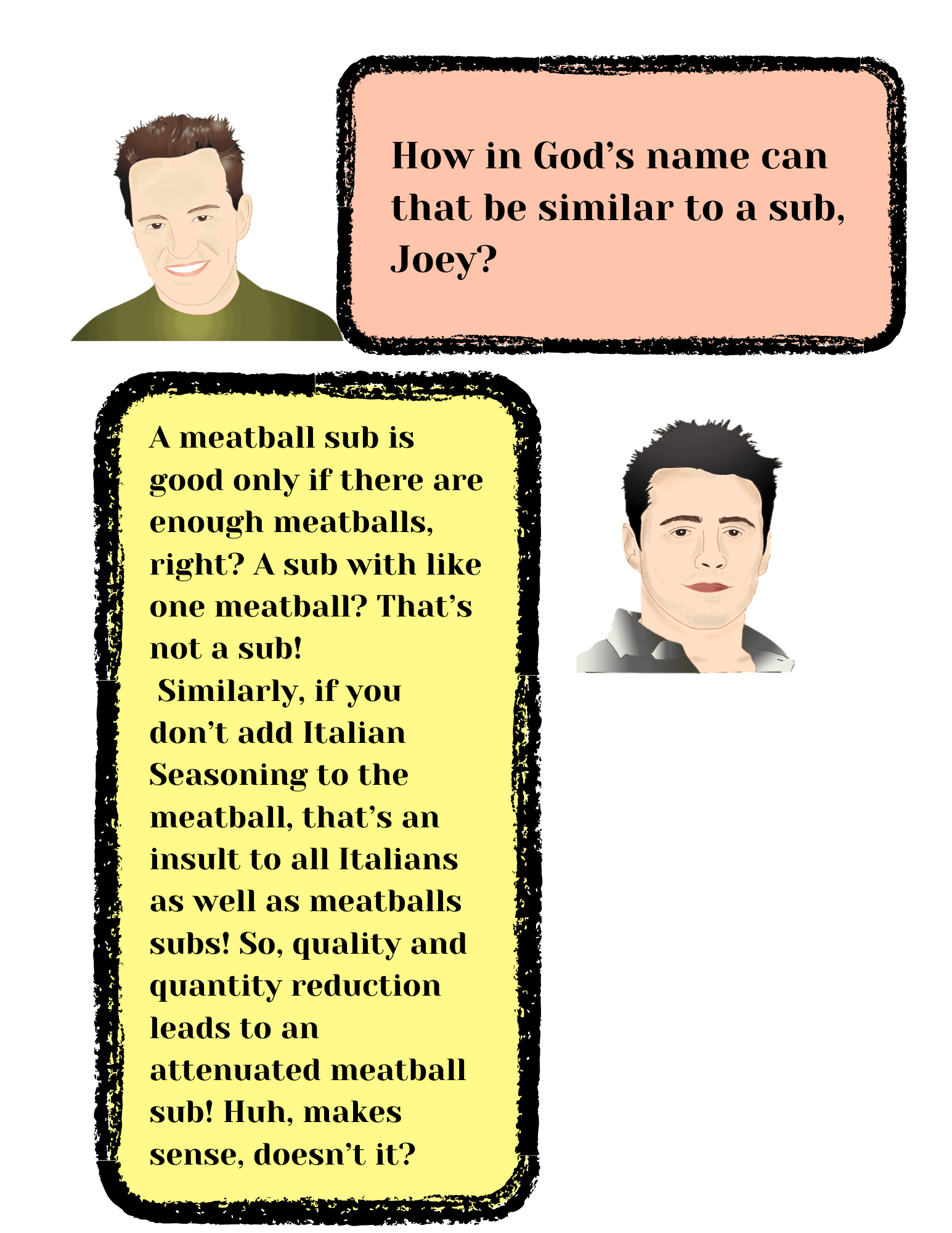 Meme illustrating X-ray attenuation: reduced quality or quantity results in an 'attenuated' outcome, analogous to a poor meatball sub.
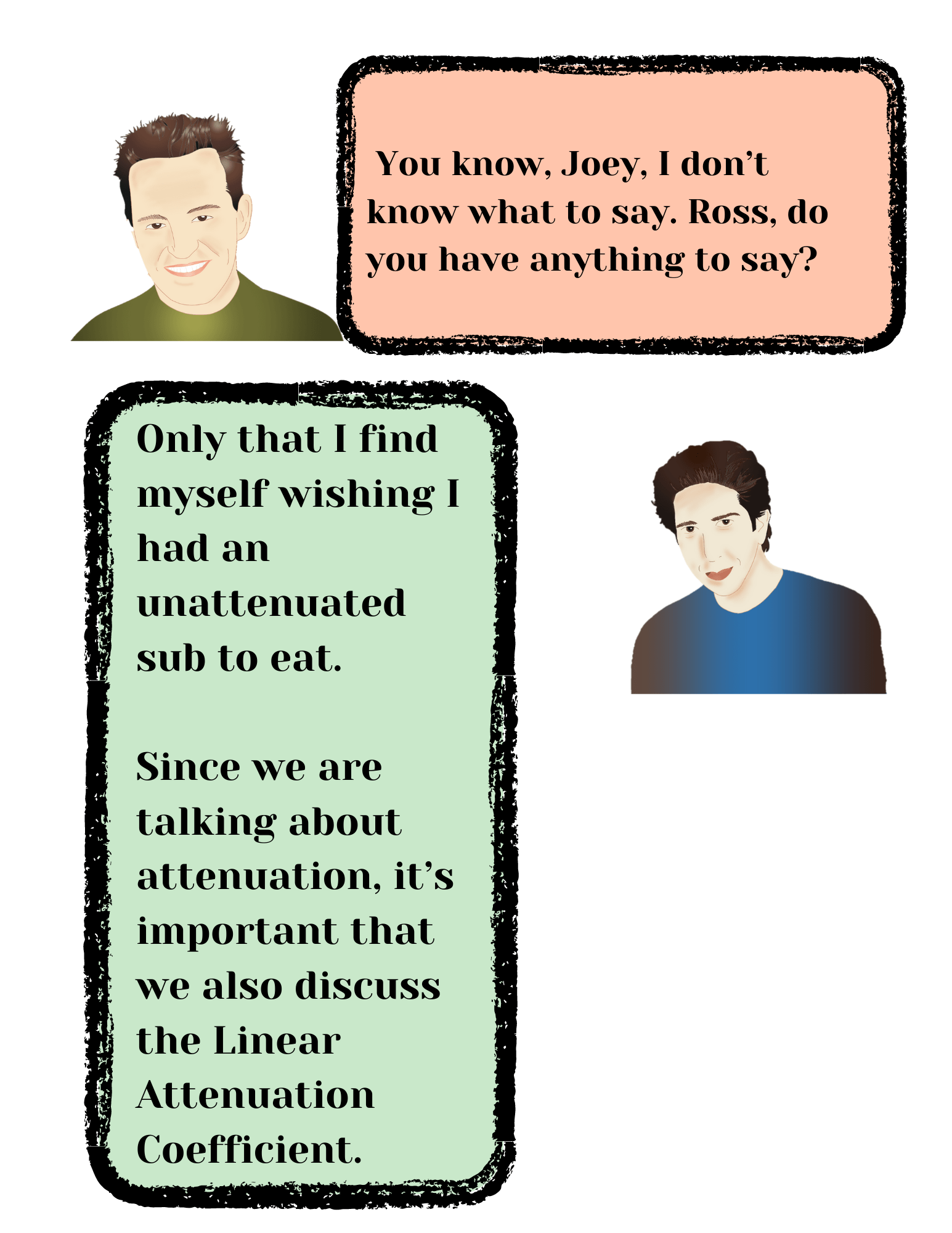 Mnemonic figure illustrating the introduction of the Linear Attenuation Coefficient (LAC) in the context of X-ray interaction with matter.
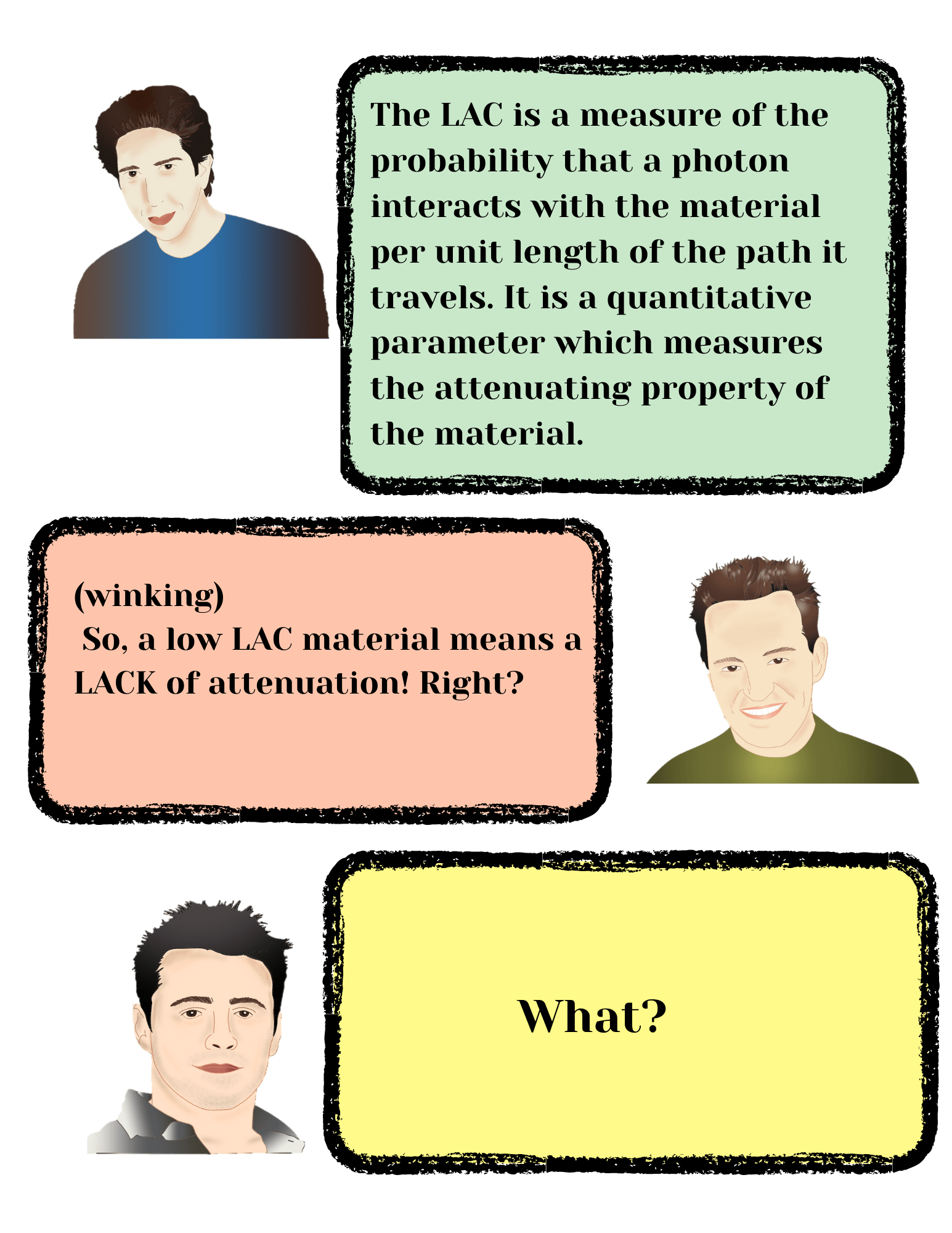 Figure explaining the Linear Attenuation Coefficient (LAC) as a measure of photon interaction probability and material attenuation properties.
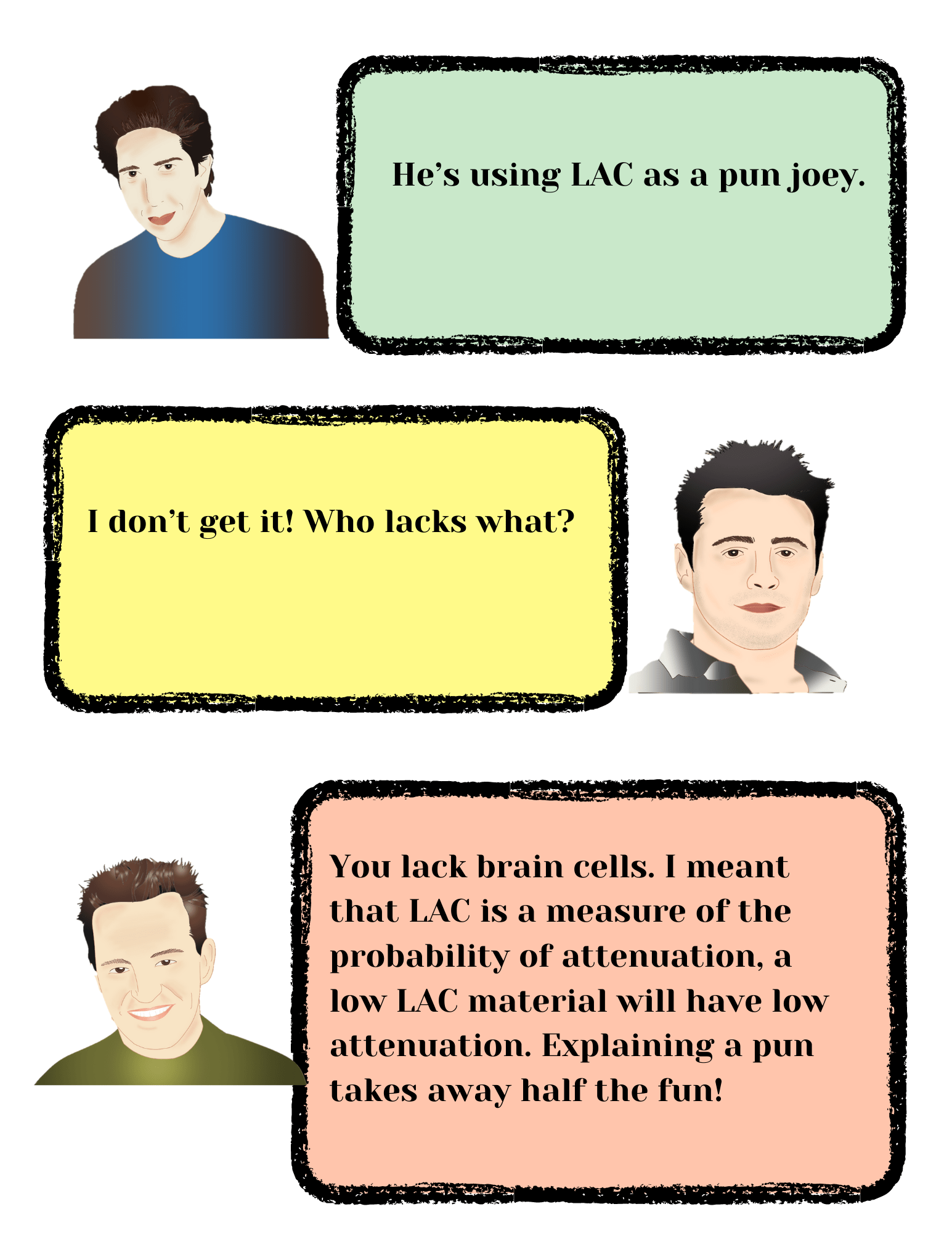 Mnemonic figure explaining that LAC (Linear Attenuation Coefficient) relates to the probability of X-ray attenuation.
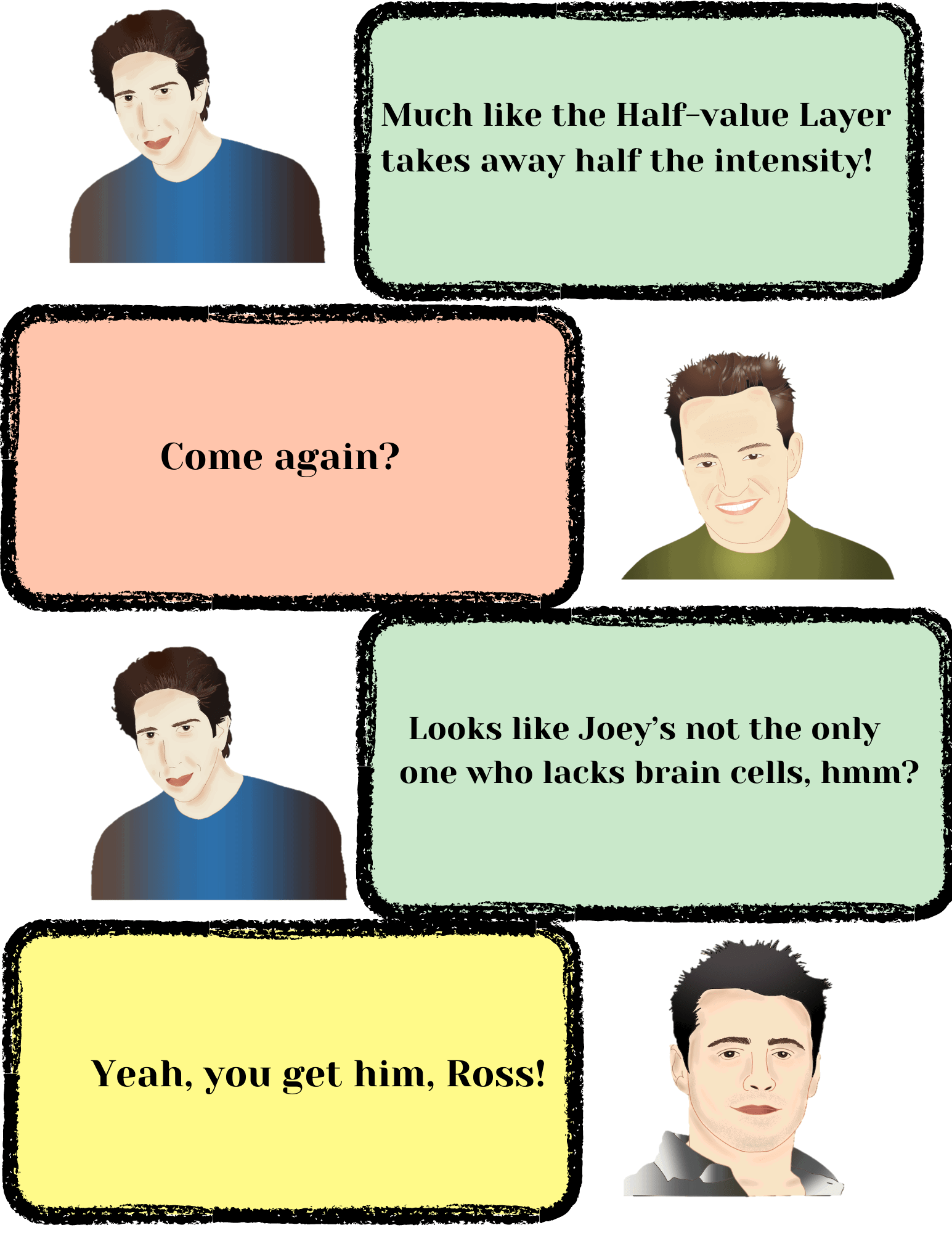 Meme illustrating the concept of Half-Value Layer (HVL) in X-ray attenuation, relating it to character dialogue.
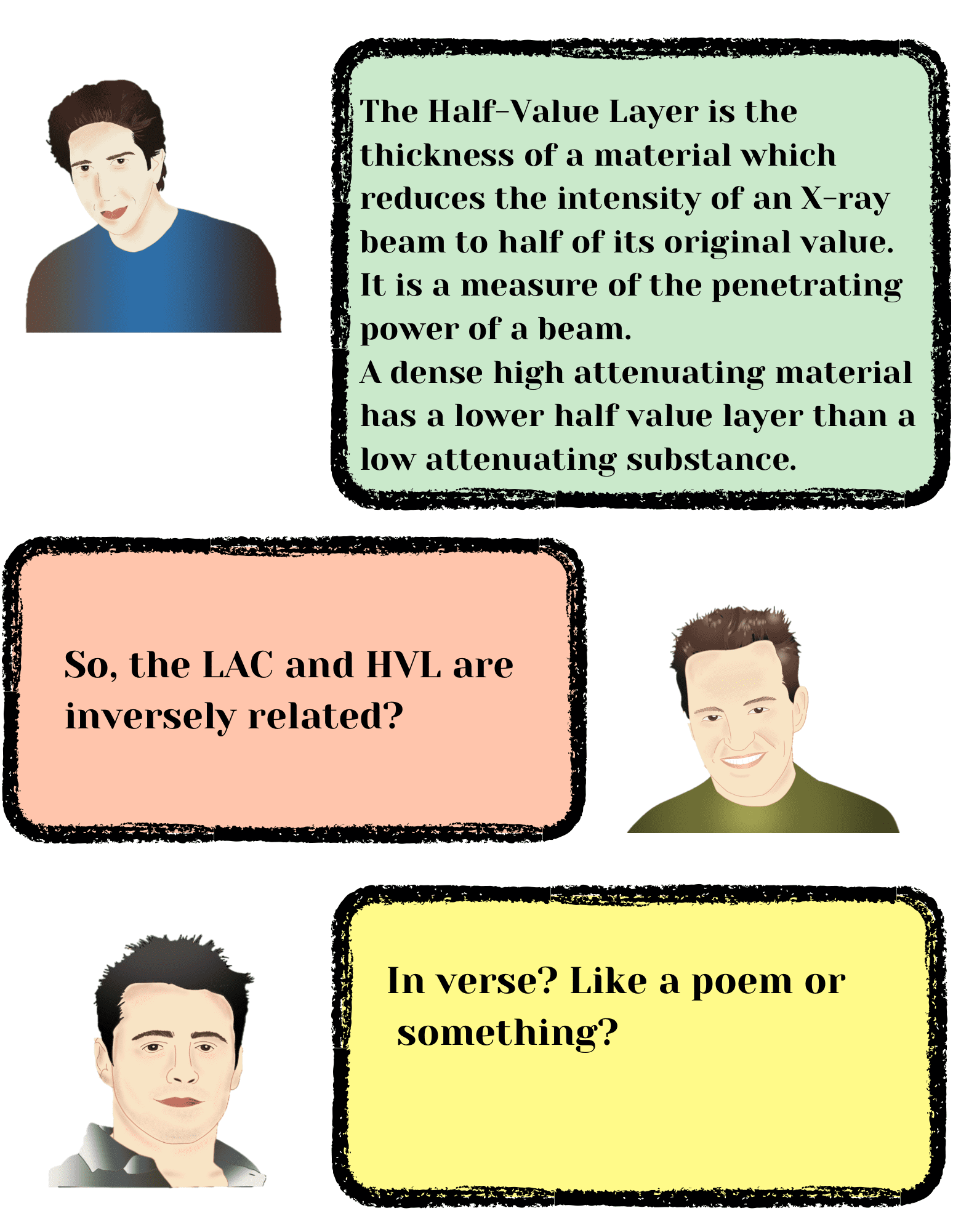 Definition and relationship of Half-Value Layer (HVL) to X-ray beam attenuation, a key concept in radiation physics and protection.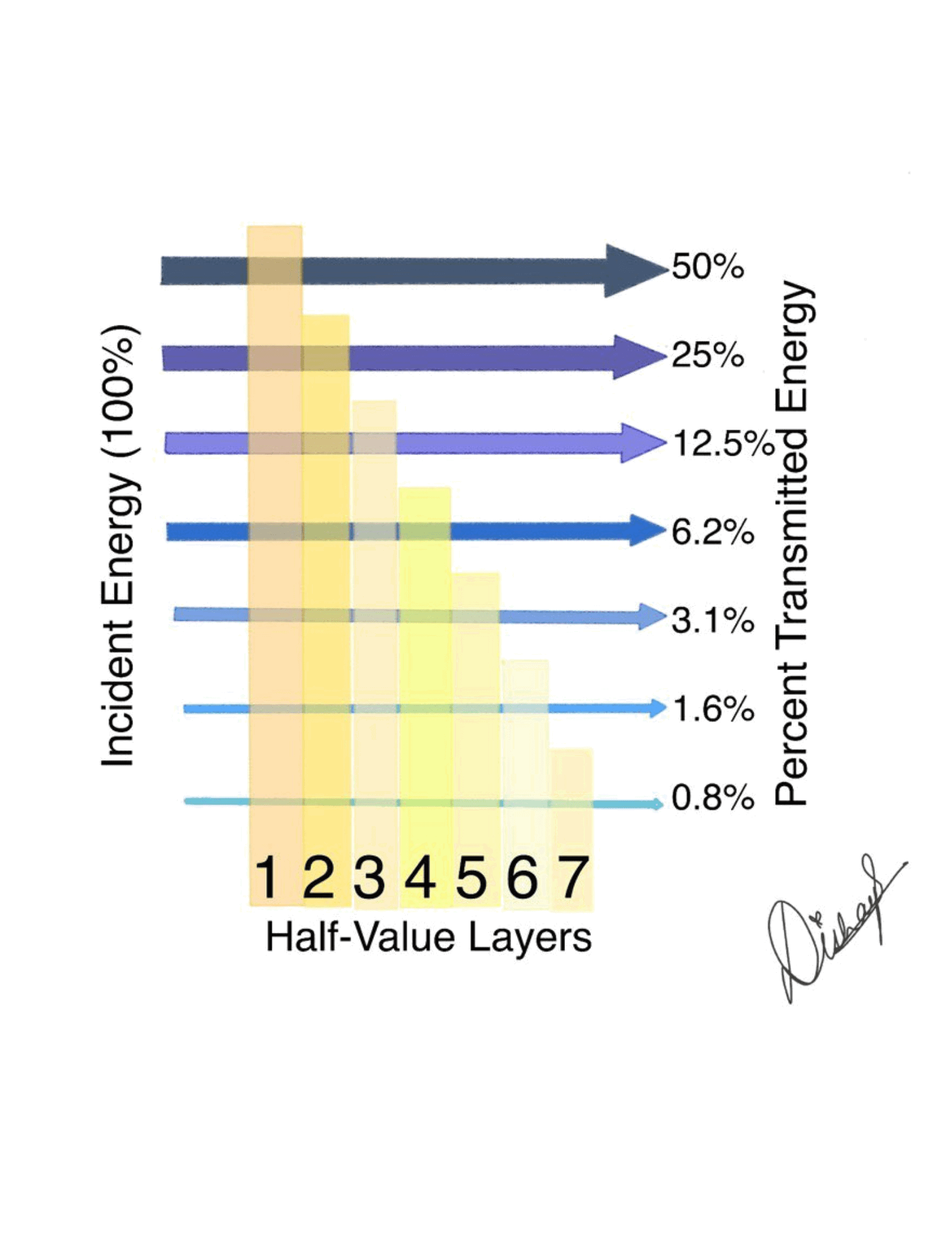
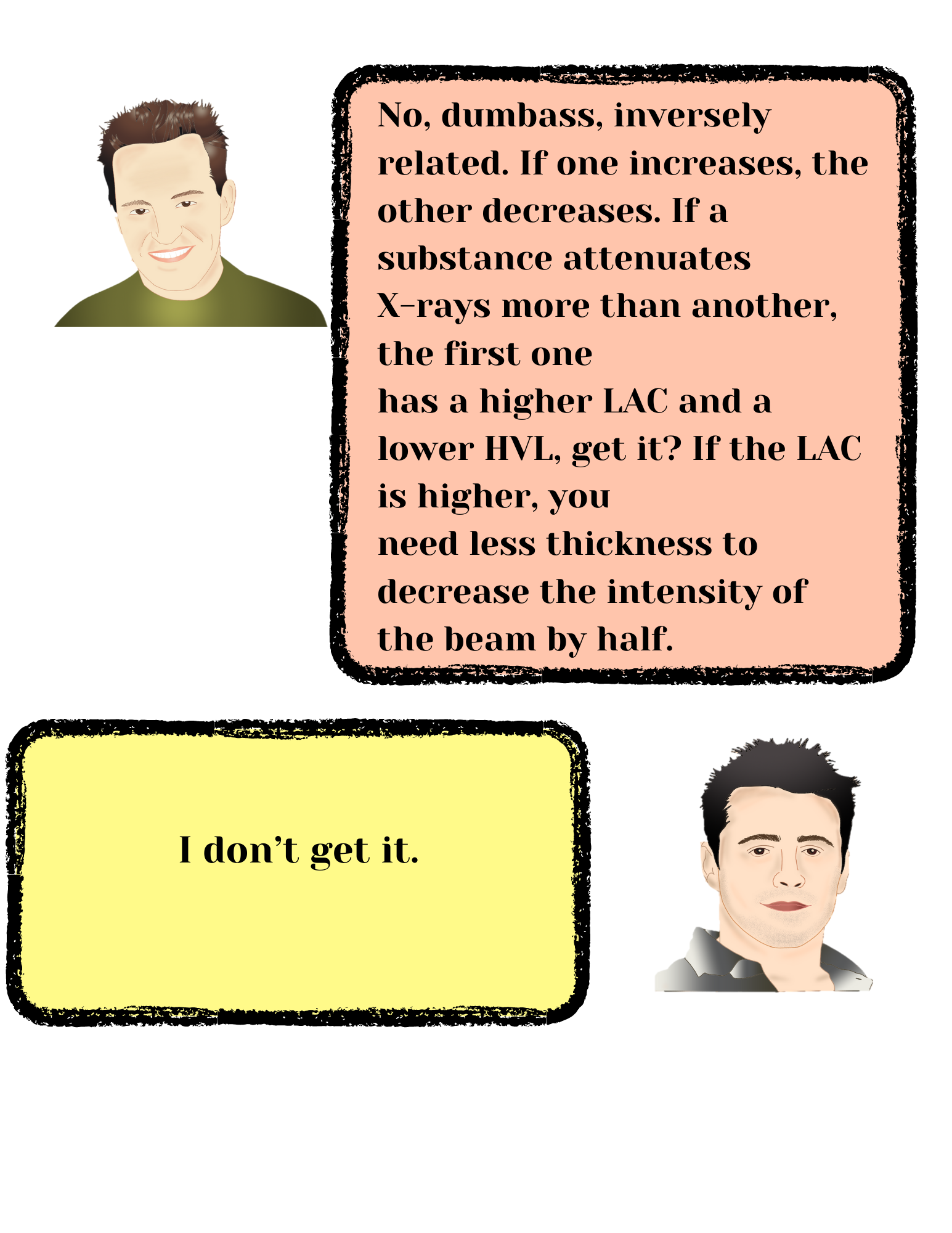 Diagram explaining the inverse relationship between Linear Attenuation Coefficient (LAC) and Half-Value Layer (HVL) in X-ray matter interaction.
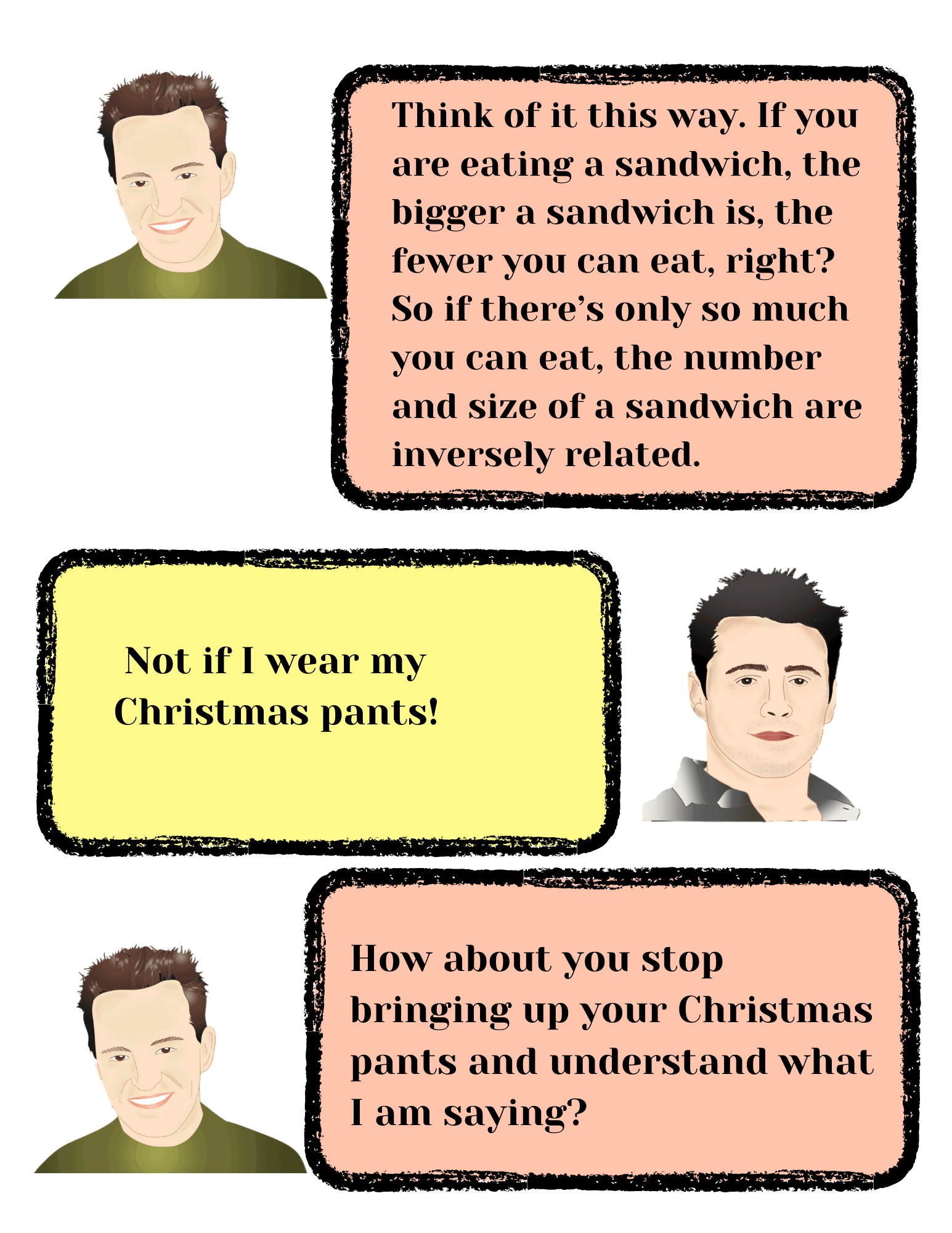 Analogy illustrating inverse proportionality using dialogue between cartoon figures, relating sandwich size to the quantity that can be eaten.
 Mnemonic or educational figure summarizing concepts related to X-ray attenuation, including Linear Attenuation Coefficient (LAC) and Half-Value Layer (HVL).
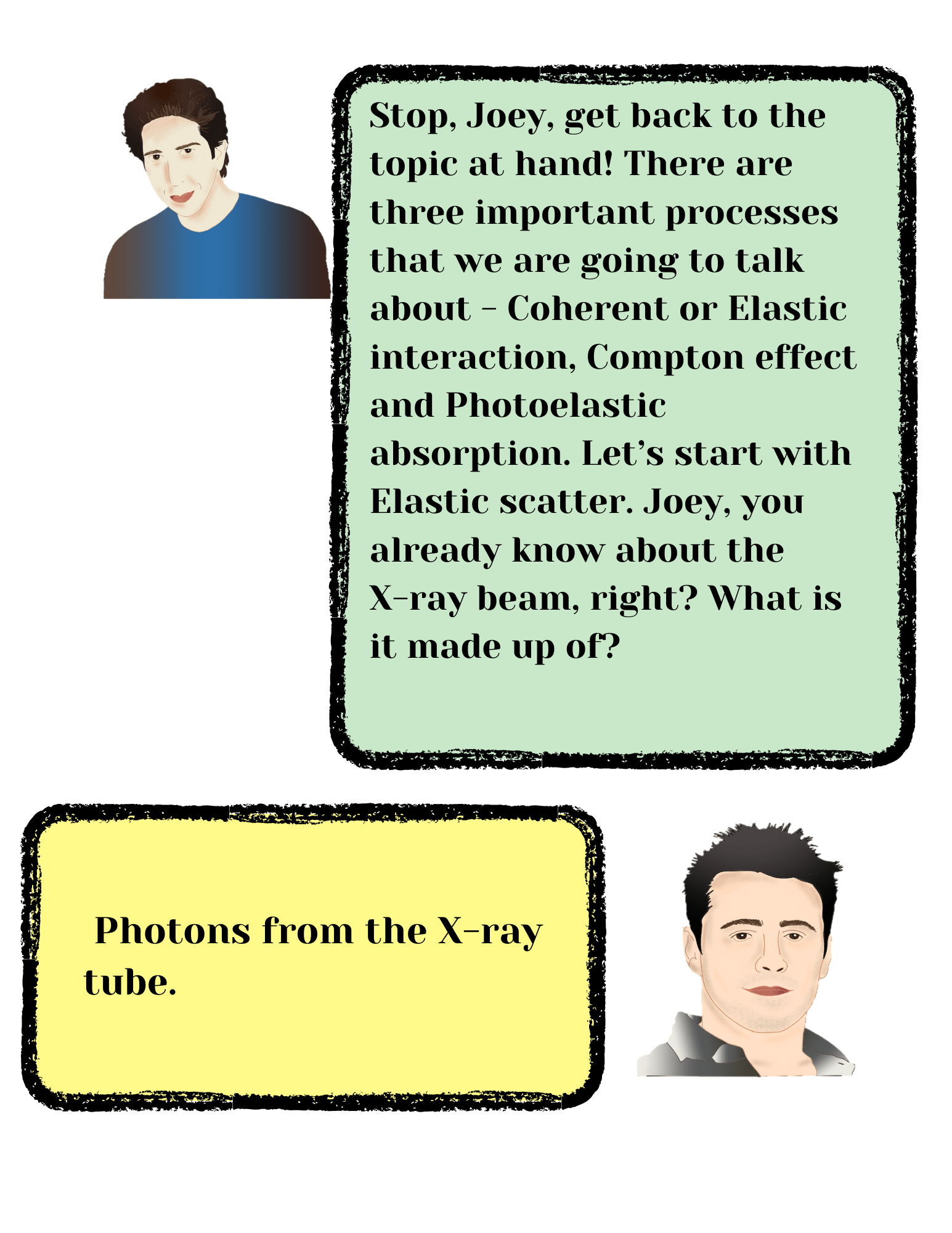 Introduction to the three main processes of X-ray interaction with matter: Coherent scatter, Compton effect, and Photoelectric absorption.
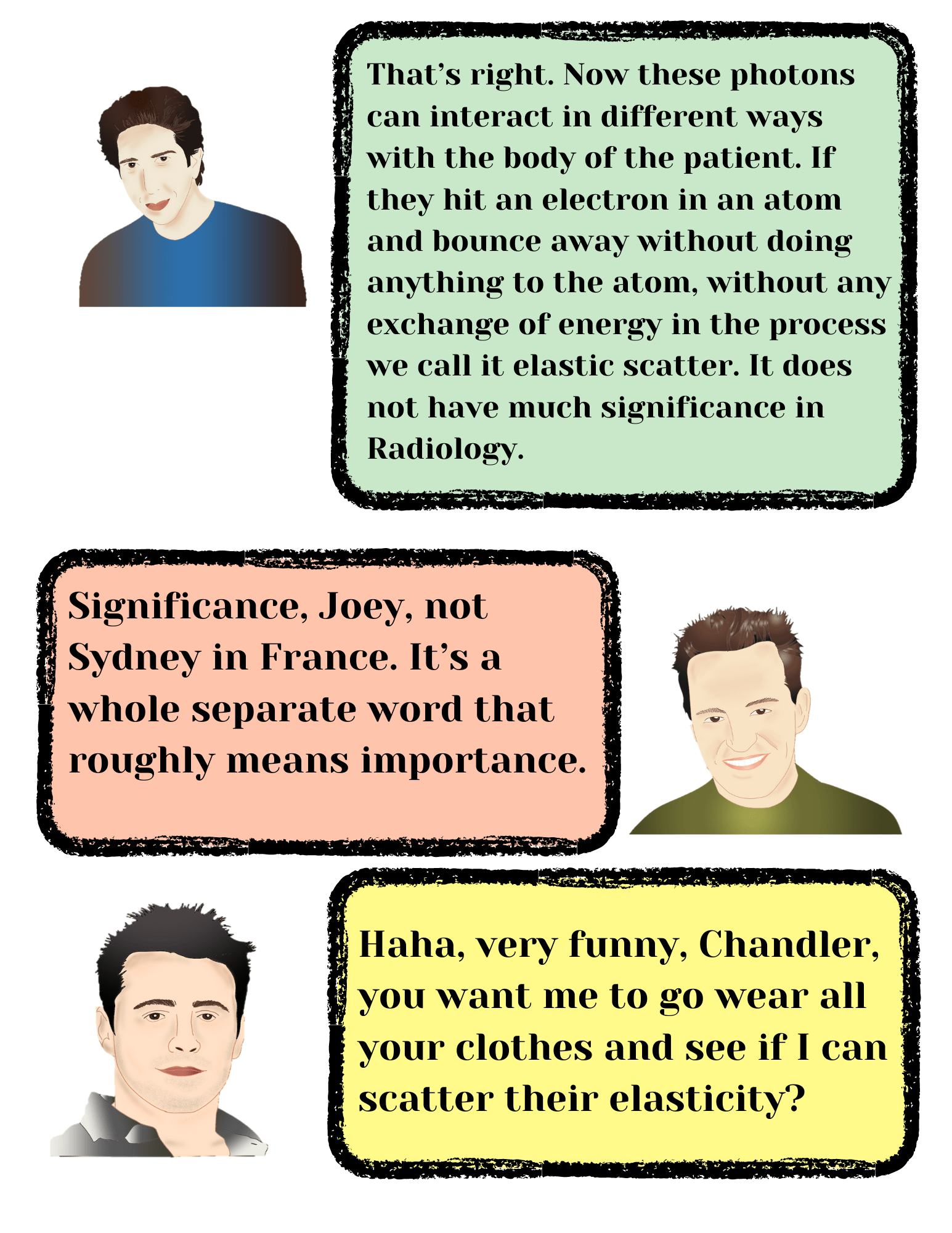 Dialogue explaining elastic scatter, an interaction of X-rays with matter that has minimal significance in diagnostic radiology.
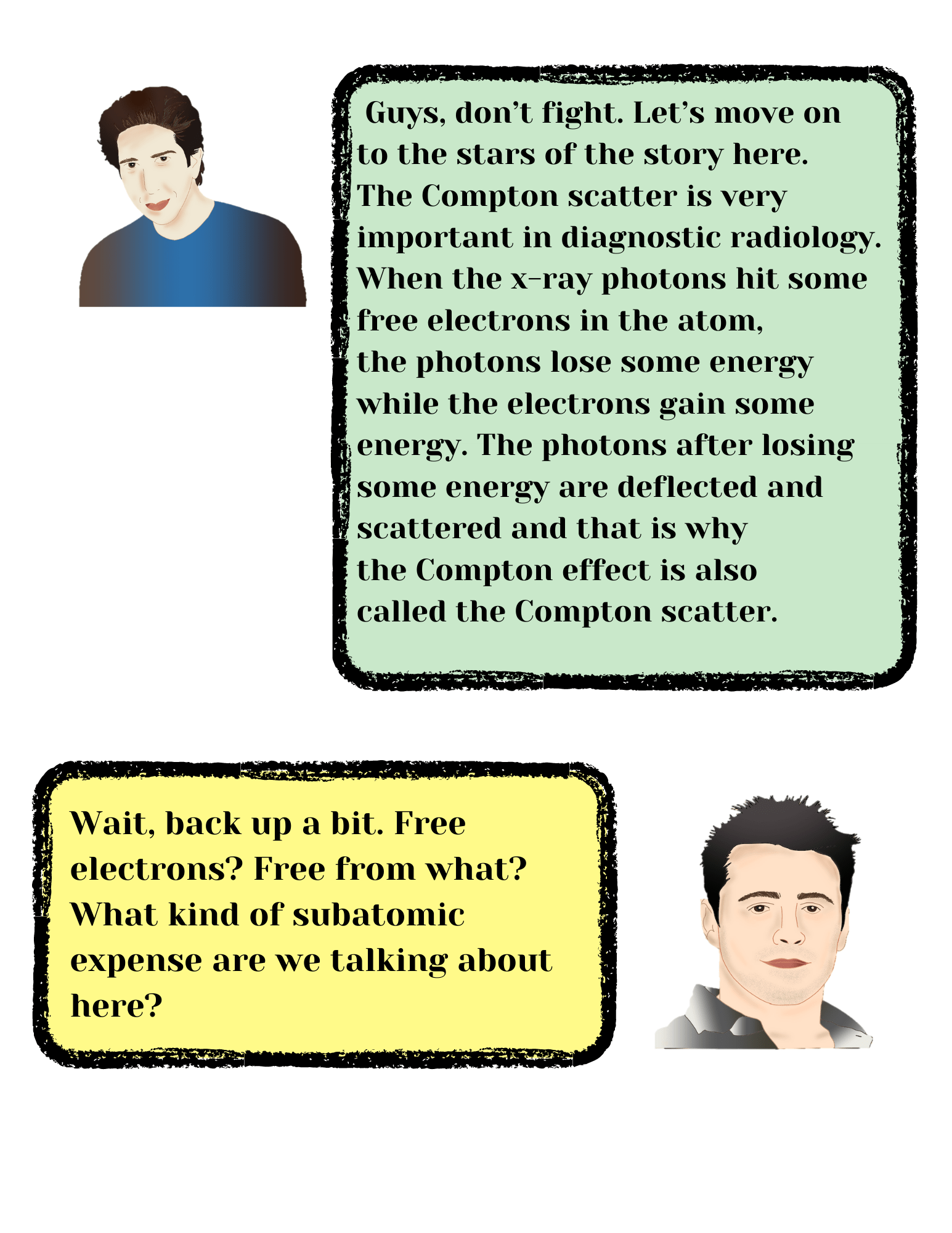 Dialogue explaining the Compton scatter effect, a crucial interaction of X-rays with matter in diagnostic radiology.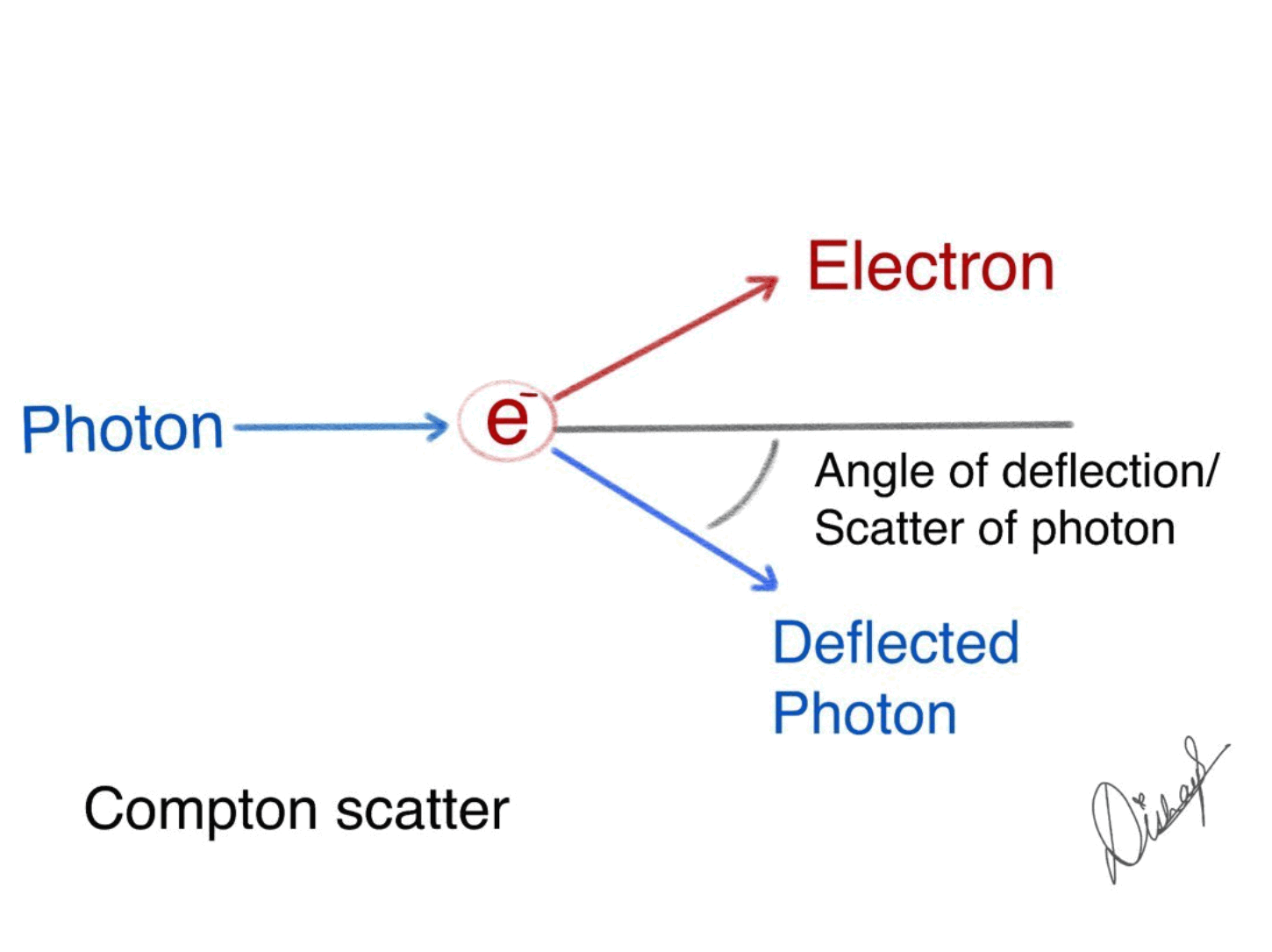
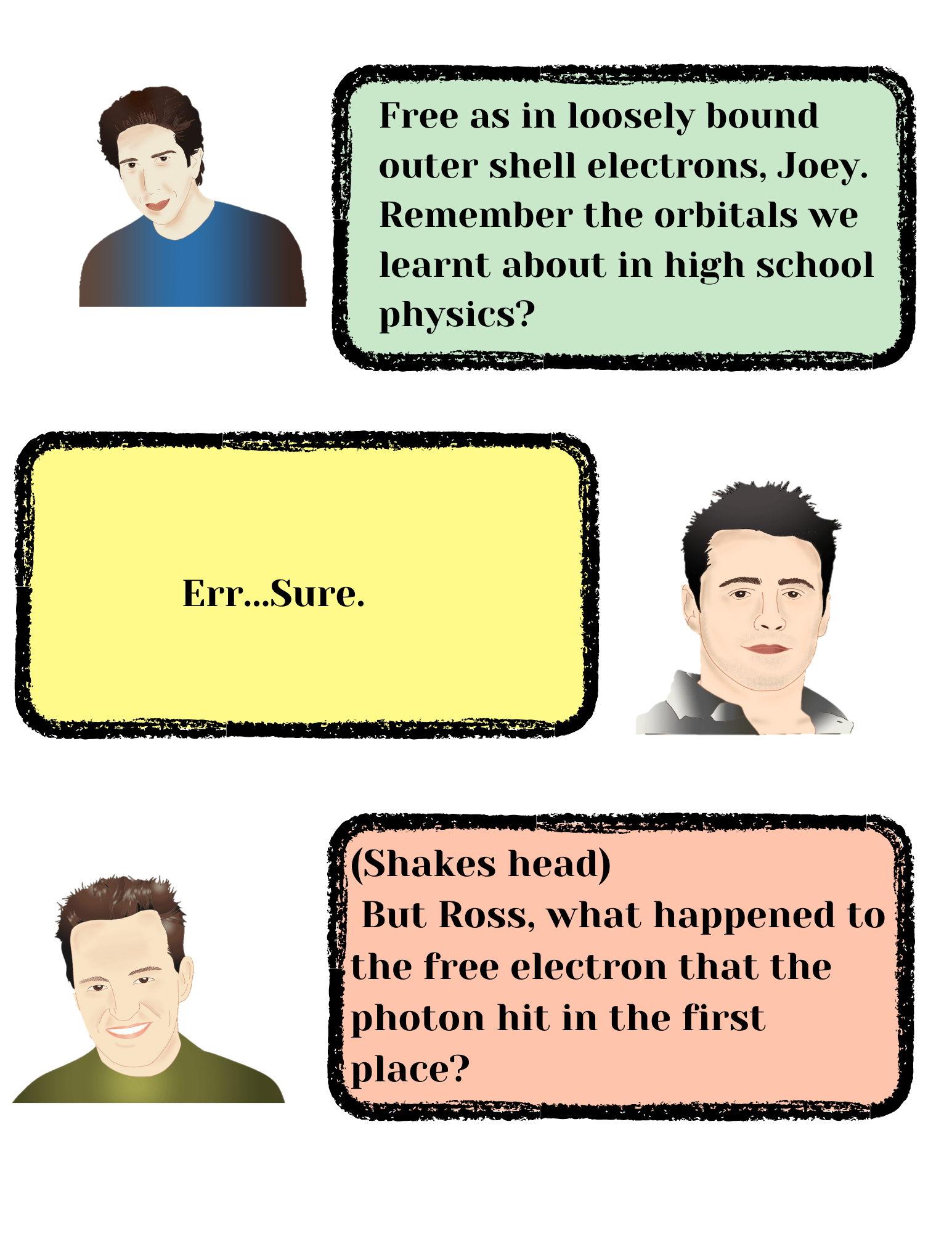 Conceptual illustration explaining the interaction of X-rays with matter, focusing on the photoelectric effect involving loosely bound outer shell electrons.
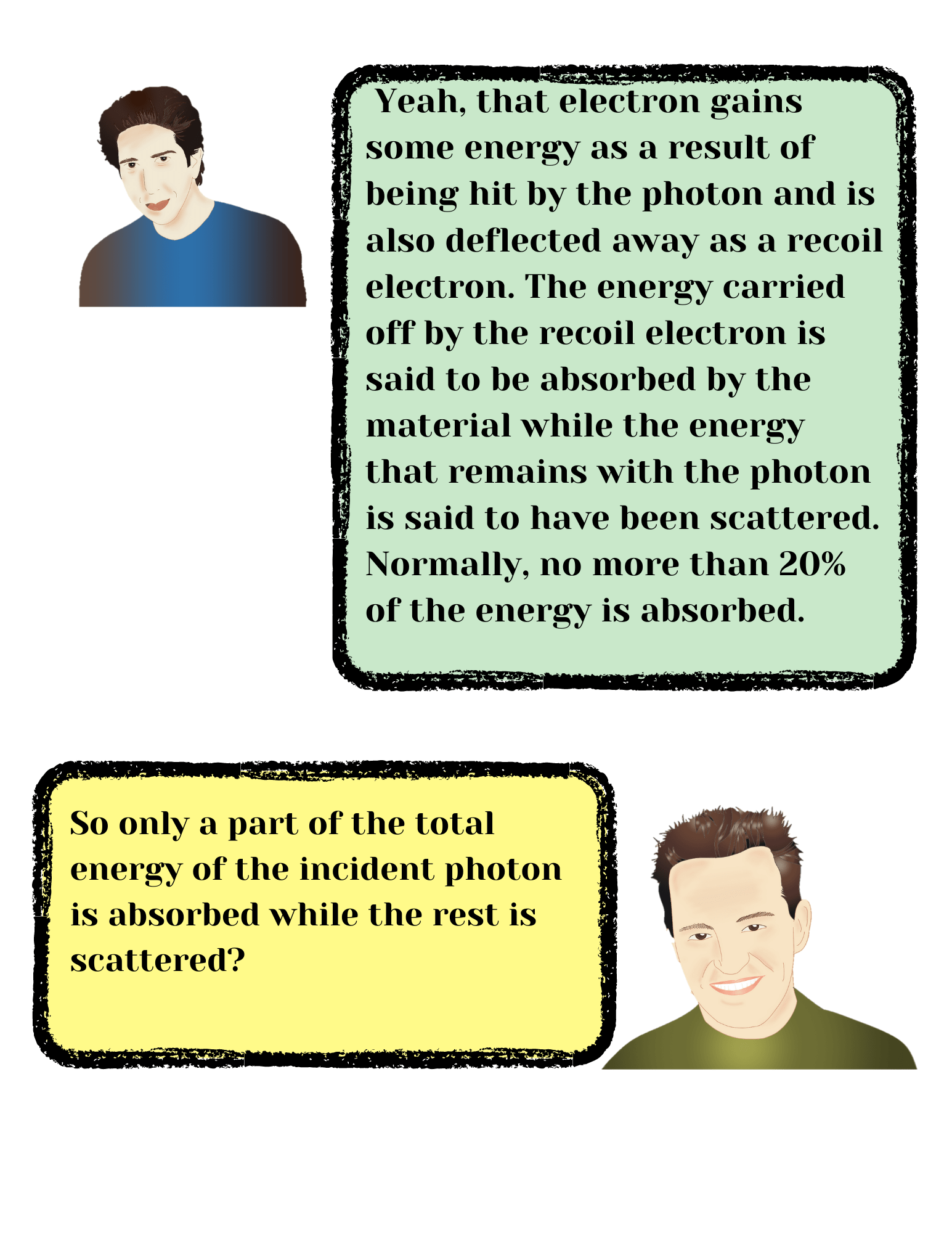 Diagram explaining Compton scattering: energy is partitioned between the recoil electron (absorbed) and the scattered photon.
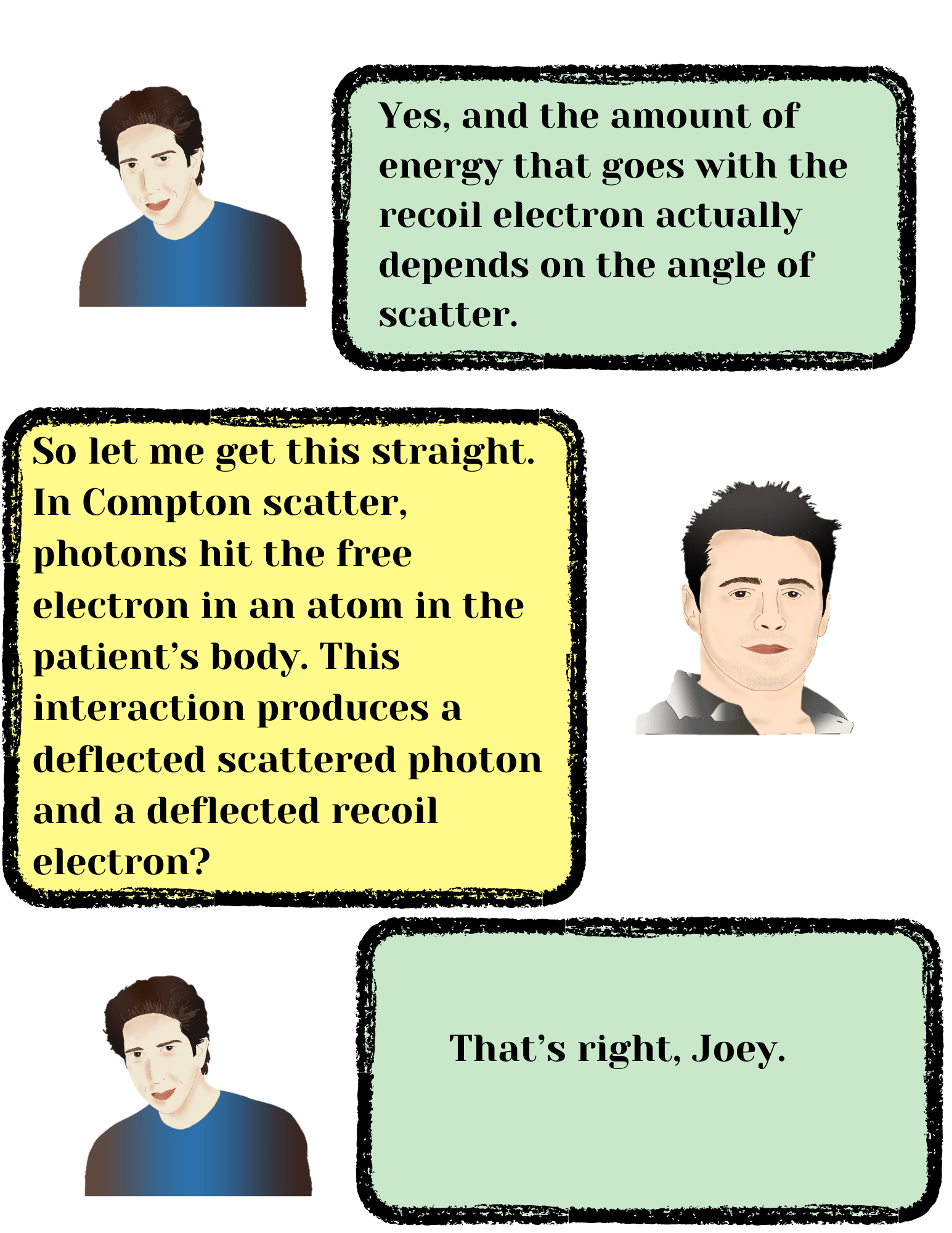 Dialogue summarizing the Compton scatter interaction: incident photon strikes a free electron, resulting in a scattered photon and a recoil electron.
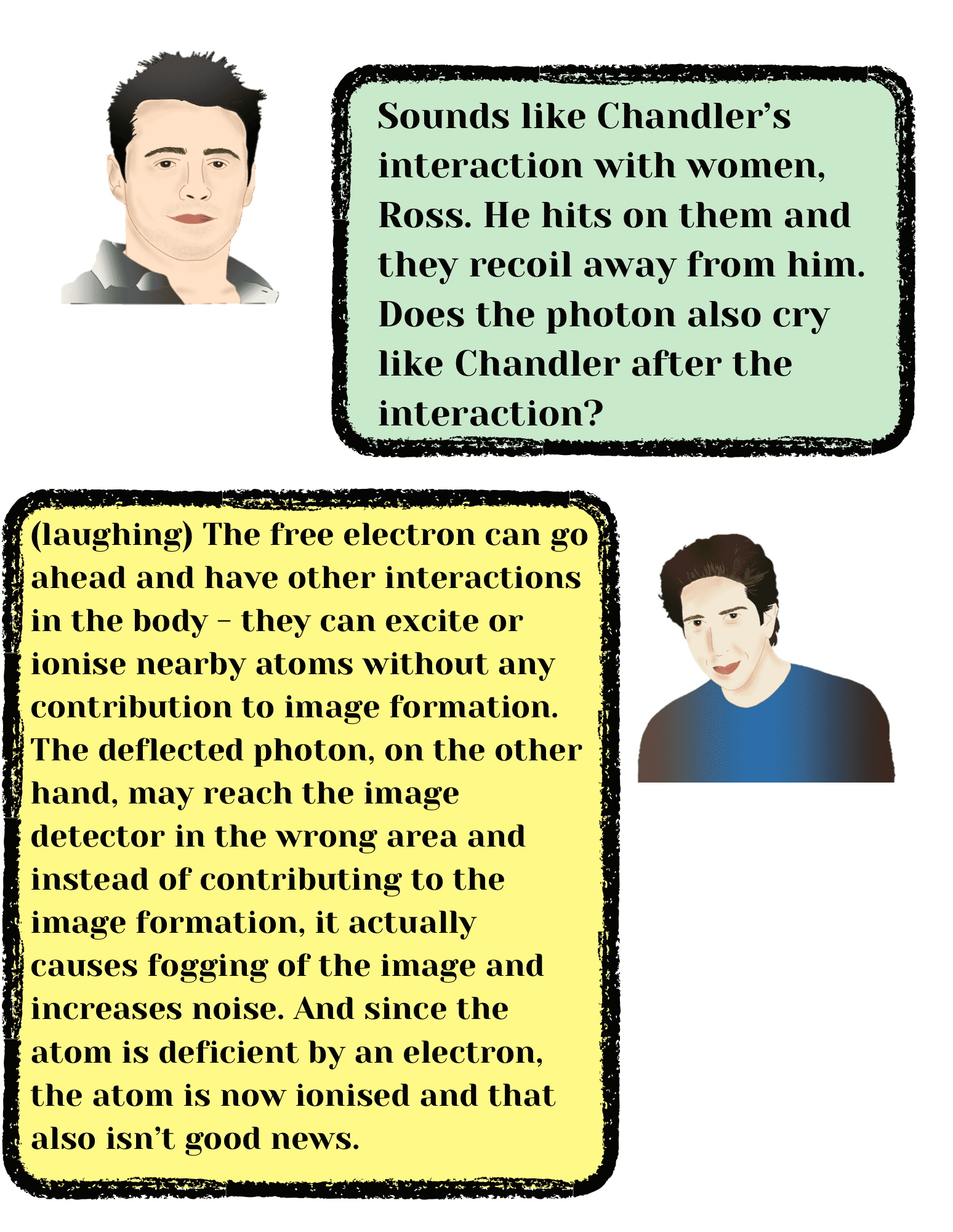 Illustration detailing the effects of Compton scatter: the free electron causes ionization, and the deflected photon degrades image quality by causing fogging and noise.
 Humorous dialogue exchange illustrating a common linguistic confusion, featuring characters resembling Joey and Chandler.
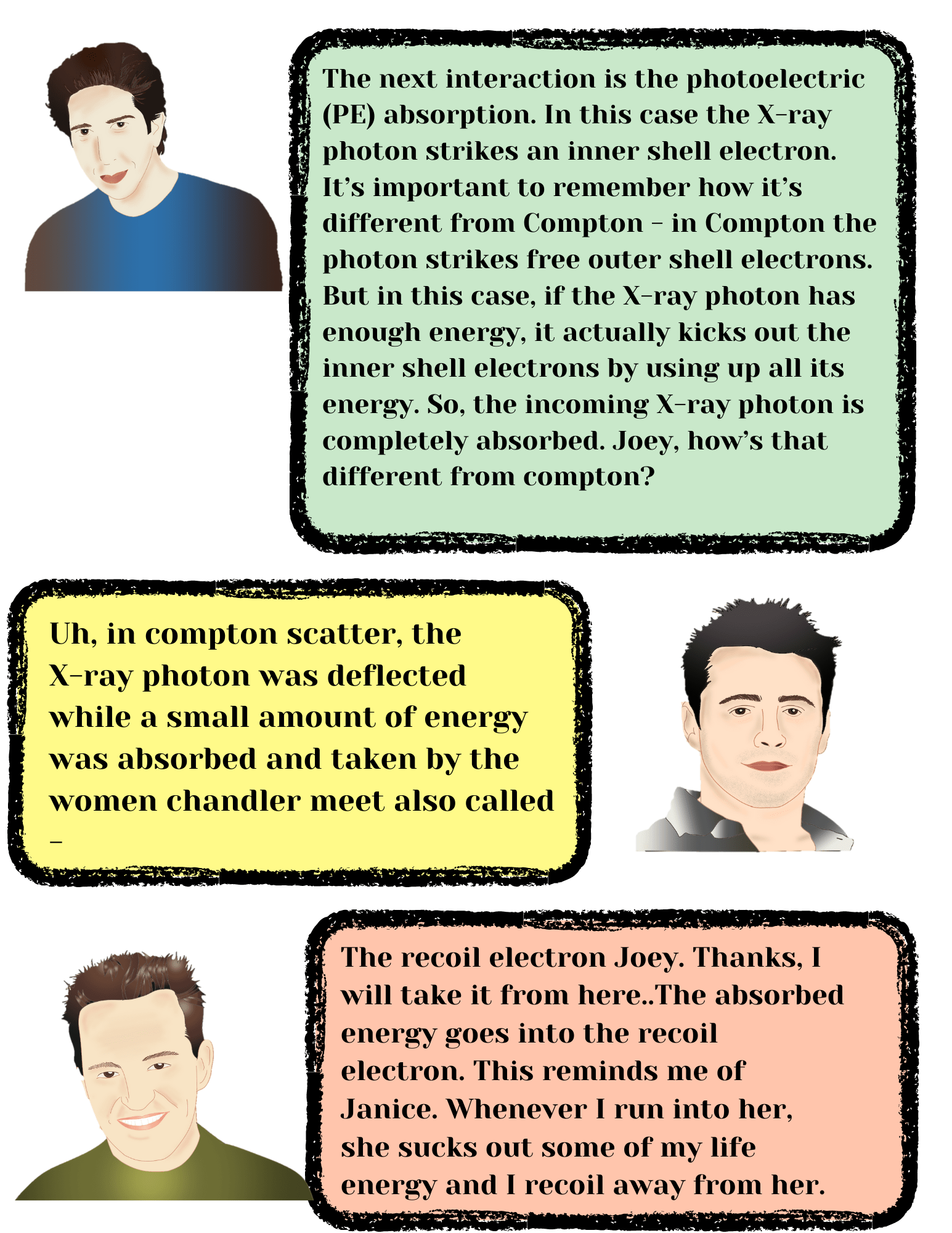 Mnemonic-style figure explaining the difference between Photoelectric absorption and Compton scatter in X-ray physics, featuring characters from the TV show Friends.
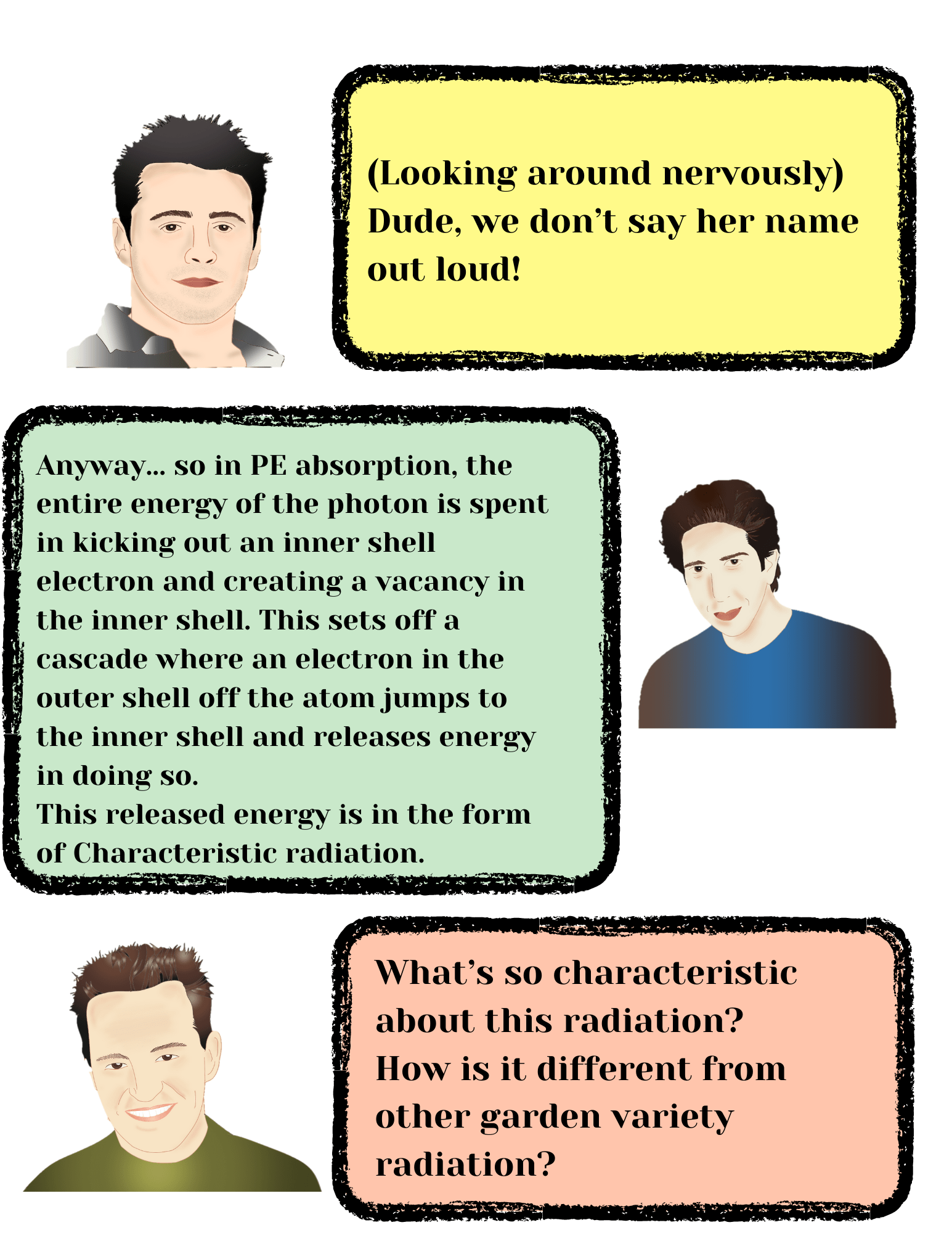 Diagram explaining the physics of photoelectric absorption and the production of characteristic radiation following X-ray interaction with matter.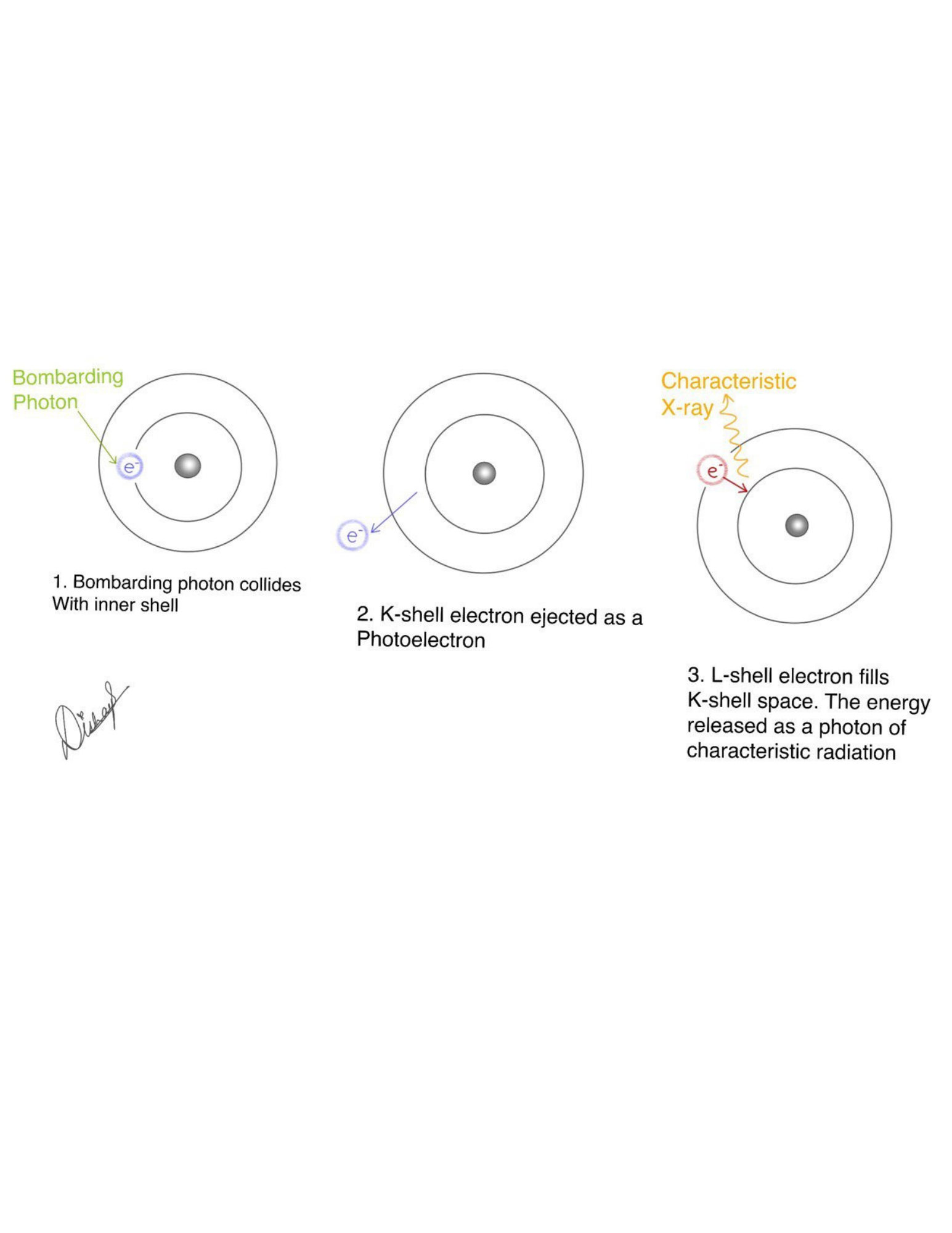
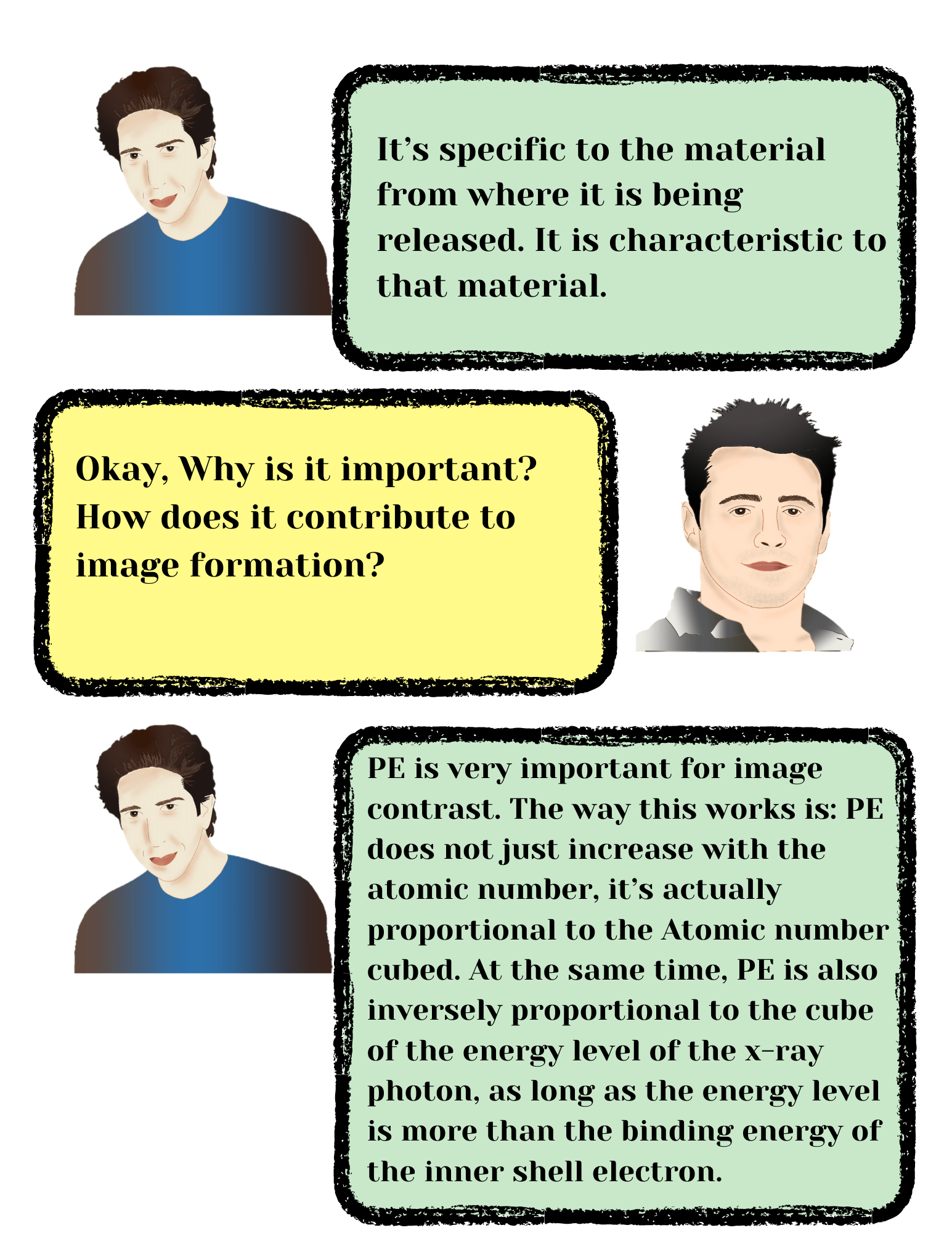 The photoelectric effect (PE) is crucial for image contrast, proportional to Z cubed and inversely proportional to photon energy cubed.
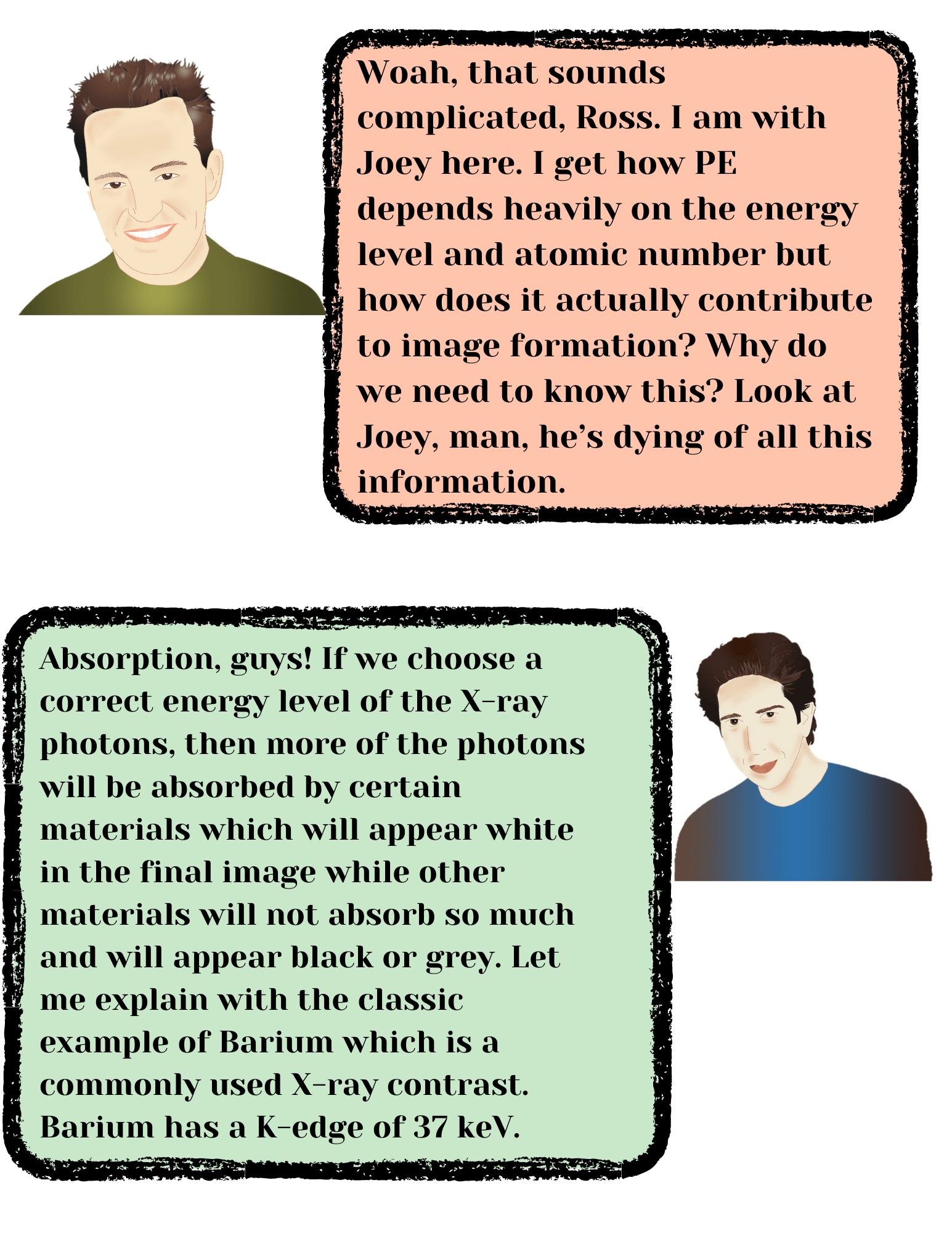 Diagram explaining how differential X-ray absorption, influenced by atomic number and energy level (e.g., Barium K-edge), creates contrast in radiographic images.
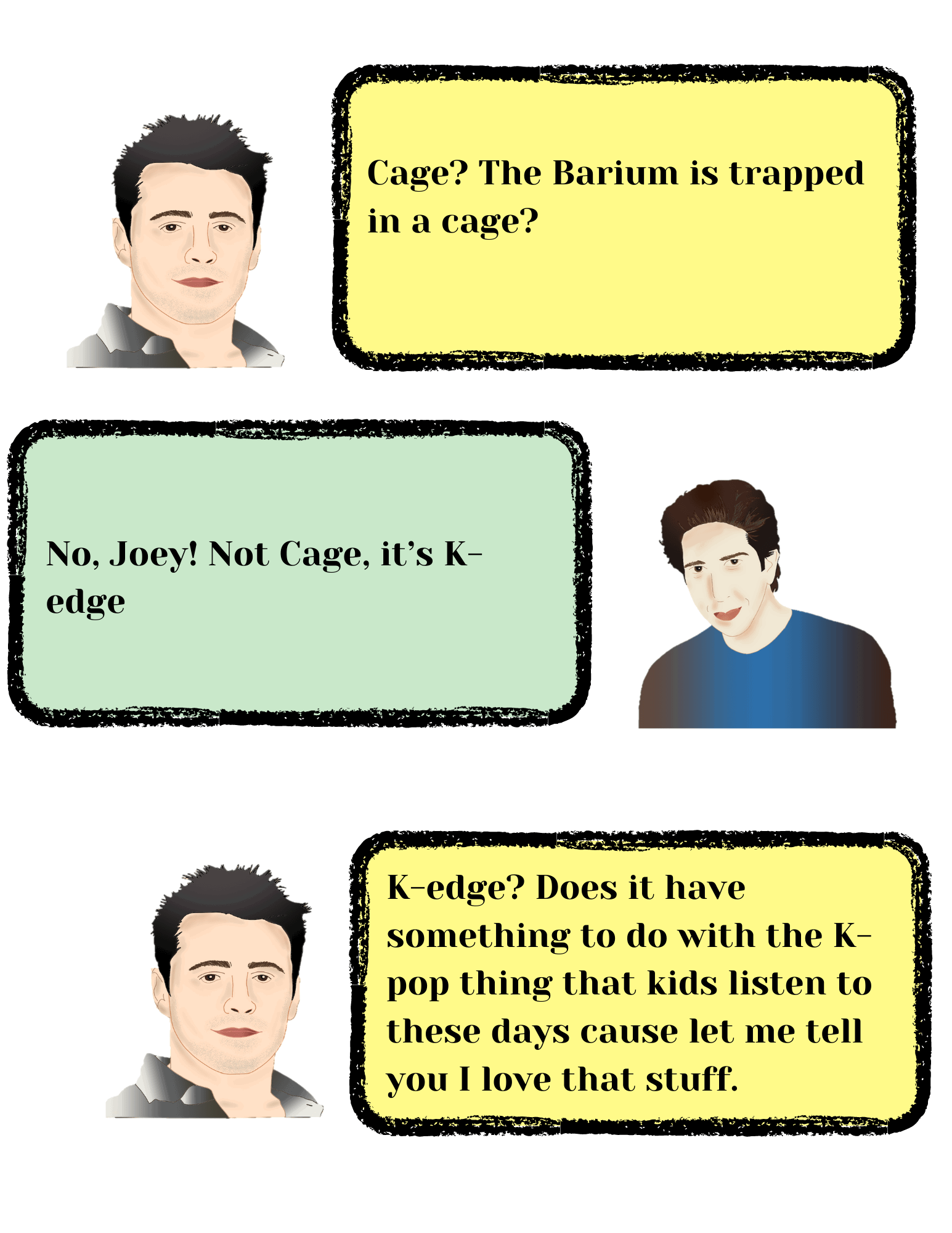 Humorous dialogue clarifying the term K-edge in X-ray physics, contrasting it with the word 'Cage' in relation to Barium.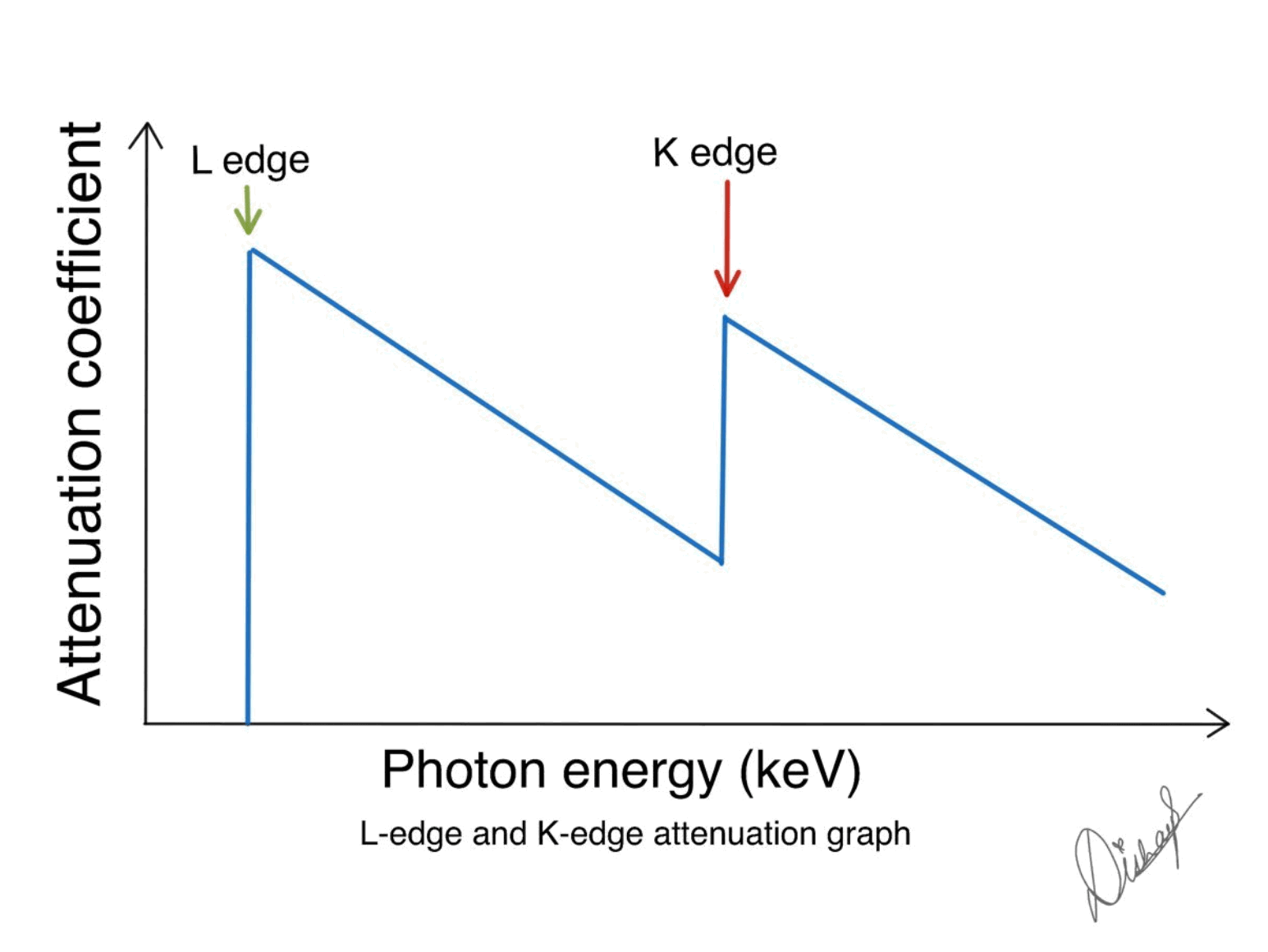
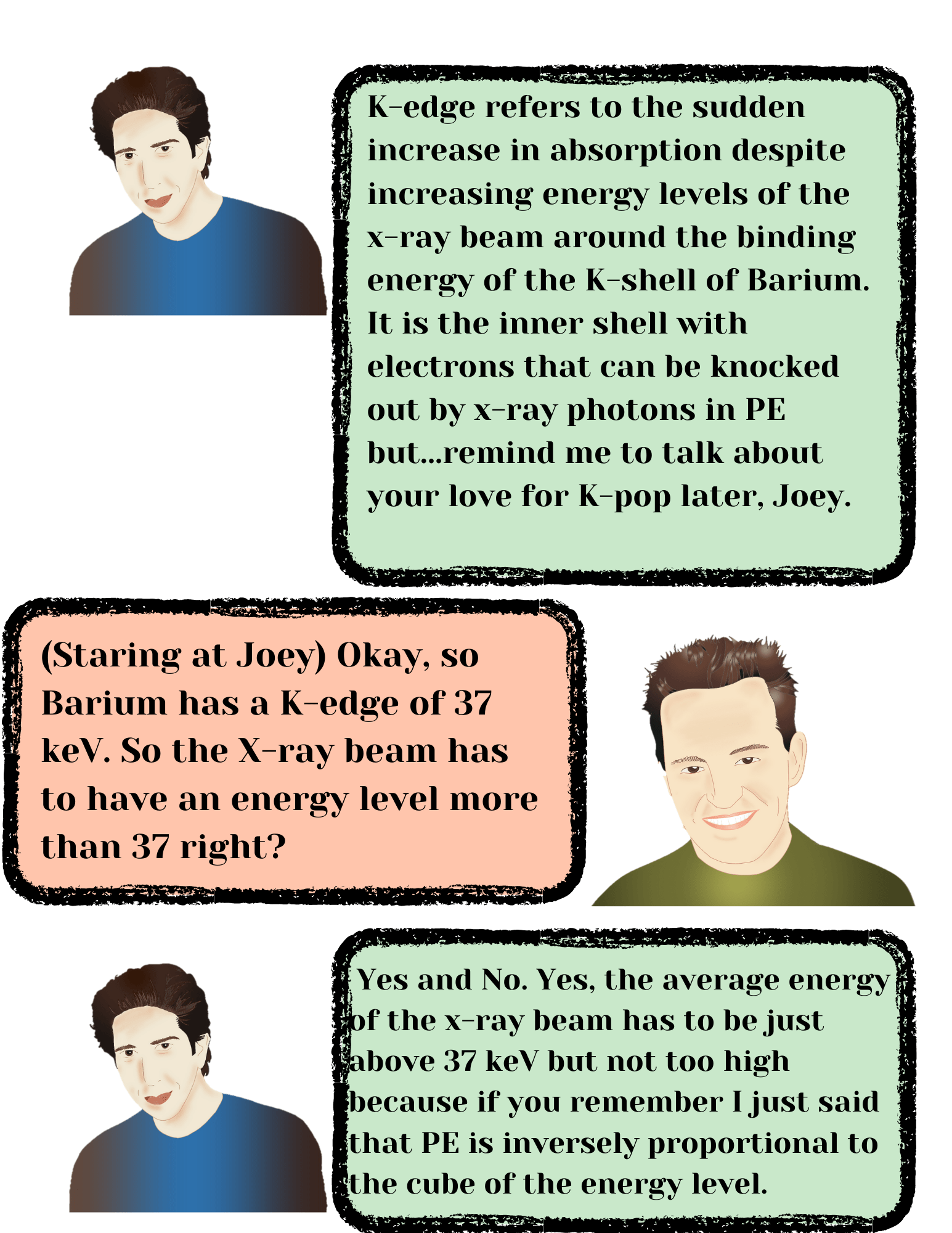 Dialogue explaining the Barium K-edge (37 keV) and its relevance to photoelectric absorption in diagnostic X-ray physics.
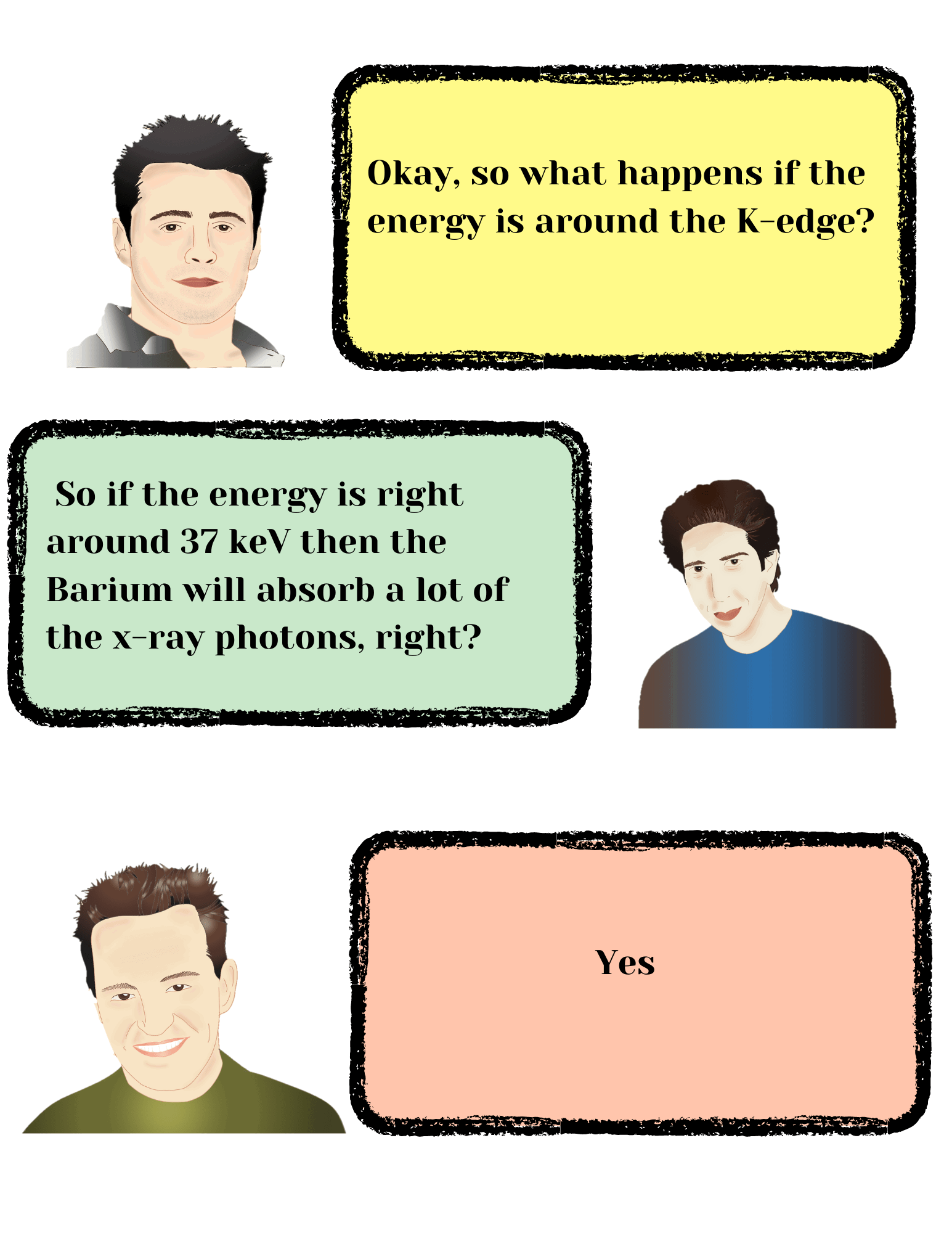 Dialogue confirming that X-ray absorption is maximized when photon energy is near the K-edge of the contrast agent, such as Barium at 37 keV.
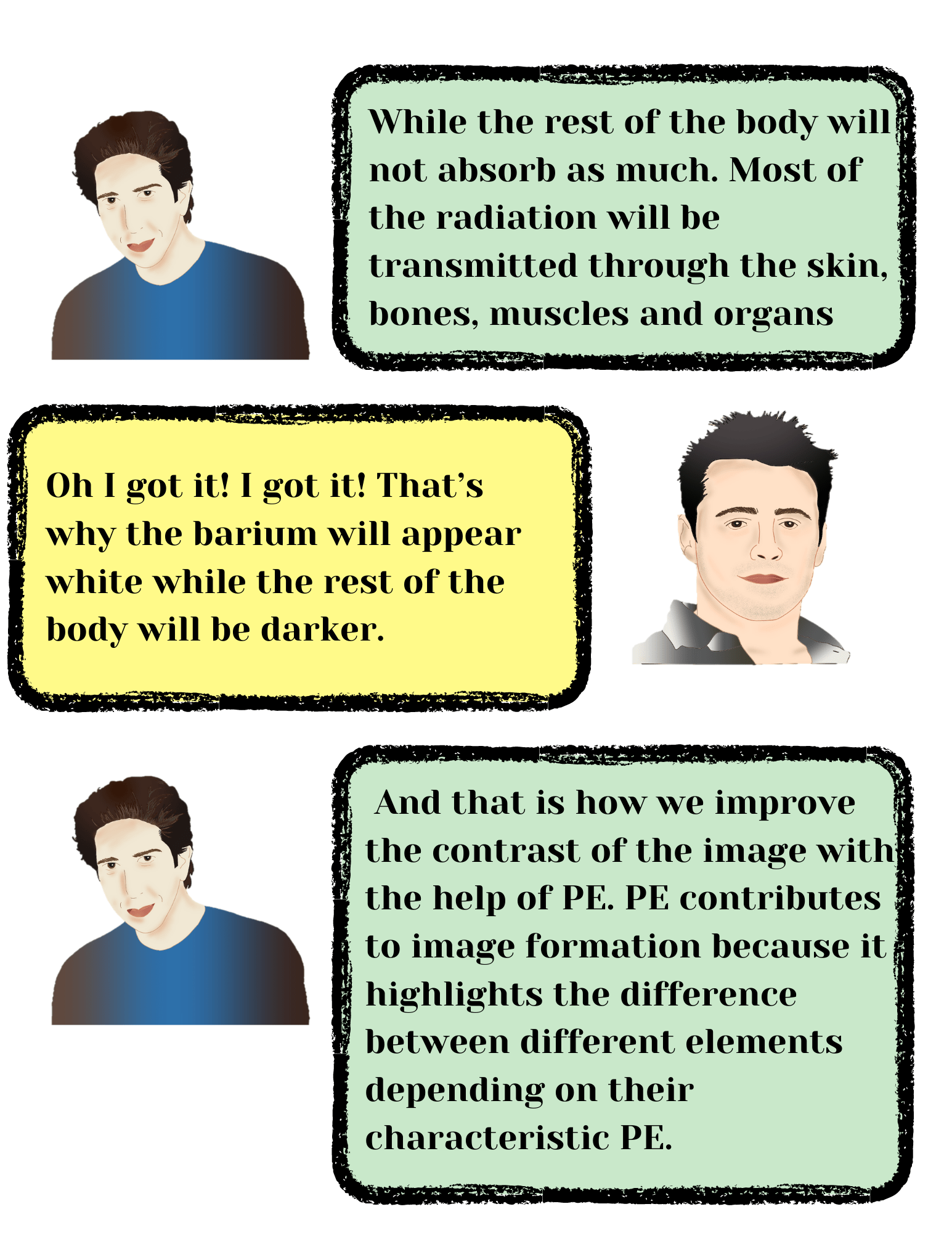 Dialogue explaining how differential photoelectric absorption (PE) of contrast agents, such as barium, enhances image contrast in radiography.
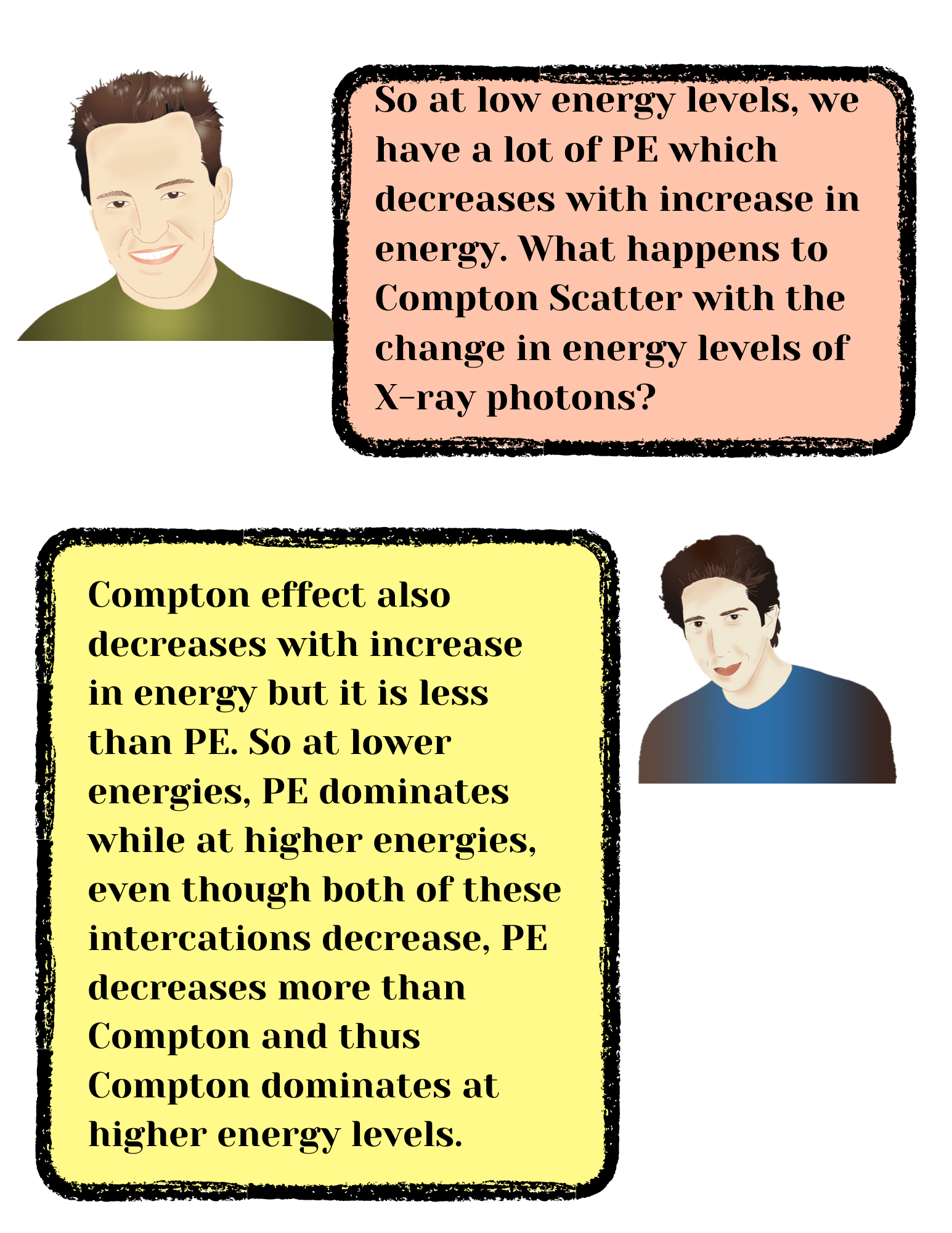 Figure detailing the crossover point where Compton scatter begins to dominate over the photoelectric effect as X-ray photon energy increases.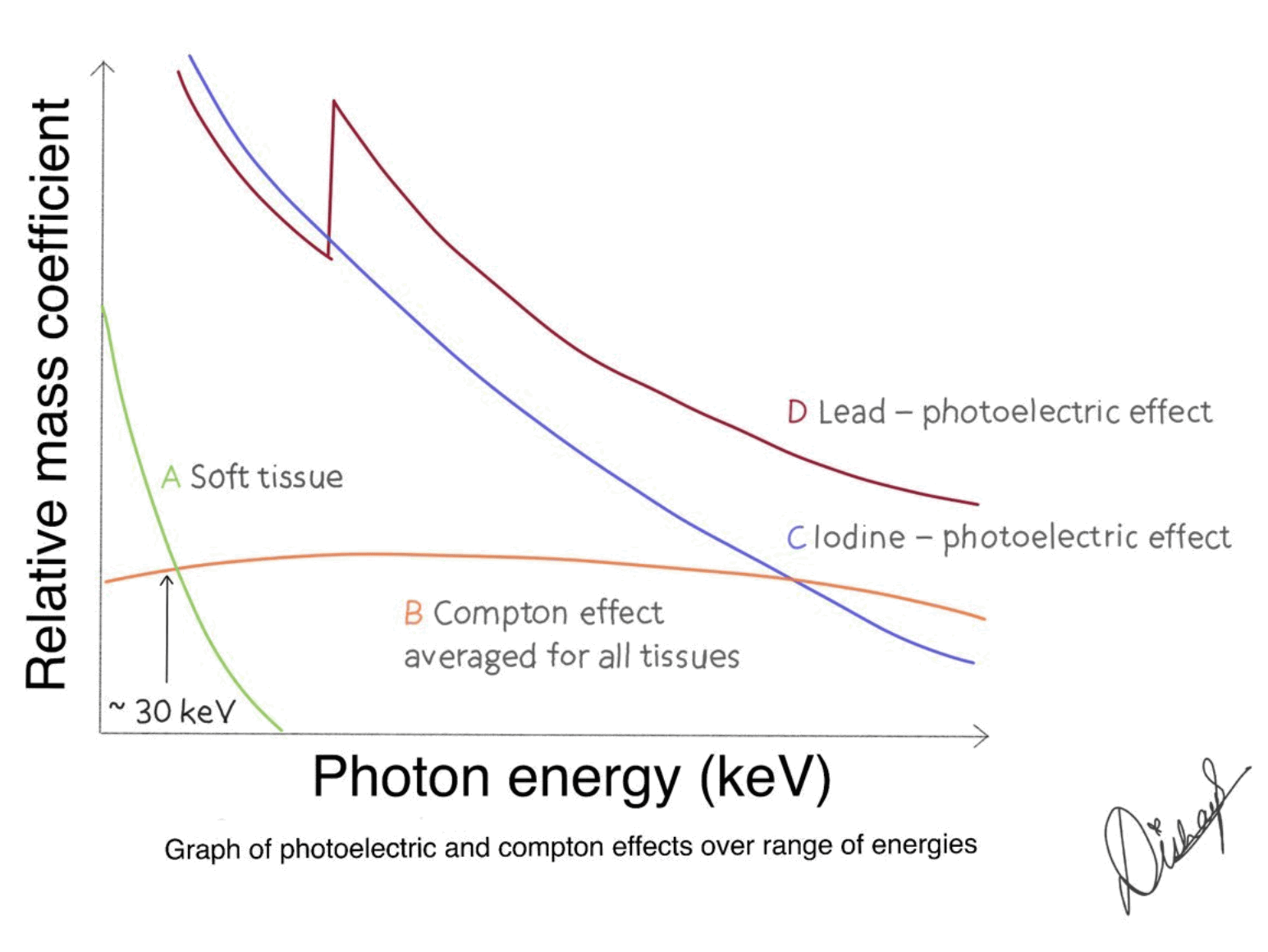
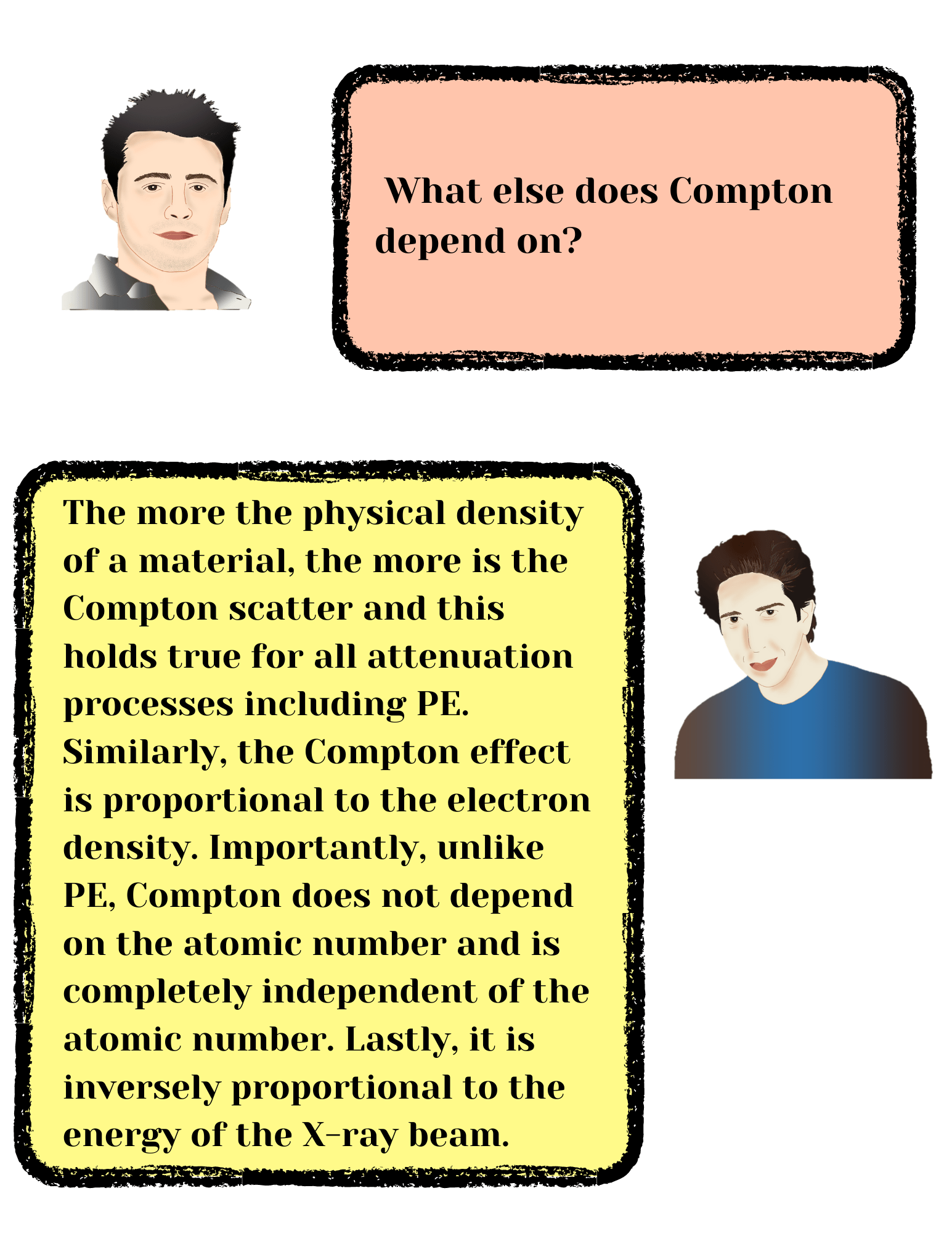 Factors influencing Compton scatter: proportional to physical density, electron density, and inversely proportional to X-ray energy.
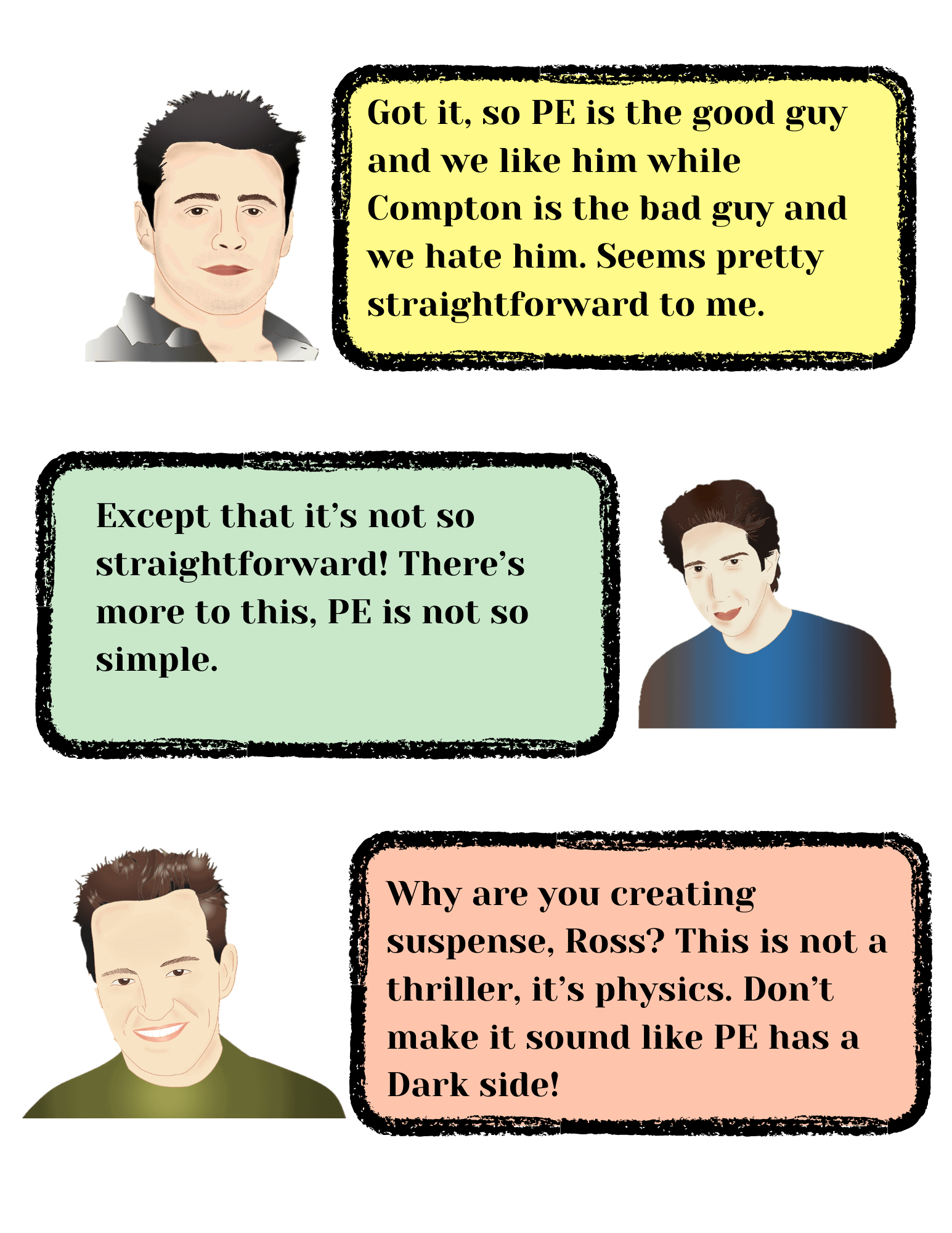 A lighthearted teaching aid contrasting Photoelectric Effect (PE) and Compton scattering interactions of X-rays with matter.
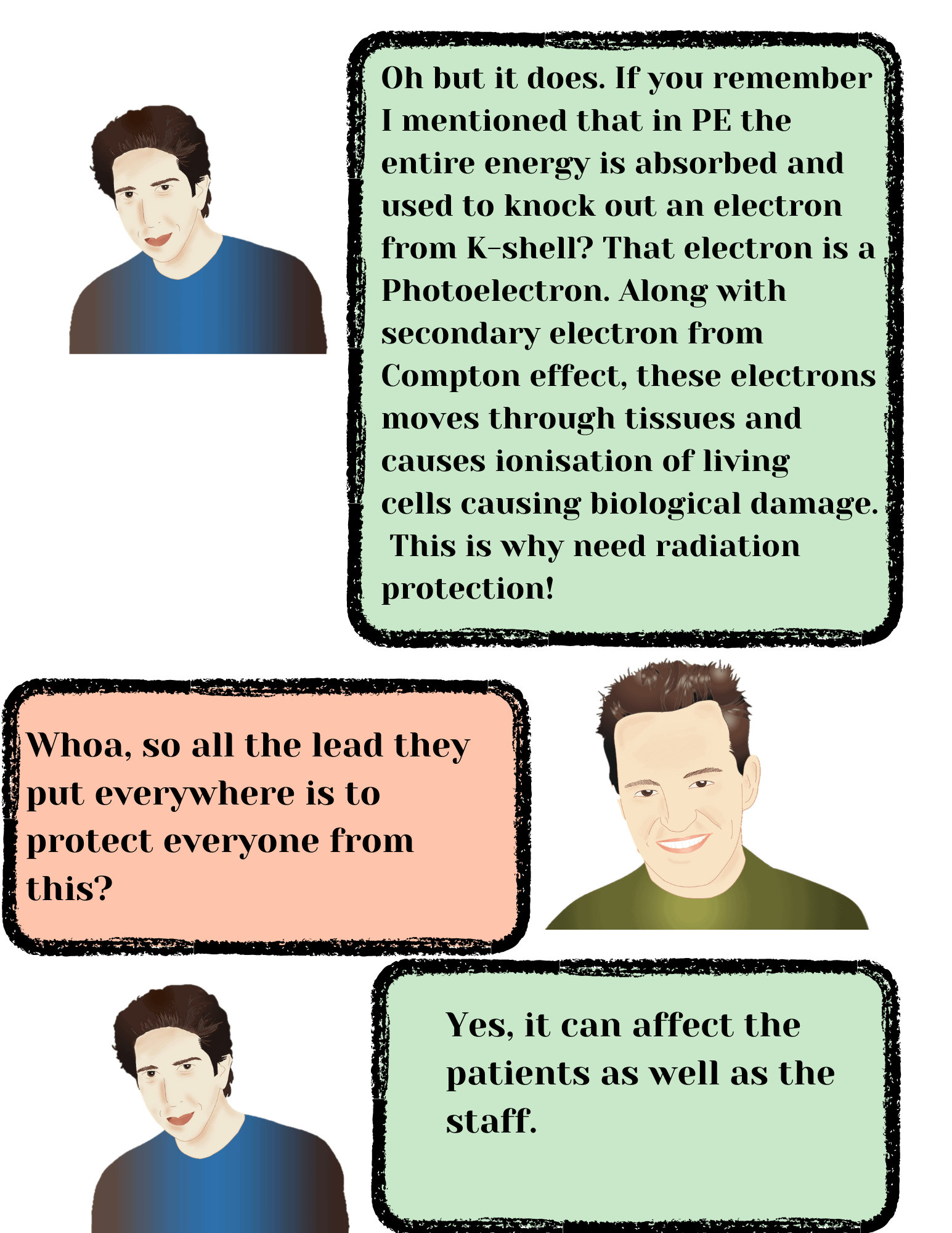 Dialogue explaining how secondary electrons from the Photoelectric and Compton effects cause ionization and biological damage, necessitating radiation protection measures.
 A lighthearted diagram summarizing a discussion on image quality factors, including contrast and noise, relevant to X-ray interactions.
Did you like it? Or as Joey would ask – How you doing (after that INTERACTION)? Let us know your thoughts in the comments section! We will be coming up with more episodes soon! Check the front page for updates!

Improve Content And Help Your Colleagues!
Found an error in the post? Please let us know using our contact page and we will update it with due credits!
If you wish to contribute radiological images for this case (or any other article on the website), you can submit them here and you will be duly credited: Submit radiology case