


Liver Abscess – Radiology Board Review
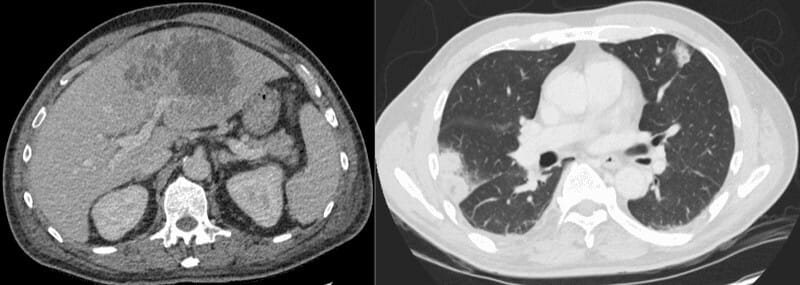
This is a CT scan showing a liver abscess within the liver parenchyma (left image) and multiple septic emboli (lung abscesses/nodules) scattered throughout both lungs (right image), consistent with disseminated infection.
- Clinical: Typically adults; fever, right upper quadrant pain, malaise, chills; risk factors include diabetes, malignancy, immune suppression, biliary disease, septic emboli; disseminated infection presents with liver abscess and septic pulmonary emboli
- Etiology/Pathophys: Pyogenic or amebic liver abscess due to bacterial or parasitic infection; liver abscess acts as a nidus for septic emboli that seed lungs causing lung abscesses or nodules
- Radiograph: Multiple bilateral lung nodules or cavitating nodules representing septic emboli; may see patchy infiltrates or lung abscesses; hepatic silhouette may be normal or enlarged
- US: Liver abscess appears as a hypoechoic or complex cystic lesion with irregular margins; often low-level internal echoes, sometimes septations; may show posterior acoustic enhancement
- CT: Liver abscess shows a centrally hypodense lesion with peripheral ring (rim) enhancement (“double-target sign”); may contain gas; segmental perfusion abnormalities adjacent; multiple bilateral peripheral lung nodules or cavitary lesions representing septic emboli
- MRI: Abscess cavity hypointense on T1, hyperintense on T2; peripheral rim enhancement on post-contrast T1; restricted diffusion on DWI in cavity and rim; perilesional edema with T2 hyperintensity; lung abscesses rarely imaged by MRI
- Nuc Med: Radiolabeled leukocyte scans or FDG-PET can show focal uptake in abscess and septic emboli; useful for detecting occult sites of infection
- Signs: Double-target sign (central hypodense cavity, inner enhancing rim, outer hypodense edema) in liver abscess on contrast CT; Cluster sign (aggregation of multiple small abscesses coalescing) in liver; pulmonary septic emboli appear as multiple cavitary nodules
- Frameworks: Liver abscesses classified by morphology on CT (Type I: ragged edges/incomplete wall; Type II: complete rim enhancement; Type III: wall without enhancement); severity guides intervention strategy
- DDx: Liver cyst (no enhancement, no rim); necrotic tumor (irregular margins, no peripheral edema); metastases (well-defined margins, no restricted diffusion rim); pulmonary septic emboli vs. vasculitis or metastases (clinical context, infectious signs favor septic emboli)
- Tx: Broad-spectrum IV antibiotics; percutaneous drainage or aspiration for large abscess or complicated cases; treat underlying source of infection; supportive care for septic emboli

Improve Content And Help Your Colleagues!
Found an error in the post? Please let us know using our contact page and we will update it with due credits!
If you wish to contribute radiological images for this case (or any other article on the website), you can submit them here and you will be duly credited: Submit radiology case