


What causes the snowstorm appearance on ultrasound?
Let me know in the comments.
Click to reveal the answer
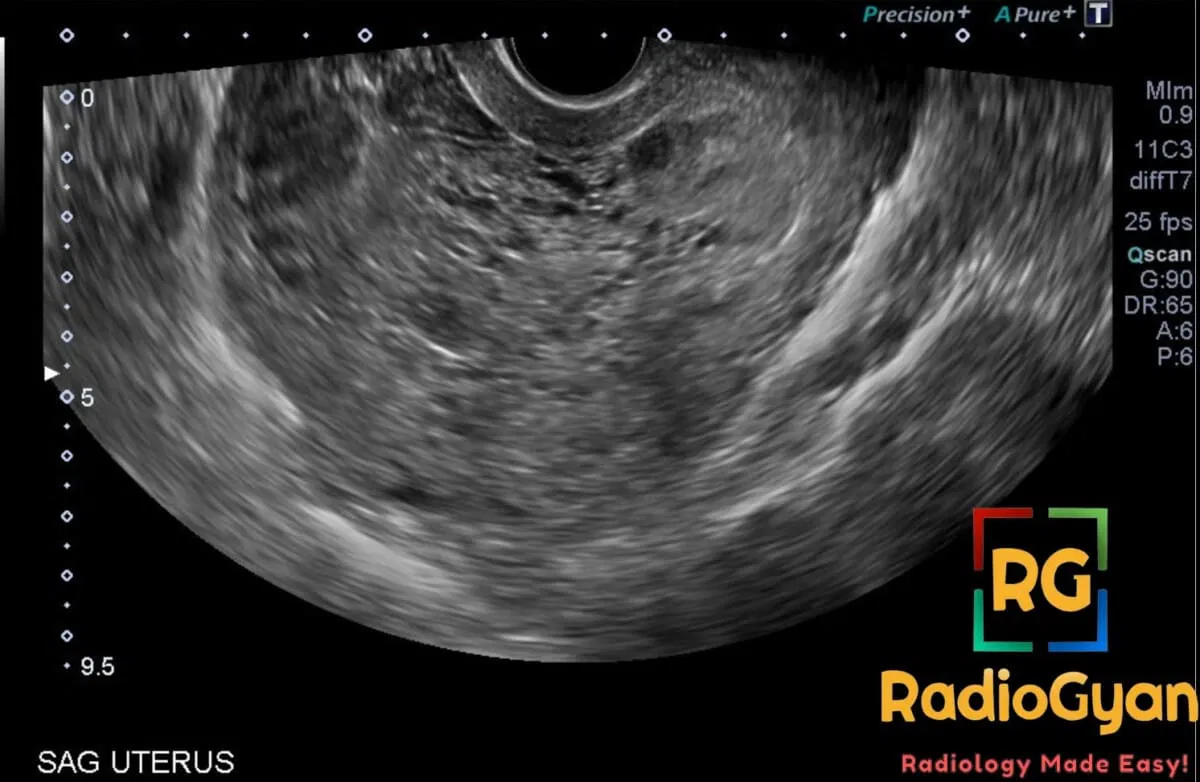
- Hydatidiform mole (uterus)
- Breast: free silicone from implant rupture
- Thyroid: diffuse sclerosing variant of PTC
- Crystal arthropathy (gout/CPPD)
- Subcutaneous emphysema
Hydatidiform mole (uterus)
Classic obstetric ultrasound usage.
The snowstorm appearance in the uterus on ultrasound classically reflects a hydatidiform mole. It shows a heterogeneous, echogenic intrauterine mass with innumerable tiny anechoic cystic spaces representing hydropic chorionic villi, typically without a normal fetus.
Why is it called so?
The echogenic mass with countless microcystic interfaces creates diffuse bright echoes resembling a snowstorm, often obscuring normal gestational structures.
Pathophysiology
Proliferation of trophoblasts and hydropic swelling of chorionic villi generate myriad fluid–tissue interfaces. The dense scatterers and internal hemorrhage produce the characteristic speckled echogenic pattern.
Breast: free silicone from implant rupture
Very common breast ultrasound usage.
In the breast, a snowstorm appearance indicates free silicone from implant rupture or injection. Echogenic “noisy” parenchyma with posterior attenuation and dirty shadowing reflects extracapsular silicone and silicone granulomas.
Why is it called so?
Numerous intensely hyperechoic scatterers produce a blizzard-like field of echoes with shadowing, analogous to a snowstorm.
Pathophysiology
Microscopic silicone droplets and granulomatous reaction create strong acoustic impedance mismatches, causing multiple scattering and attenuation, yielding the classic speckled, shadowing appearance.
Thyroid: diffuse sclerosing variant of PTC
Classic thyroid usage.
The snowstorm appearance in the thyroid gland on ultrasound is due to innumerable diffuse microcalcifications, most classically seen in the diffuse sclerosing variant of papillary thyroid carcinoma (DSVPTC). Similar patterns may be seen in metastatic or inflammatory thyroid disease.
Why is it called so?
There are countless tiny, bright (hyperechoic) foci scattered through the parenchyma, resembling snowflakes within a storm.
Pathophysiology
Widespread psammoma bodies (microcalcifications) arise from dystrophic calcification of necrotic tumor cells and chronic inflammation, creating dense point reflectors responsible for the “snowstorm” echoes.
Crystal arthropathy (gout/CPPD)
Common MSK ultrasound usage.
Within joints or bursae, a snowstorm appearance may reflect mobile echogenic crystals suspended in effusion, seen with gout (monosodium urate) or CPPD. Hyperechoic foci swirl with transducer pressure or joint movement.
Why is it called so?
Numerous bright particles drift like snowflakes within fluid, producing a flurry of moving echoes.
Pathophysiology
Aggregated crystals act as strong point scatterers. In gout, concomitant double contour sign and tophi may coexist; in CPPD, chondrocalcinosis is typical.
Subcutaneous emphysema
Artifact-based usage in soft tissues.
In the soft tissues, a snowstorm appearance can be produced by subcutaneous gas, showing multiple bright echoes with ring-down/comet-tail artifacts and dirty shadowing, which can obscure deeper structures.
Why is it called so?
Countless rapidly changing bright echoes from gas microbubbles resemble a blizzard.
Pathophysiology
Gas–tissue interfaces generate strong reflection and reverberation artifacts. Clustering of bubbles accentuates scattering, producing the characteristic noisy field.

Improve Content And Help Your Colleagues!
Found an error in the post? Please let us know using our contact page and we will update it with due credits!
If you wish to contribute radiological images for this case (or any other article on the website), you can submit them here and you will be duly credited: Submit radiology case