


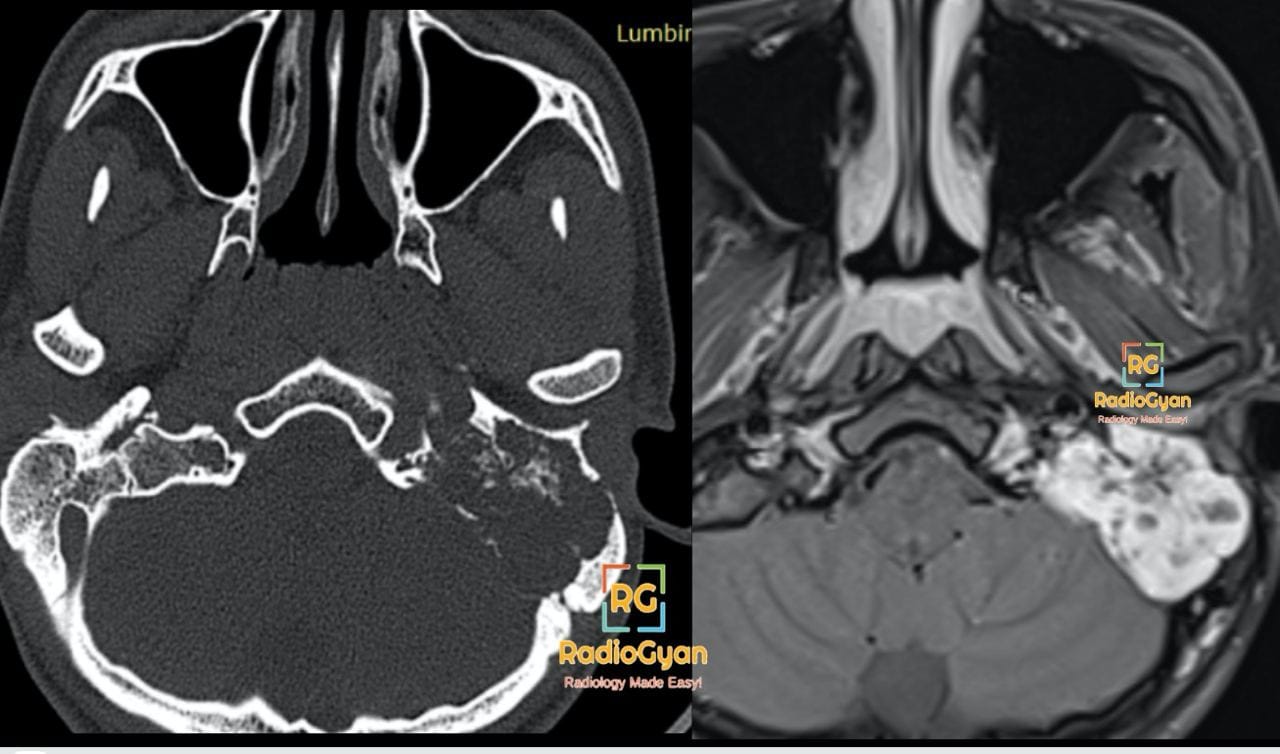
This is an axial computed tomography (CT) scan and an axial magnetic resonance imaging (MRI) scan of the skull base, demonstrating a Left Glomus Jugulare Paraganglioma. The CT scan on the left shows bone erosion and destruction involving the left jugular foramen. The MRI on the right reveals a brightly enhancing, lobulated mass in the same region, consistent with the diagnosis.
Glomus Jugulare – Radiology Board Review
- Clinical: Middle-aged adults (40-60y), F>M; pulsatile tinnitus, hearing loss, cranial neuropathies (CN IX, X, XI); mass effect at skull base; rare familial syndromes with SDH mutations
- Etiology/Pathophys: Paraganglioma of neuroendocrine origin arising from paraganglia in the jugular foramen region; hypervascular tumor derived from glomus bodies associated with tympanic/auricular branches of CN IX/X
- Radiograph: Permeative, moth-eaten bone destruction of the jugular foramen; irregular bone erosion adjacent to tumor mass
- CT: Lobulated soft tissue mass in left jugular foramen with intense post-contrast enhancement; bone erosion and destruction of adjacent skull base including jugular foramen; no middle ear involvement
- MRI: T1 iso- to hypointense lobulated mass with “salt-and-pepper” appearance due to flow voids and hemorrhage; T2 hyperintense with multiple punctate flow voids; intense homogeneous or heterogeneous enhancement post-gadolinium
- Nuc Med: Increased tracer uptake on somatostatin receptor imaging (e.g., Ga-68 DOTATATE PET/CT); MIBG scan less sensitive for head and neck paragangliomas; useful for detecting multifocal/metastatic disease
- Signs: “Salt-and-pepper” appearance on MRI due to slow flow/high vascularity; jugular foramen erosion on CT as a classic sign of glomus jugulare tumor
- Frameworks: Fisch classification (A-D) based on extent of local invasion and surgical resectability; important for planning treatment and prognosis
- DDx: Petrous bone/cholesteatoma (no intense enhancement, bone remodeling rather than destruction); schwannoma (more homogeneous, less vascular, no flow voids); meningioma (dural tail, less bone destruction)
- Tx: Surgical excision in accessible lesions; preoperative embolization to reduce vascularity; radiotherapy for unresectable or residual tumor; surveillance for multicentric disease in hereditary cases

Improve Content And Help Your Colleagues!
Found an error in the post? Please let us know using our contact page and we will update it with due credits!
If you wish to contribute radiological images for this case (or any other article on the website), you can submit them here and you will be duly credited: Submit radiology case